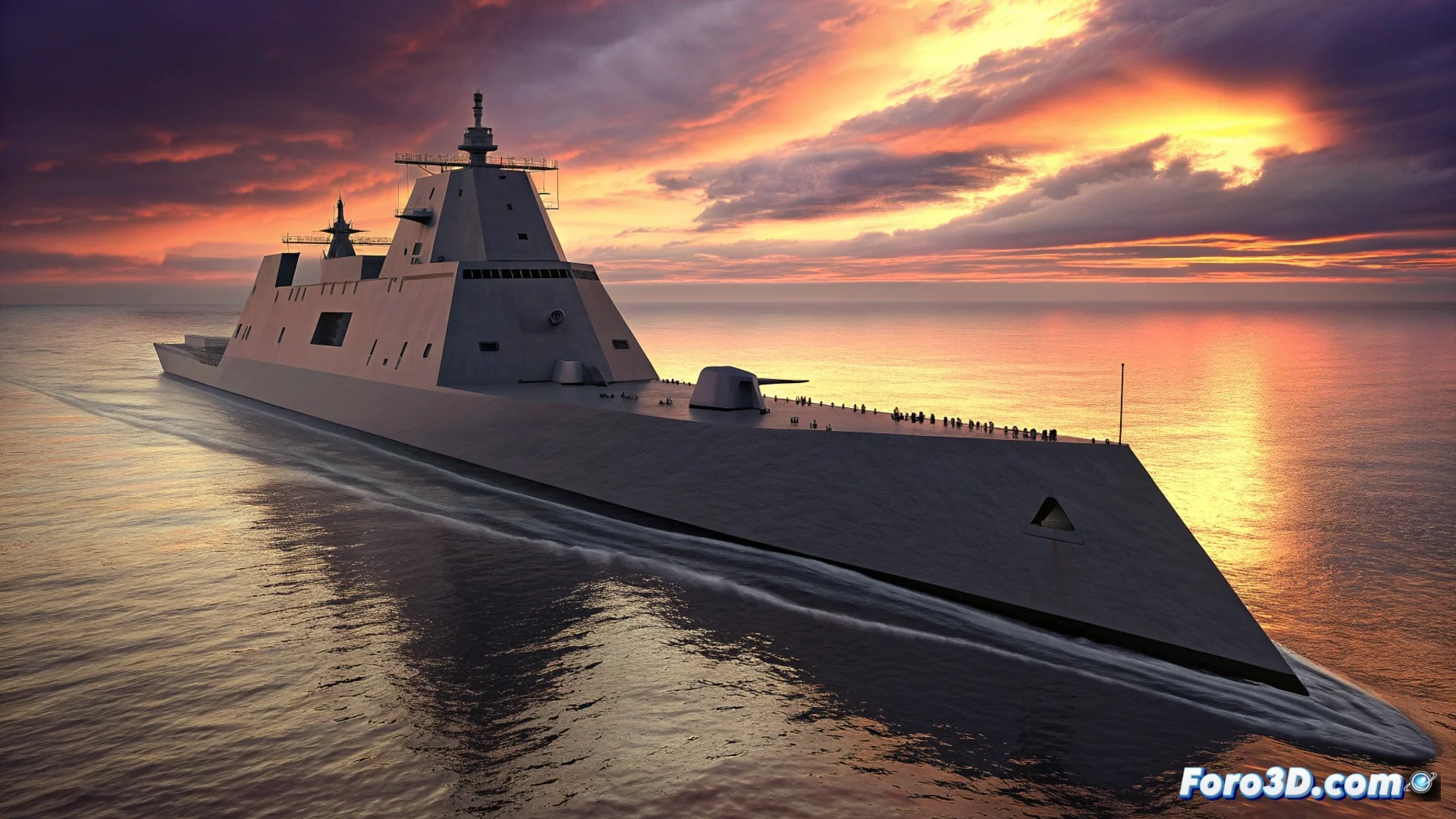
The Zumwalt DDG-1000 Destroyer: A Stealth Modeling Challenge
The Zumwalt class, identified as DDG-1000, represents the forefront of multi-mission destroyers for the U.S. Navy. Its design philosophy prioritizes minimizing its radar signature through a radical silhouette and angular surfaces. This approach poses a unique challenge for digital artists seeking to recreate it in 3D. 🚢
Anatomy of a Stealth Design
The hull shape, known as tumblehome, slopes inward above the waterline, a total contrast to conventional hulls. This feature merges with a monolithic pyramidal superstructure that eliminates right angles and exposed masts. The result is an extremely low profile that's hard to detect by radar. Its main dimensions are 182.9 meters in length, 24.6 in beam, and 8.4 in draft.
Armament and Integrated Systems:- AGS Guns: Two advanced 155 mm artillery systems forward, for firing long-range projectiles.
- Mk 57 VLS Launchers: Eighty peripheral cells that can house Tomahawk, SM-2, or ESSM missiles.
- Point Defense: Two 30 mm Mk 46 automatic guns for close threats.
Modeling this ship requires extreme patience, as its clean design makes any symmetry error or misaligned texture stand out like a tower in a flat field.
Key Technical Tips for Accurate Modeling
When tackling this project in 3D, the absolute priority is capturing its stealth profile. The transition between the tumblehome hull and the superstructure pyramid must be continuous and seamless. Elements like the sensor mast are fully integrated into this shape, without protrusions.
Critical Details to Consider:- The AGS gun turrets are bulky and feature angular faces to scatter radar waves.
- The Mk 57 vertical launchers are recessed into the deck, without altering the clean outline.
- All secondary external elements, such as railings or boats, are stored in internal compartments that only open when needed.
Final Tips for Optimal Results
Clean lines and perfect symmetry are non-negotiable. Any protruding geometry or texture that doesn't align with the model's facets will ruin the stealth illusion. It's essential to plan the topology to flow with the ship's angular shapes and pay meticulous attention to UV maps. Mastering this model means understanding the intersection between military naval design and the technical requirements of high-level 3D modeling. ⚓