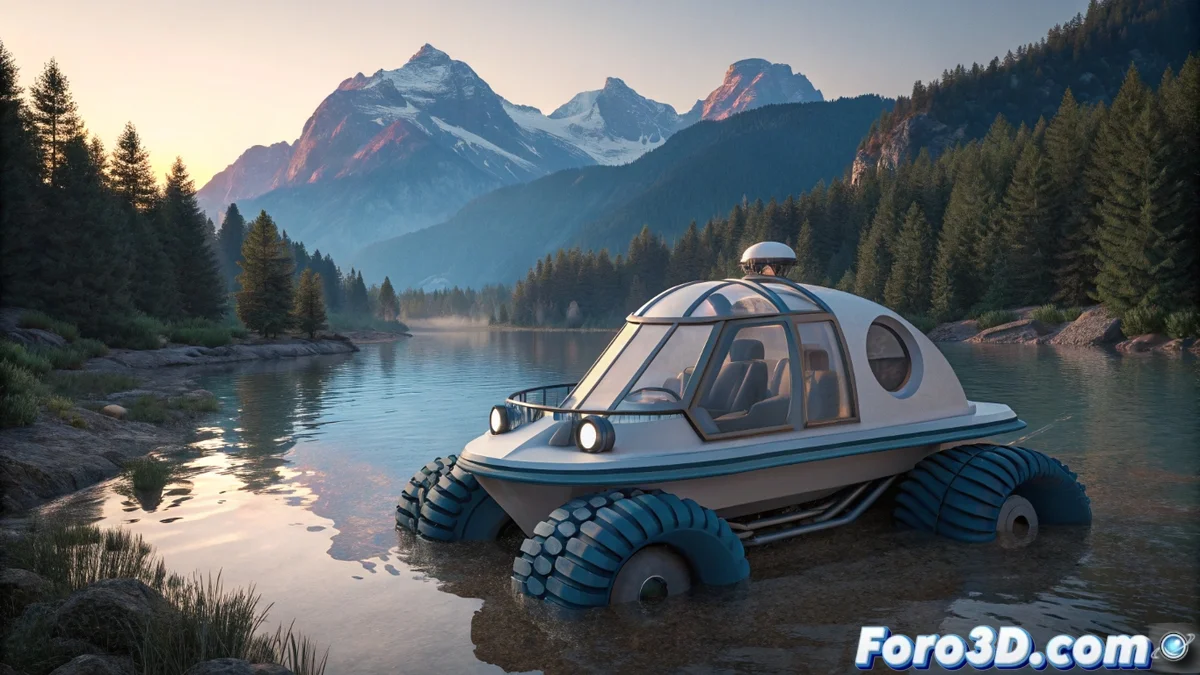
The Z-Triton 2.0: an amphibious vehicle created with large-scale 3D printing
Imagine a vehicle that is your car, your boat, and your small RV, all in one. That is the groundbreaking concept behind the Z-Triton 2.0, a project that redefines adventure mobility. Its existence would not be possible without the fundamental role of large-scale 3D printing, which acts as the technological pillar to materialize this integrated vision. 🚤🚲
Additive manufacturing as the project catalyst
The true innovation of the Z-Triton 2.0 lies not only in its multifunctionality, but in how it is built. Additive manufacturing allows creating the hull and main body components as monolithic and optimized structures. This method eliminates the need for costly assemblies and molds, providing unprecedented freedom to design complex shapes that are both lightweight and extremely resistant.
Key advantages of 3D printing in this project:- Weight and material reduction: The ability to print internal structures with honeycomb or lattice optimizes the strength-to-weight ratio, crucial for a vehicle that operates in two media.
- Unified complex geometries: The necessary hydrodynamic curves for efficient water displacement and a cohesive aesthetic are achieved, impossible with traditional methods without multiple joints.
- Simplification of the production process: Manufacturing large sections as single pieces accelerates production and reduces potential failure points. 🏗️
Large-scale 3D printing is what transforms an ambitious design concept into a viable and functional prototype, demonstrating its potential beyond rapid prototyping.
Extreme modularity for the modern explorer
The value proposition of the Z-Triton 2.0 unfolds in three main modes of use. On land, it functions as a electric tricycle that is urban and sustainable. Upon encountering a body of water, an almost magical transformation takes place: the chassis rises to deploy pontoons and a propeller, instantly turning it into a stable boat. Finally, its design incorporates a minimal living space that can accommodate two people for overnight stays, fulfilling the role of a micro-camper.
Main vehicle functionalities:- Dual mobility: Smooth transition between electric land transport and water navigation, thanks to a structural design conceived for both environments.
- Adventure autonomy: The integrated space for sleeping and storing gear enables expeditions without relying on traditional infrastructure, ideal for camping in remote locations accessible by water.
- Guaranteed robustness: The 3D-printed structure is designed to withstand the mechanical and environmental stresses of both asphalt and rivers or lakes. ⛺
A new horizon for design and manufacturing
The Z-Triton 2.0 is more than a curious vehicle; it is a tangible testament to where industrial design can head with the right tools. It demonstrates how large-scale 3D printing enables integrating disparate functions into a single optimized product, challenging the limitations of conventional manufacturing processes. This project not only proposes a new way to travel, but also points to a path where geometric complexity and structural efficiency ally to create truly innovative and customizable mobility solutions. 🌅