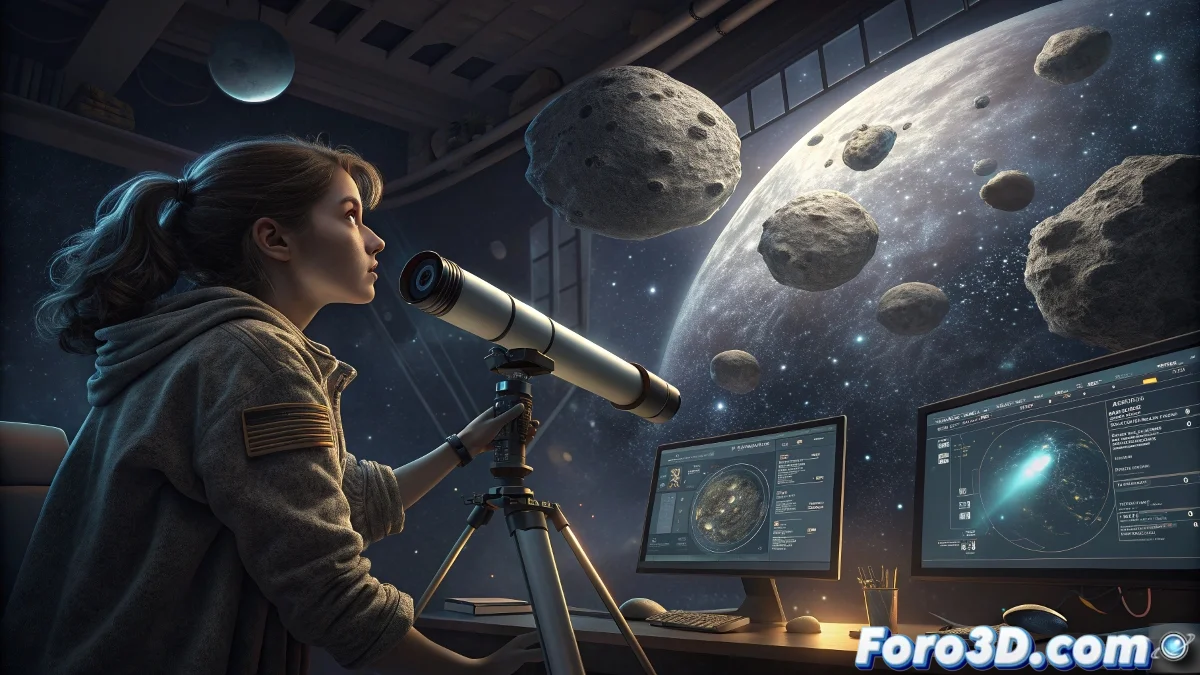
The Young Astronomer Who Discovered Asteroids: When Passion Surpasses Resources
In an era where science seems dominated by large institutions and million-dollar budgets, a story emerges that reminds us of the power of individual passion: a self-taught young astronomer has achieved what many professional observatories cannot—discovering asteroids from her home observatory. Armed with modest telescopes, open-source astronomical software, and unwavering determination, this teenager has identified several near-Earth objects, proving that scientific discovery is no longer the exclusive territory of academic elites. Her story not only inspires but offers a perfect canvas to recreate in Blender, combining human narrative with scientific visualization. 🌟
The News: Democratization of Astronomy
The case of this young woman—whose name is kept confidential due to her age—represents a growing trend in citizen science. Using relatively affordable equipment (8-inch telescope, basic CCD camera) and dedicating entire nights to observation, she has managed to identify three previously uncatalogued asteroids. Her methodology combines sweep astronomical photography with meticulous analysis of image sequences, searching for those points that move against the fixed stellar background. Most notably, her discoveries have been validated by the Minor Planet Center, the international authority on the matter, granting her official credit and naming rights. 🔭
Key Elements of the Story:- discovery from non-professional amateur equipment
- validation by international astronomical institutions
- accessible yet rigorous methodology
- inspiration for young self-taught scientists
Modeling the Environment: The Home Observatory
In Blender, we begin by recreating the space where the magic happens. We model a home observatory in a garden or terrace, with details that convey dedication: constellation posters, stacked astronomy books, a coffee thermos for long nights. The main telescope is created using precise polygonal modeling, adding details like control knobs and cables connecting to the camera. The dim lighting with a red desk lamp (to not affect night vision) creates an intimate and focused atmosphere. This environment is not just a backdrop; it is a testament to the effort behind the discovery. 🏠
No PhD is needed to do science, curiosity and perseverance are
The Starry Sky: Recreating the Celestial Vault
For the astronomical background, Blender offers multiple approaches. We can use high-resolution HDR images as environment textures, or create a procedural particle system that generates stars with realistic variations in brightness and color. The key is astronomical precision: constellations must be correctly positioned according to the date and location of the observation. For the discovered asteroids, we create irregular geometries with rocky materials, and animate them moving slowly against the fixed stellar background—that characteristic movement that reveals their nature to trained eyes. 🌌 Techniques for the Sky in Blender:
- high-resolution HDRI for realistic backgrounds
- particle system for dense star fields
- asteroid motion animation with Keplerian trajectory
- atmosphere and astronomical seeing effects
Visualization of the Discovery: From Data to Revelation
The key animation scene shows the moment of discovery. We create a computer screen with astronomical software where image sequences play showing that moving point. We use material and shader animation to simulate the software interface, with red circles highlighting the asteroid when the astronomer identifies it. We can add a visual "eureka" effect—a special glow, enthusiasm particles—that conveys the excitement of the find. The transition between the screen and the real sky can be done through a match cut that unites both worlds. 💻
Special Effects and Visual Narrative
To emphasize the meaning of the discovery, we add visual elements that transcend the literal. An orbital diagram that builds automatically, showing the trajectory of the new asteroid. A cosmic connection effect where energy lines connect the astronomer to her discovery. The temporal evolution can show how the asteroid finally receives an official name, completing the discovery cycle. These elements not only make the animation more engaging but communicate the emotional and intellectual impact of the scientific achievement. 🎬
Narrative Elements in Blender:- transitions between human scale and astronomical scale
- visual effects representing the insight moment
- real-time astronomical data visualization
- abstract representation of discovery emotion
Representing this story in Blender is more than creating an engaging animation; it is celebrating the democratization of science and inspiring the next generation of discoverers. Every 3D model, every light effect, every orbital animation contributes to a powerful message: that the universe is there to be explored, not just by space agencies and multimillion-dollar observatories, but by anyone with curiosity, dedication, and a telescope. By recreating this story in Blender, we not only tell an individual achievement but visualize a future where science belongs to everyone. And in that future, perhaps the next great astronomical discovery is waiting in someone's garden, ready to be found. 🚀