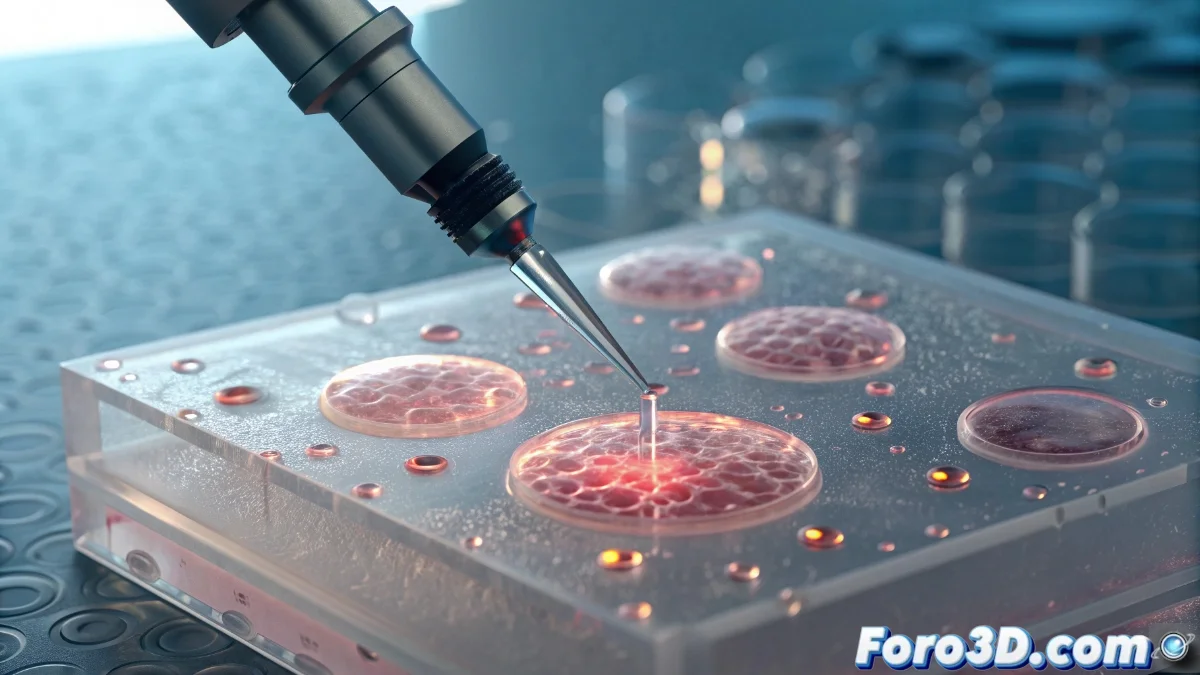
The World's Smallest Bioprinter for Internal Tissue Repair
A team of Canadian researchers has revolutionized the field of regenerative medicine by developing the most compact bioprinting device in existence, specifically designed to regenerate damaged tissues inside the human body without the need for traditional surgical interventions 🩺.
Endoscopic Bioprinting Technology
This miniaturized bioprinter employs a microfluidic system that allows for the deposition of living cells and biomimetic hydrogels with extraordinary precision, achieving sub-millimeter resolutions. Unlike conventional equipment that requires external exposure of the tissue, this innovative device is introduced using minimally invasive techniques similar to conventional endoscopic procedures.
Notable Technical Features:- Microfluidic extrusion mechanism for controlled cell deposition
- Ability to operate in confined and hard-to-reach anatomical spaces
- Sub-millimeter precision in the construction of tissue scaffolds
Direct internal bioprinting represents a paradigm shift in regenerative medicine, enabling precise interventions without significant scarring
Revolutionary Medical Applications
This pioneering technology has particularly significant implications for professionals whose voice is their primary working tool, such as singers, educators, and communicators. Preclinical studies demonstrate faster and more complete functional recoveries compared to traditional tissue repair methodologies.
Potential Medical Applications:- Regeneration of injured vocal cords in voice professionals
- Repair of tubular tissues like the urethra and blood vessels
- Customization of bioinks according to the specific requirements of each tissue
Future of Internal Bioprinting
The development of this miniaturized bioprinter opens unforeseen horizons in regenerative medicine, although researchers emphasize that technical challenges still remain to be overcome. The possibility of performing regenerative interventions in situ marks the beginning of a new era in personalized and minimally invasive medical treatments 🔬.