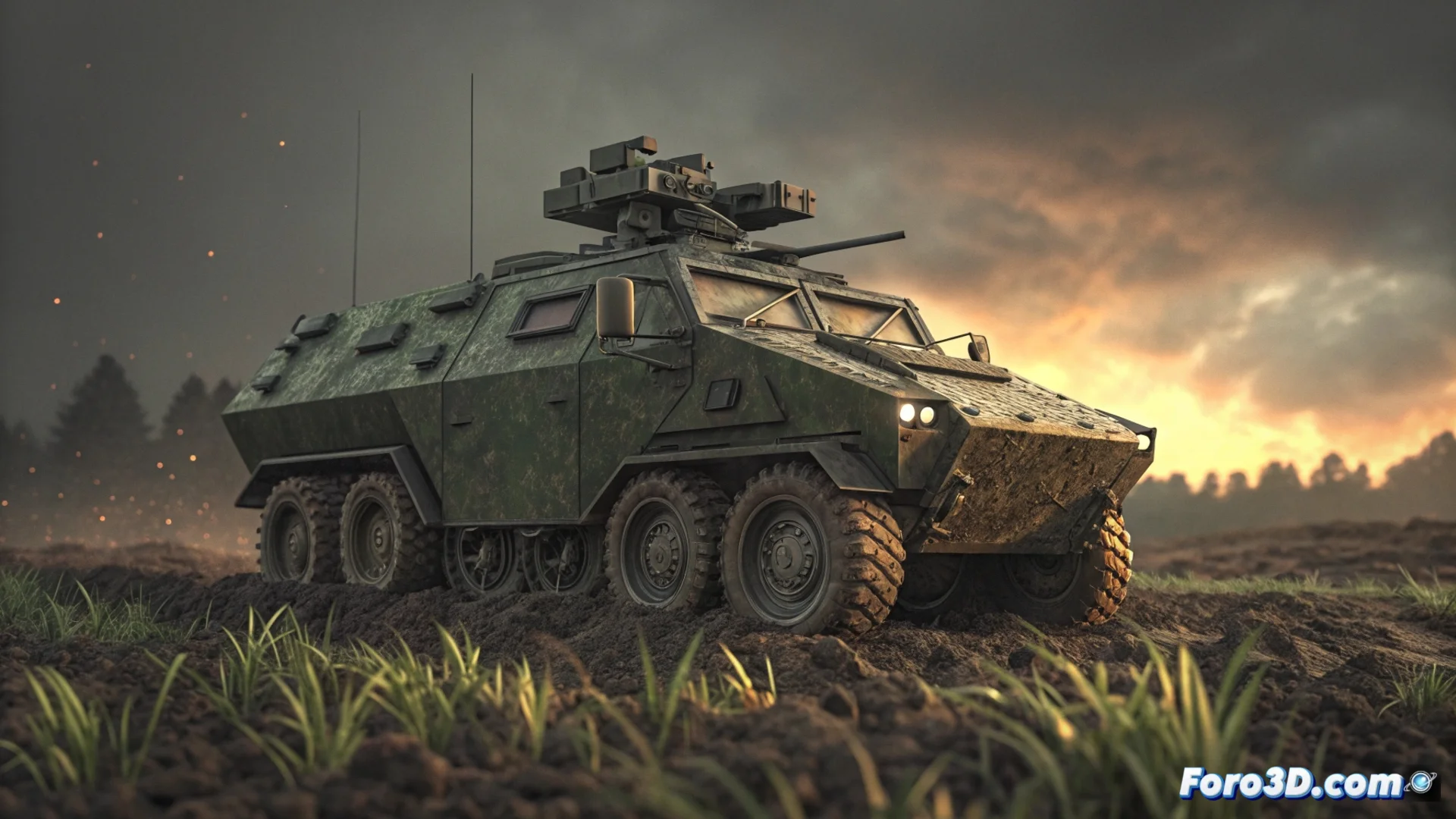
The Wiesel AWC: a German Air-transportable Armored Vehicle
In the field of light military systems, the Wiesel AWC (Armoured Weapons Carrier) stands out for its design philosophy centered on strategic mobility. This German tracked vehicle is designed to provide armored firepower to units that must move by air quickly. 🚁
Dimensions and Design for Air Transport
The most defining feature of the Wiesel is its minimal size. With only 3.55 meters long, 1.82 wide, and 1.82 high, its silhouette is low and discreet. This compact and lightweight design allows it to be transported inside transport helicopters or cargo planes, facilitating rapid deployment in various theaters of operations. Its appearance resembles a small tank without a turret, a configuration that sacrifices heavy protection for agility and air-transportability.
Key physical characteristics:- Total length: 3.55 meters, ideal for internal loading.
- Low profile: 1.82 meters high, reducing its visual signature.
- Reduced weight: Direct result of the air transport requirement.
Its such low profile makes it, on the battlefield, sometimes mistaken for a particularly belligerent and well-armed armadillo.
Versatility on the Battlefield: Modular Armament
The true strength of the Wiesel AWC lies in its modular configuration. The base platform can equip different weapon systems according to the specific mission requirements, transforming it into an adaptable weapon system. This versatility allows the same platform to perform reconnaissance, fire support, or defense tasks.
Available weapon systems:- MG3 Machine Gun: 7.62 mm caliber for close defense and suppression.
- MK 20 Rh 202 Autocannon: 20 mm to engage light targets.
- TOW Missile Launcher: To engage and neutralize armored targets.
- Stinger Missiles: In its variant for air defense against aircraft.
Mobility and Operation in Complex Environments
Despite its reduced size, the vehicle maintains notable off-road capabilities. Its tracked suspension allows it to move through difficult terrain where wheeled vehicles would have problems. The crew, however, operates in a very reduced space inside the armored hull, a compromise accepted to prioritize strategic mobility and the ability to deploy firepower where it is most needed. Its design fulfills the objective of being the armored and powerful extension of airborne units. ⚙️