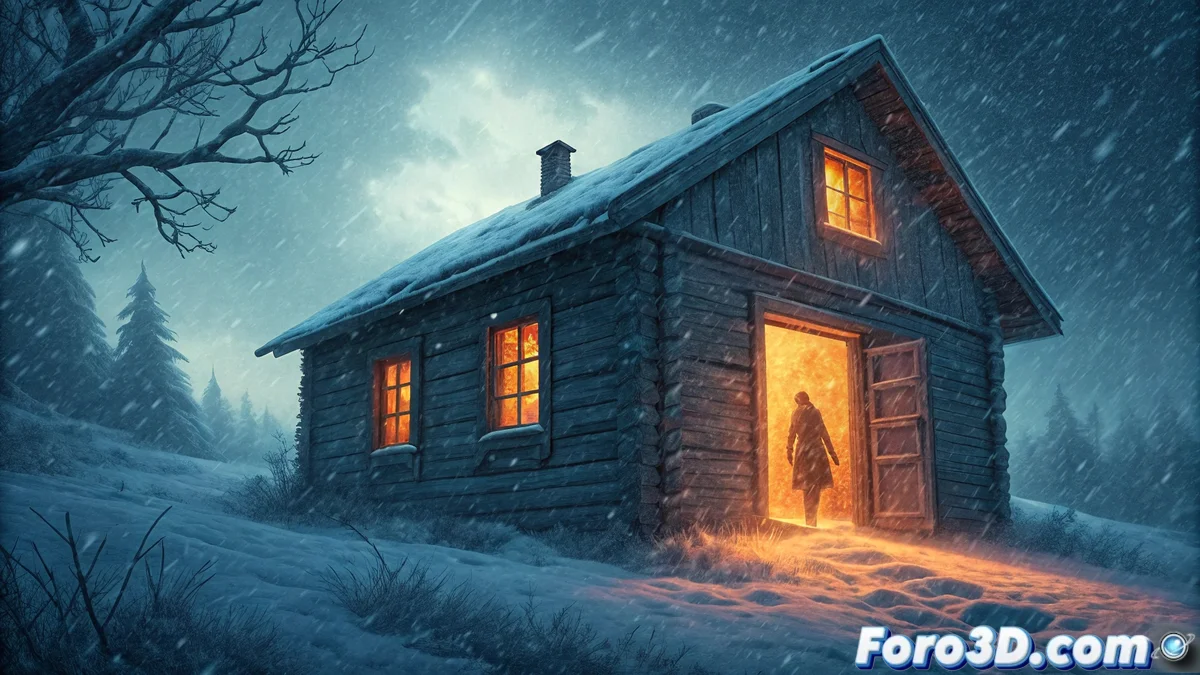
The Whistle of the Winter Window: Nordic Legends and Animation in OpenToonz
Legends about the winter whistle originated in Nordic communities during the Little Ice Age, between the 14th and 19th centuries. These narratives offered supernatural explanations for deaths by hypothermia in extreme snowstorms, depicting spirits that used familiar sounds to lure people out of their shelters. 🏔️
Historical Development and Cultural Adaptation
With the expansion of fishing and logging communities across Scandinavia, the legend evolved by incorporating local elements. In the Faroe Islands, it took on a maritime character, while in Finland it merged with indigenous mythologies. During the 19th century, Scandinavian Romantic authors incorporated these tales into their works, consolidating the current narrative structure. Industrialization and improvements in home insulation transformed the perception of the phenomenon, shifting from a tangible threat to a preserved cultural legacy in oral tradition.
Key Elements of the Legend:- Origin in rural areas of Norway and Sweden with prolonged winters
- Adaptation to geographic contexts such as maritime and forested regions
- Transition from popular belief to influence on contemporary Nordic literature and cinema
The whistle of the window symbolizes the personification of hostile natural forces and human vulnerability to perceptual deception in critical situations.
Project Setup in OpenToonz
Launch OpenToonz and set up a new project with 1920x1080 pixel resolution and 24 fps. Establish a timeline for a 5-second animation, organizing two main layers: one for the static background of the cabin and another for the animated blizzard elements. Adjust the color system to RGB and select smooth interpolation to ensure natural transitions in particle movements. 🎬
Essential Initial Setup:- Dimensions: 1920x1080 px, duration: 5 seconds (120 frames)
- Layers organized for background and dynamic animations
- Smooth interpolation mode for fluidity in transitions
Modeling, Lighting, and Special Effects
Use vector drawing tools to design the cabin with rough textures and irregular strokes that simulate age. The window must include a space between the frame and the wall, crucial for the narrative. Use separate layers for the warm interior with dim light and the icy exterior, adding a barely visible human figure through the frosted glass. Apply the lighting module to create contrast: orange tones at 30% intensity in the interior and cold blues at 70% in the exterior. Set up adjustment layers with Gaussian blur filter to simulate frost on the glass, and assign wood materials with pronounced grain. For the blizzard, implement the particle system with organic speed and direction, and add a sound distortion effect using sinusoidal deformation layers. ❄️
Technical Details for Visual Effects:- Rough textures and grain in wood materials for realism
- Snow particles with minimal specular shine to avoid artificial reflections
- Sound distortion effects with sinusoidal deformation around the window
Rendering and Cultural Legacy in Animation
For the final render, select the H.264 codec with high quality and medium compression. Enable 4x antialiasing and export as a PNG image sequence to maximize control in post-production, ensuring storm details remain sharp. This representation demonstrates how animation software can capture legends that have chilled the blood of generations, though the original Nordic artists would undoubtedly have preferred central heating over so much icy atmosphere. The legacy of this legend endures as a reminder of the dangers of the Arctic winter and the importance of seasonal preparation, influencing Nordic horror cinematic and literary productions. 🎭