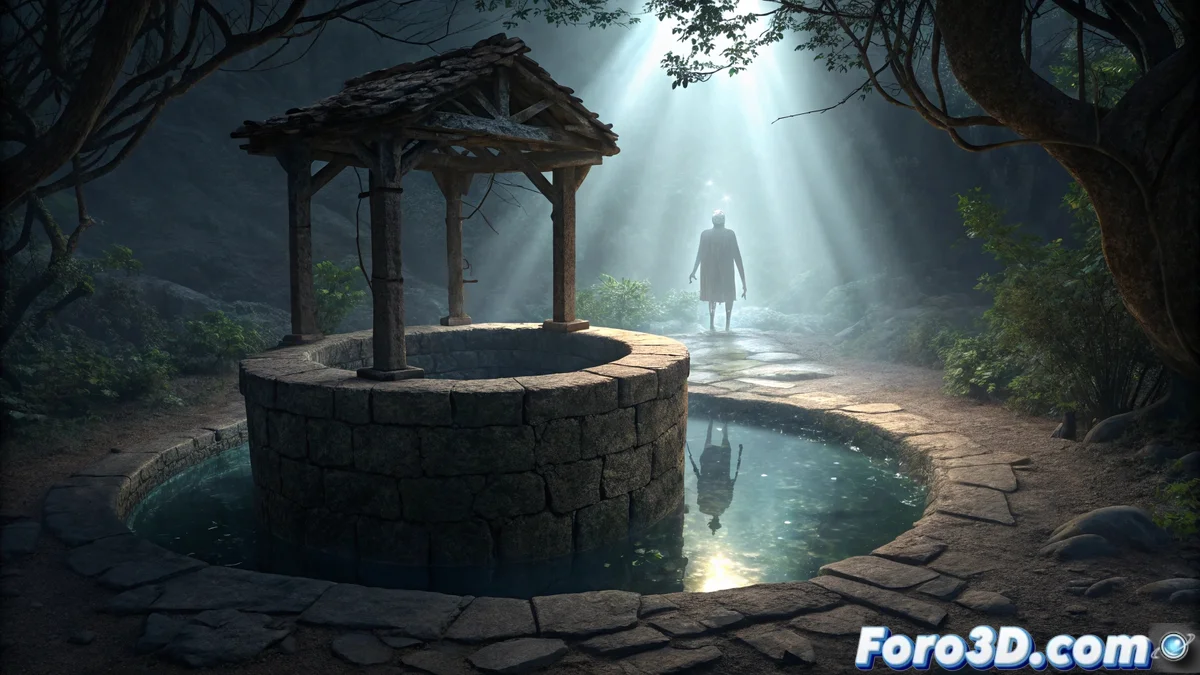
The Well of the Inverted Shadow: African Legend and 3D Modeling
The fascinating tradition of the well of the inverted shadow originates in the rural communities of West Africa, where water not only serves a vital function but also embodies deep spiritual meanings. According to ancestral narratives, this enigmatic well is located in a remote village and has the ability to reflect an inverted version of the spiritual shadow of anyone who peers into its waters. The central belief holds that each individual possesses an autonomous shadow that can exist independently, adding a terrifying nuance to this legend 🌍.
Origins and Evolution of the Legend
Over generations, knowledge about this well was passed down orally as a spiritual warning within specific communities. Traditional guardians established rigorous ritual protocols for interacting with the well, determining that the expression of the aquatic reflection reveals the state of the real shadow. If the reflection shows happiness, it indicates that the shadow is watching and preparing to replace the person; if it shows horror, it means the shadow is free and the individual can escape this dimensional exchange. This cultural legacy reflects the dualistic worldview present in numerous African cultures, where reflections and shadows contain profound metaphysical meanings.
Key Elements of the Tradition:- Oral transmission as a spiritual warning between generations
- Ritual protocols developed by traditional guardians
- The aquatic reflection as a diagnosis of the real shadow's state
The well functions as a spiritual diagnostic tool, allowing people to know the state of their connection with their dark counterpart.
Preparation and Setup in ZBrushCoreMini
To recreate this legend in the digital realm, we begin by opening ZBrushCoreMini and setting up a new document with square proportions, which facilitates the circular composition of the well. We adjust the resolution to a medium level that allows for sufficient details without overloading the system. We select a basic sphere from the 3D primitives as a starting point, as this geometric shape serves as an ideal base for modeling the ancestral well 🎨.
Initial Modeling Steps:- Create a new document with square proportions to optimize composition
- Set medium resolution to balance detail and system performance
- Select a primitive sphere as the structural base of the well
Structural Modeling and Texturing
We use the Move brush to hollow out the sphere and create the circular opening of the well, ensuring the walls maintain adequate thickness for a realistic structural appearance. We apply the DamStandard brush to carve irregular patterns into the stone, simulating natural erosion caused by time and the elements. For the well's edge, we slightly extrude the upper edge using the Inflate brush, creating a weathered stone texture that evokes antiquity. Finally, we add a separate plane to represent the reflective water at the bottom of the well, positioning it slightly below the edge to achieve a depth effect.
Lighting, Materials, and Special Effects
We set up the lighting with a zenith angle that simulates daylight filtering into the well's interior, adjusting the light intensity to create marked contrasts between the bright exterior and the dark interior. For the stone material, we select a rocky texture with earthy tones and apply subtle color variations that simulate moss and moisture. The water material was configured with high reflectivity but slight turbidity to suggest depth and mystery. To create the illusion of the inverted shadow, we modeled a stylized human figure with a defined facial expression using basic alpha brushes, positioning this reflected figure on the water plane with an inverted orientation. We applied the polypainting system to add supernatural colors to the reflection, clearly differentiating it from the real environment. In the final render, we adjusted the shading parameters to accentuate the contrast between reality and the reflection, exporting in PNG format to preserve transparency if necessary 🌊.
Key Technical Aspects:- Zenith lighting for contrasts between light and darkness
- Rocky textures with color variations for realism
- Reflectivity and turbidity in the water material for depth
Cultural Legacy and Application in 3D Modeling
This tradition not only represents the African dualistic worldview but also endures in contemporary communities as a metaphor about the dual nature of the human being and the risks of losing control over hidden aspects of the personality. The project demonstrates that even free software like ZBrushCoreMini can capture terrifying legends with a high level of detail and expressiveness. However, after modeling the well of the inverted shadow, you might want to check your own reflection in a normal mirror to make sure you're still yourself 😨.