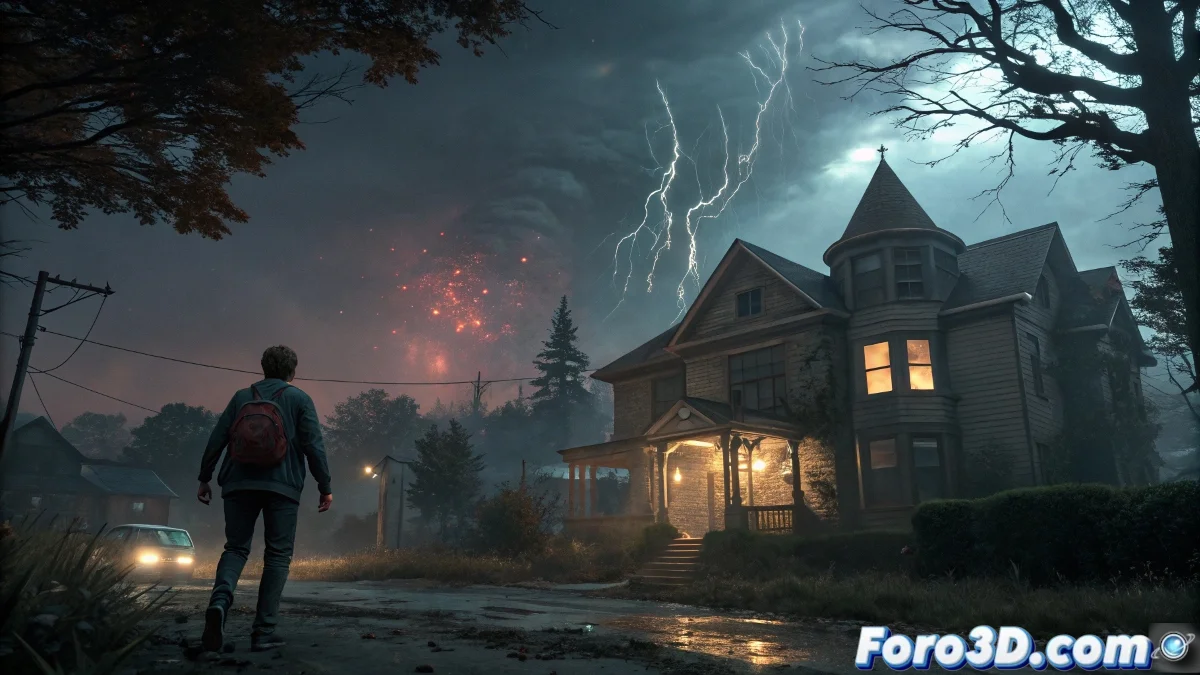
When the Upside Down Became Scarier Than Ever
DNEG elevated the cosmic horror in Stranger Things 4 with visual effects that significantly expanded the series' universe. Their work included three key areas:
1. The Evolution of the Upside Down
- New biomes: Developed alien ecosystems with Houdini
- Particle systems: Created "living fog" with organic movement
- Organic textures: Designed surfaces that appear to breathe
- Portal expansion: Enhanced spatial distortion mechanisms
2. Vecna: A Villain Made of Nightmares
"Vecna needed to be both human and monstrous. Every tentacle, every open wound told part of his story" - VFX Supervisor
- Complex rigging for his alien limbs
- Torn skin simulations in Houdini
- Particle system for the "mind dust"
- Seamless integration with Jamie Campbell Bower's performance
3. Epic-Scale Destruction
- Bone fracture simulations during the deaths
- Creel house destruction with realistic physics
- Atmospheric effects for the interdimensional storm
- Integration of digital crowds in panic scenes
Cutting-Edge Technology for Horror
DNEG used an innovative pipeline:
- Machine Learning: To accelerate particle simulations
- Houdini Solaris: To handle complex USD scenes
- Nuke 3D: For multi-layer compositions
- Arnold Rendering: To maintain the cinematic look
Details That Made the Difference
- 47 different versions of the living roots
- 300+ layers for the Mind Lair shots
- Custom shader for interdimensional membranes
- Fluid simulation for the "inverted rain"
The Perfect Balance
DNEG achieved:
- Maintaining the series' nostalgic aesthetic
- Introducing striking new visual elements
- Creating fluid transitions between dimensions
- Developing a coherent visual language for cosmic horror
This work sets a new standard for visual effects in television series, combining technical innovation with powerful visual storytelling.