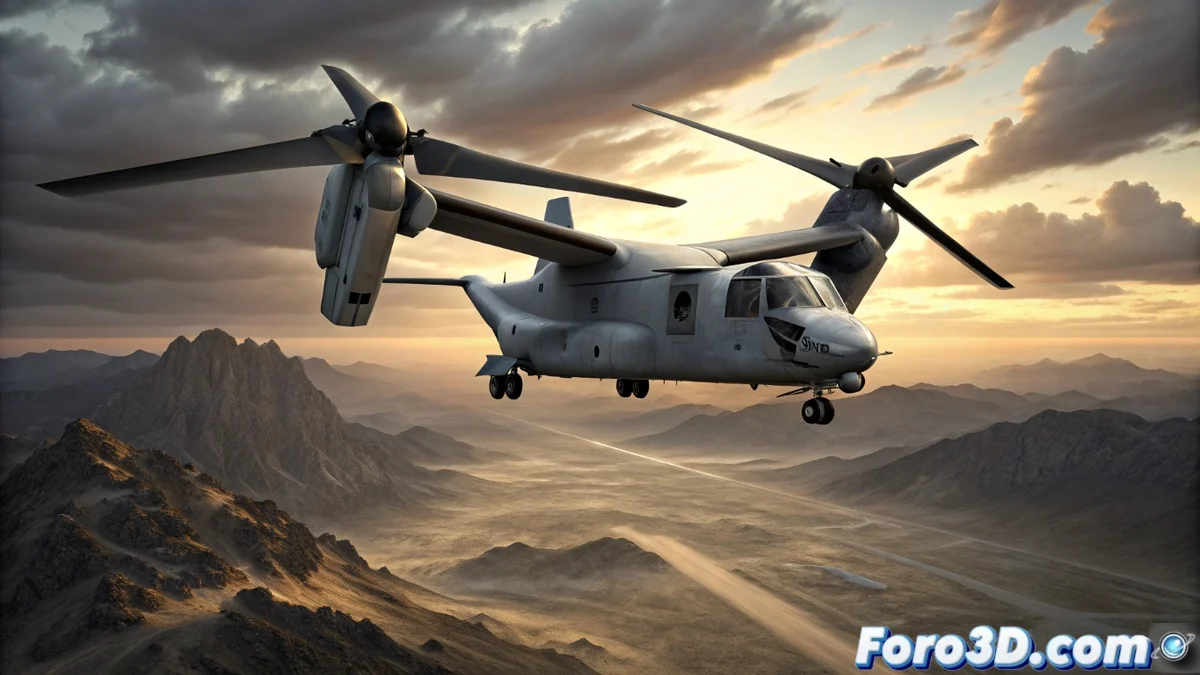
The V-22 Osprey: the tiltrotor aircraft
Developed in the United States, the V-22 Osprey is a revolutionary aerial platform designed for tactical transport missions. Its unique engineering combines the capabilities of a helicopter to operate in confined spaces with the speed and range of a fixed-wing aircraft, creating a multimodal solution for modern military forces. ✈️
Configuration and flight capabilities
The heart of its operation lies in its tilting engine nacelles, which can rotate up to 90 degrees. This feature enables vertical takeoffs and landings (VTOL), facilitating operations on aircraft carriers, rugged terrain, or limited deployment zones. Once airborne, the rotors tilt forward, transforming the aircraft into an efficient turboprop for high-speed cruise flights.
Key design dimensions:- Length: 17.5 meters, with an aerodynamic fuselage that houses the cockpit and cargo area.
- Wingspan with rotors: 25.8 meters, equipped with two large-diameter three-bladed propellers at the wingtips.
- Height in helicopter mode: 6.73 meters, allowing storage in naval hangars.
The Osprey efficiently connects hovering capability with superior cruise speeds, redefining tactical air mobility.
Armament and operational roles
Beyond its transport profile, the Osprey is an adaptable platform. For high-risk missions, it can be configured with defensive armament systems, increasing its survivability in hostile environments. Its rear loading ramp is not only vital for the rapid movement of personnel and equipment but also serves as a mounting point for weapons. 🛡️
Armament options and variants:- Defensive armament: M240 machine gun or Minigun system mounted on the rear ramp for protection during disembarkation.
- Ventral turret: Some specialized versions incorporate a turret with a GAU-17 rotating cannon for enemy fire suppression.
- Versatile missions: It is employed in airborne assault, medical evacuation (MEDEVAC), resupply, and special forces operations.
Legacy and technological evolution
Although today it is a fundamental asset, the path of the V-22 Osprey was marked by significant technical challenges during its development. Initial problems with control systems and propellers earned it a complicated reputation, being seen as a high-risk program. However, perseverance in its engineering overcame these obstacles, culminating in an aircraft that always lands in style and demonstrates the value of innovation in aerospace design. Its success has laid the foundation for future advanced air mobility concepts. 🚁➡️✈️