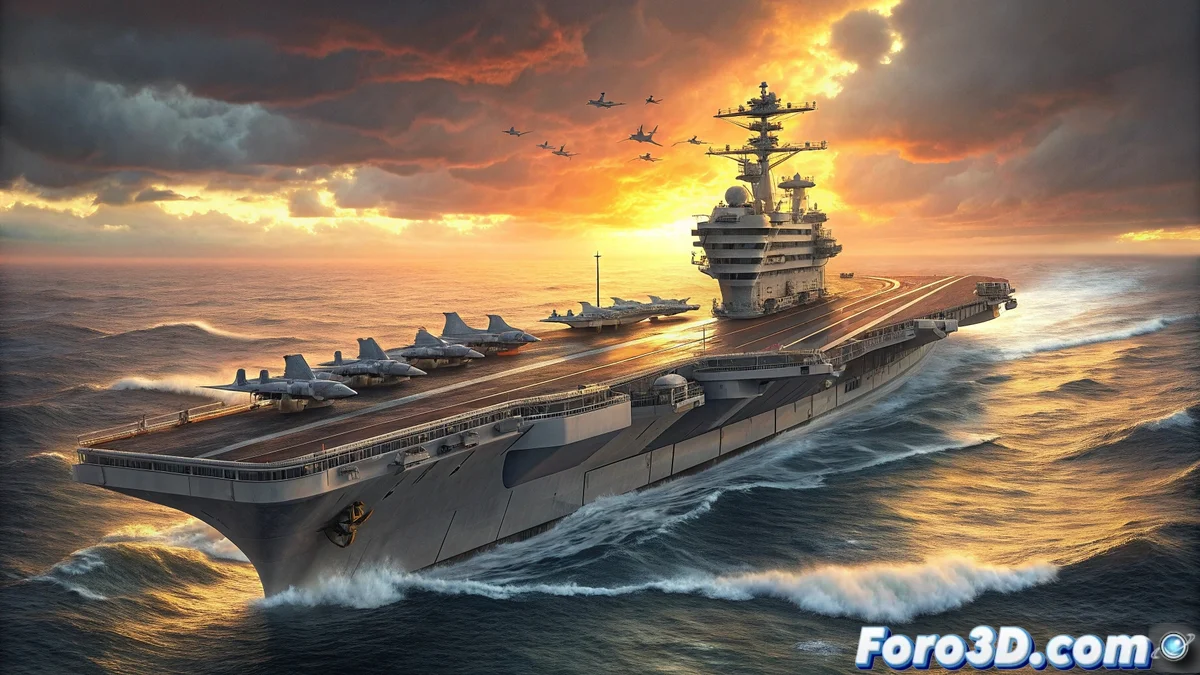
The USS Gerald R. Ford: Supreme Challenge for Naval 3D Modeling
The USS Gerald R. Ford embodies the pinnacle of technological expression in U.S. nuclear aircraft carriers, featuring revolutionary innovations that make it a fascinating project for digital artists specialized in 3D modeling. This naval engineering marvel displaces around 100,000 tons and reaches speeds exceeding 30 knots, powered by two A1B nuclear reactors that ensure virtually unlimited operational autonomy in any ocean on the planet 🌊.
Critical Dimensions for Precise Digital Recreation
The exact measurements of the naval colossus are fundamental for achieving realistic three-dimensional modeling: 332.85 meters overall length, 78 meters maximum beam on the flight deck, and 7.8 meters operational draft. The air operations surface features an optimized design capable of accommodating approximately 90 modern combat aircraft, including stealth F-35C Lightning II fighters, F/A-18E/F Super Hornets, along with helicopters and latest-generation drones 🚁.
Main Structural Features:- Overall length of 332.85 meters with 78-meter beam on flight deck
- Capacity for 90 modern combat aircraft and unmanned systems
- Operational draft of 7.8 meters for deep-water navigation
Modeling this aircraft carrier is like trying to recreate a floating city where every screw has its own classified instruction manual.
Technological Systems and Advanced Surface Details
The electromagnetic EMALS systems for aircraft launch and AAG for recovery represent significant advances over traditional steam catapult mechanisms. The digital recreation must incorporate the eleven advanced weapons elevators, the dual-band radar DBR, and complex defensive systems such as ESSM, RAM, and CIWS launchers complemented by four 25 mm MK-38 Mod 2 machine guns. The reduced control island and flight deck with its parking markings, launch areas, and arrestor wires provide countless details for high-fidelity texturing ⚡.
Key Technological Elements for Modeling:- EMALS and AAG systems for electromagnetic air operations
- Eleven advanced elevators for armament and supplies transport
- Dual-band DBR radar and ESSM, RAM, and CIWS defensive systems
Structural Complexity in Digital Recreation
The three-dimensional recreation of the USS Gerald R. Ford demands meticulous attention to every component, from the nuclear propulsion systems to the smallest operational details on deck. Every structural, technical, and defensive element contributes to the overall complexity of the project, transforming the modeling into a technical precision exercise that faithfully replicates this floating city of cutting-edge military technology 🏗️.