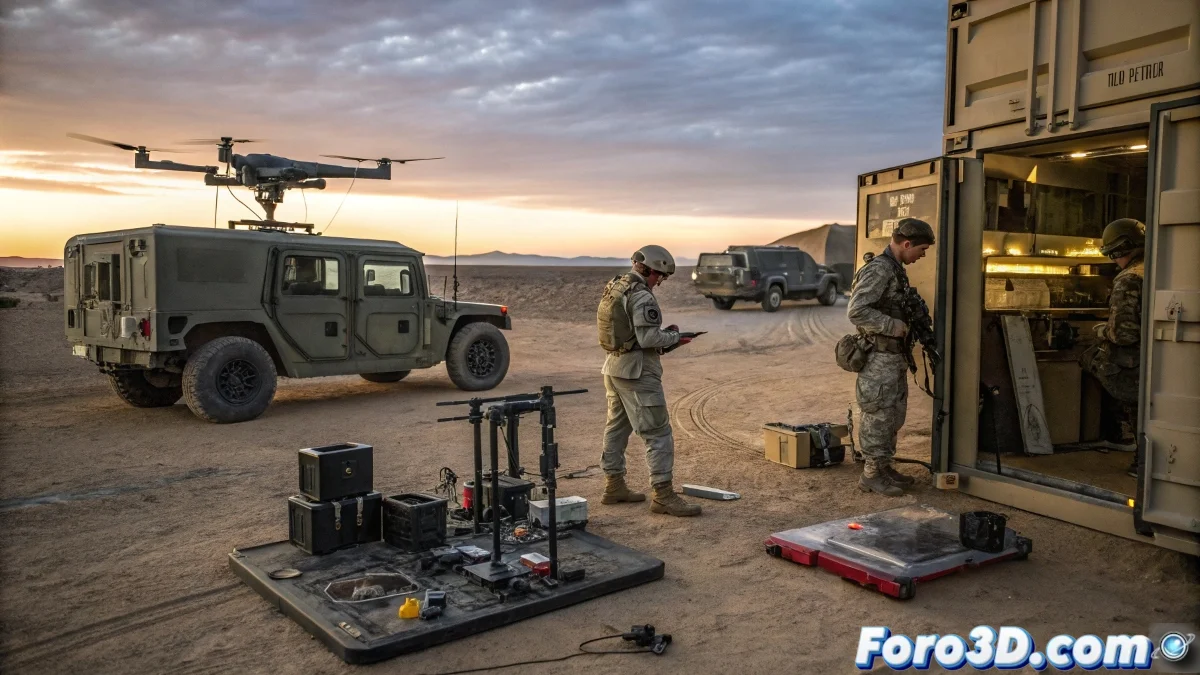
The US Army Prints Drones Right on the Battlefield
Imagine having to wait weeks for a spare part while in the middle of a mission. 💥 Well, the US Army said "no, thanks" and now takes its own 3D printers to the field of operations. Not to make figurines, but to manufacture drones and critical parts in hours. The result? Less logistics and more action. 🚀
From mobile containers to equipped tents, these 3D printers (FDM and SLA) are changing the way technical problems are solved in the midst of a mission. Because sometimes, the best ally isn't a soldier, but a good roll of filament.
From SolidWorks to the Desert: Design Under Pressure
Military technicians use software like Fusion 360 or Blender to redesign parts on the fly. Did a drone break? No problem: they model it, print it, and have it ready before the enemy finishes their coffee. ☕ Of course, not everything comes out perfect: some drones come out with more wobble than a poorly calibrated 3D model.
- Advantages: Reduced times, adaptability, and less dependence on distant factories.
- Challenges: Printing failures, defective parts, and the eternal struggle against warping in extreme environments.
- Fun Fact: Someone forgot the supports once and ended up with a fuselage that looked like the work of an Italian chef. 🍝
The Future of Military Logistics?
The goal is clear: print most components in situ, leaving behind long waiting times. But, as in any 3D project, there's trial and error. Some parts don't work, other drones refuse to fly… but every failure is a lesson learned. After all, even the best render needs a few attempts before it's perfect. ✨
So, the next time your 3D printer fails, remember: even the US Army has issues with first layer adhesion. The difference is they can't afford a "well, I'll try tomorrow." 😅