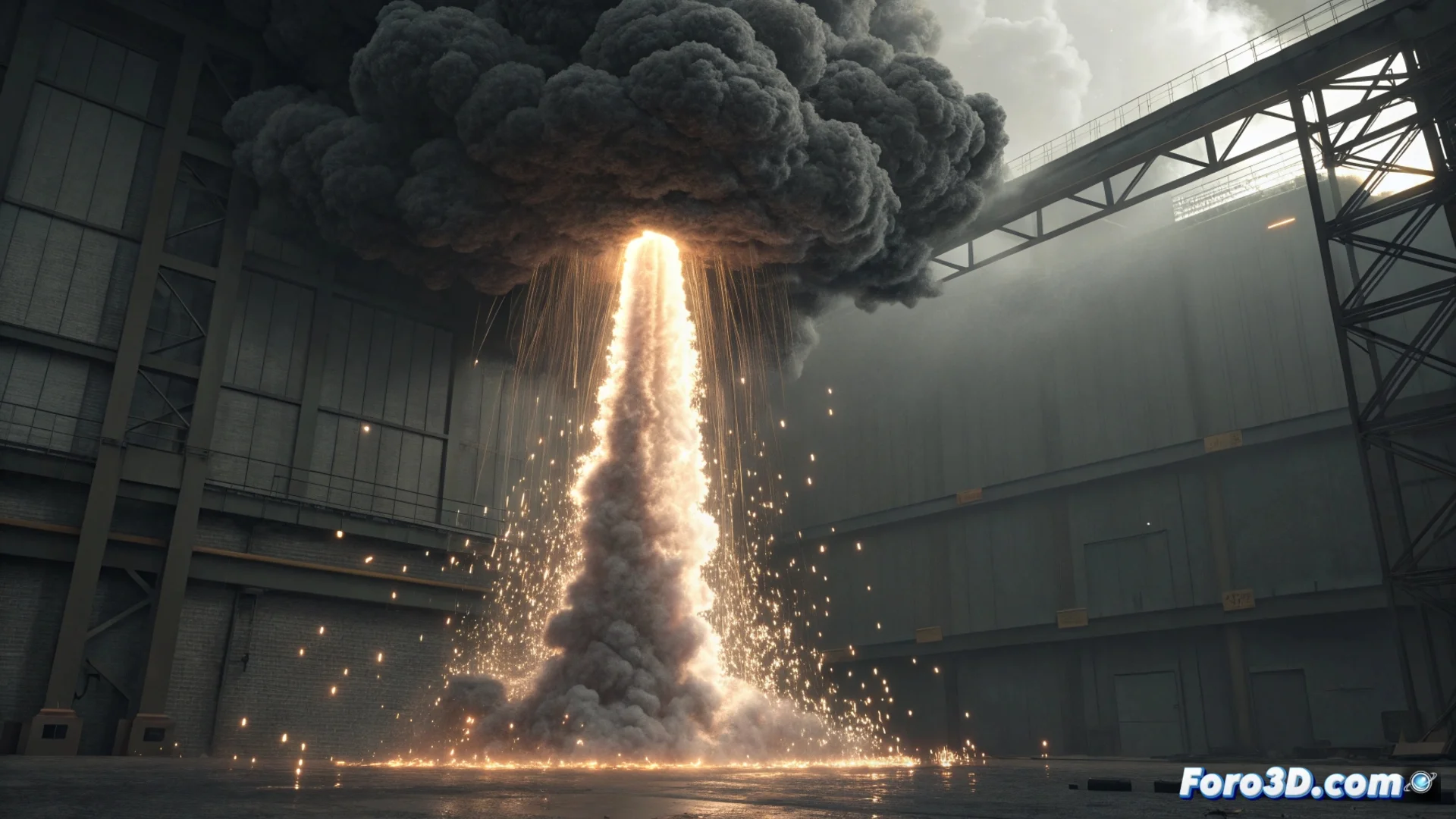
Unreal physics in particles affects visual credibility
When animating particle systems for effects like smoke or sparks, it's common for artists to set parameters that deviate from real physical behavior. This approach generates a sense of falseness that the audience perceives immediately, even if they can't always identify the reason. Obvious errors break immersion and divert attention from the main narrative, even when other scene elements are well-executed. 🎬
Key physical parameters you must adjust
To avoid your simulation looking fake, you must focus on three fundamental forces. Gravity must correspond to the particle's scale and density; light smoke tends to rise, not sink like a rock. Turbulence simulates the organic movement of air, but applying it excessively creates artificial chaos. The viscosity or drag of the medium dictates how particles lose speed; suspended dust disperses gradually, not stops suddenly.
Common mistakes you must avoid:- Animating fire smoke with the density and fall of water, creating a gray waterfall that no one believes.
- Making sparks bounce in the air like elastic balls, without the parabolic trajectory and rapid real cooling.
- Setting up dust particles that float weightlessly or stop abruptly, ignoring inertia and air resistance.
A credible particle system is based on observing and referencing the real world, not inventing behaviors for artistic convenience.
Strategies to simulate credible behavior
The foundation for achieving convincing particles is observing reality. Study how candle smoke moves or the dispersion pattern of sparks when using a grinder. In your software, start with realistic physical values as a base. Only then make controlled adjustments to exaggerate the effect for a clear narrative purpose, not by accident. Integrate force fields to direct movement organically, combining automatic simulation and manual control.
Steps to verify your simulation:- Reference real-world video material before starting to set parameters.
- Test the particle system in different shots and camera angles to check visual coherence.
- Adjust the scale of gravity and turbulence in relation to the size and speed of your scene.
The final impact on visual narrative
The credibility of particle effects is not a minor technical detail, but a pillar of visual immersion. When the viewer perceives that the smoke falls too fast or the sparks float without gravity, their mind disconnects from the story. Investing time in adjusting basic physics ensures your effects support the narrative instead of sabotaging it. The ultimate goal is for the technique to disappear, allowing the visual illusion to be complete and powerful. ✨