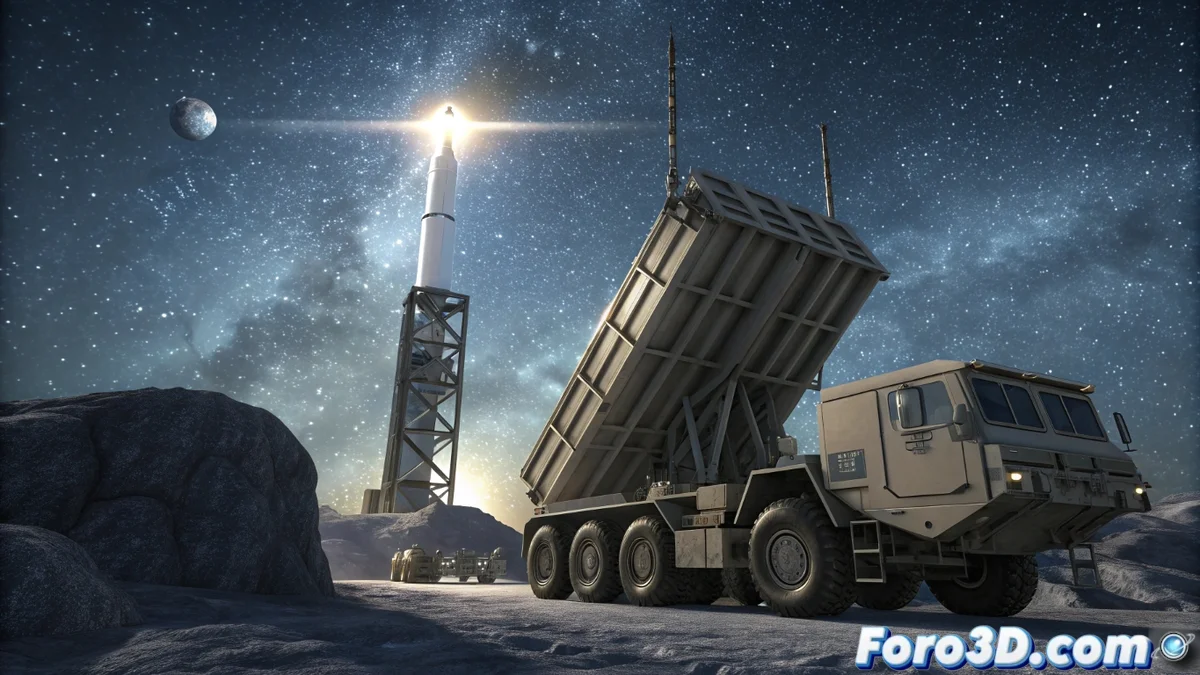
The US THAAD Anti-Missile Defense System
In the landscape of modern strategic defense, the Terminal High Altitude Area Defense (THAAD) stands out as the United States' most advanced technological solution to counter ballistic threats. Its primary mission is to detect, track, and destroy short- and medium-range enemy missiles during their final descent phase, operating both within and outside the Earth's atmosphere. This mobile defensive shield operates autonomously, providing an indispensable layer of protection to safeguard high-value regions and deployed troops against potential attacks with conventional or weapons of mass destruction warheads. 🛡️🚀
Components and Architecture of the Defensive Shield
The effectiveness of THAAD lies in the synergy of its key elements. The offensive core consists of its kinetic interceptors, 6.17-meter-long projectiles launched from a transporter erector launcher (TEL). Each of these platforms can house and deploy up to eight ready-to-fire missiles. The fundamental piece for mission success is the AN/TPY-2 radar, an X-band system with extraordinary range and processing power, capable of distinguishing between real targets and decoys at continental distances to guide the interceptor with millimeter precision.
Main Elements of the System:- Interceptors: 6.17m long and 0.37m diameter missiles, designed for direct kinetic collision.
- TEL Launcher: Heavy vehicle approximately 12 meters long that transports and operates the eight interceptor missiles.
- AN/TPY-2 Radar: X-band radar system with exceptional detection, tracking, and target discrimination capabilities.
Hit-to-kill technology transforms a physical impact into pure destructive energy, eliminating the need for a traditional explosive warhead.
Interception Mechanism and Operational Capabilities
The defining feature of THAAD is its kinetic interception method, known as "hit-to-kill". Unlike systems that use fragmentation warheads, the THAAD interceptor is guided to collide directly with the threatening warhead, destroying it solely through the immense kinetic energy released upon impact. This capability allows it to act as an impenetrable barrier in two domains: in exoatmospheric space and during the target's fiery atmospheric reentry. Its rapid deployment and impressive test record establish it as a top-tier deterrent element in global geopolitics.
Key Interception Capabilities:- Kinetic Interception (Hit-to-Kill): Target destruction by direct collision, without explosives.
- Dual Capability: Neutralizes threats both in outer space and in the upper atmosphere.
- Rapid Deployment: Mobile system that can be transported and activated in hours in operational theaters.
A Challenge of Extreme Precision
Operating THAAD is comparable to the ultimate precision challenge. It involves making one projectile hit another traveling at thousands of kilometers per hour, in the vast darkness of space, where margins for error are nonexistent and the consequences of failure are catastrophic. It is the embodiment of a defense concept where technology, intelligence, and reliability merge to create an active shield, representing the absolute vanguard in worldwide ballistic missile defense. 🎯💥