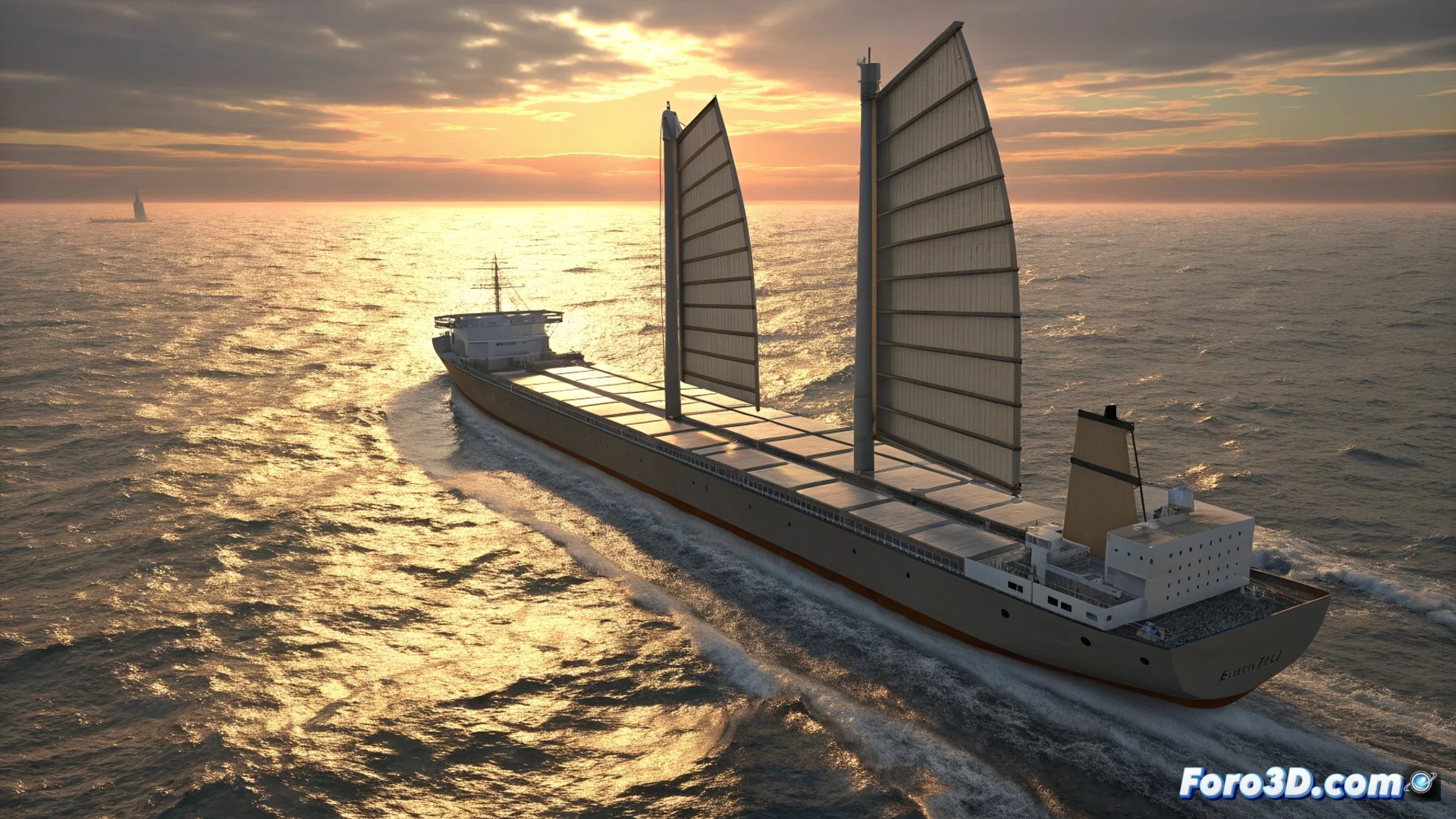
United States Designs Autonomous Cargo Ship with Rigid Wings
A team of engineers in United States is developing a revolutionary concept for maritime transport: a cargo ship that requires no crew on board and harnesses wind power as its primary propulsion source. This innovative project aims to demonstrate that it is possible to cross the Atlantic Ocean with minimal human intervention, marking a milestone toward complete autonomy at sea. 🚢
A Propulsion System Inspired by Modern Sailing
The most striking feature of this vessel is its two large rigid wings, which function as a high-tech sail system. Made with composite materials that are lightweight and extremely durable, these structures are not fabrics but solid surfaces that orient themselves automatically. A complex algorithm constantly analyzes real-time weather data and calculates the perfect angle for the wings to capture the wind optimally, thereby maximizing forward thrust. To ensure operation in all conditions, the ship includes an auxiliary diesel engine that activates in ports or during dead calms.
Key Components of the Propulsion System:- Composite Rigid Wings: Aerodynamic structures that replace traditional sails.
- Control Algorithm: Software that processes wind data and adjusts orientation to achieve maximum efficiency.
- Hybrid Propulsion: Combines primary wind power with a backup diesel engine for precise maneuvering.
This approach aims to transform maritime cargo transport, making it safer and reducing long-term operating costs.
Sensors and Artificial Intelligence Govern the Ship
Operating without people on deck requires an exceptional level of environmental perception. The ship integrates an advanced network of LiDAR sensors, high-definition radars, 360-degree cameras, and global positioning systems (GPS). This technological suite allows the vessel to detect obstacles, other ships, adverse weather conditions, and follow the pre-planned route with great accuracy. Autonomous navigation is supervised from a land-based control center, where human operators can intervene remotely if necessary, although the ship is designed to make most decisions on its own.
Essential Elements for Autonomy:- Perception Network: Set of radars, cameras, and sensors that create a detailed image of the maritime environment.
- Avoidance System: Artificial intelligence that calculates safe trajectories to prevent collisions.
- Remote Control: Land station that monitors the voyage and serves as backup for critical decision-making.
Impact and Future of Autonomous Transport
The central goal of this development goes beyond mere automation: it seeks to drastically reduce the consumption of fossil fuels and polluting emissions in the maritime sector, harnessing clean and renewable energy such as wind power. By eliminating living spaces for the crew, the hull design can also be optimized to carry more cargo or be more hydrodynamically efficient. It seems that, in the not-too-distant future, cargo ships could "work from home," undertaking long transoceanic voyages completely independently. 🌊⚡