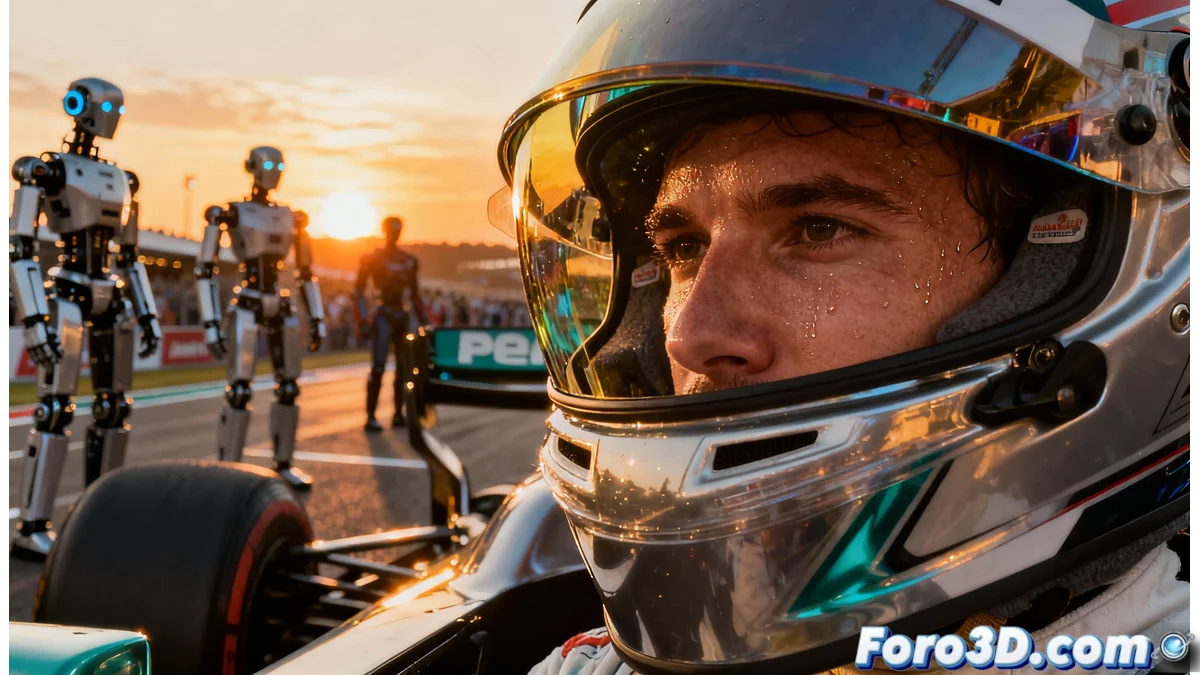
The Ultimate Duel: Human Pilots vs. Artificial Intelligences on the Track
The atmosphere on the starting grid is an electrifying mix of sounds. The visceral roar of a single competitor's hybrid engine contrasts with the ominous silence of the rest of the fleet, whose systems are already active and calculating. This is the new landscape of elite motorsport: a battlefield where human intuition and courage face off against the cold logic of predictive algorithms. The race transcends the struggle for the podium; it is an experiment to determine what qualities define true mastery at the wheel. 🏁
Machine Supremacy: Pure Calculation and Absolute Efficiency
Autonomous vehicles represent the pinnacle of algorithmic precision. Their digital brains assimilate a constant torrent of telemetry data, adjusting parameters like aerodynamics, battery power delivery, and tire degradation for every millimeter of asphalt. They lack fatigue, experience no nervousness, and their reaction times render the concept of "human reflex" obsolete. Their driving is the materialization of optimal strategy, a choreography of perfect racing lines where the error variable has been minimized. For the human pilot, this becomes a monumental challenge: trying to outperform an adversary that not only reacts but anticipates.
Key advantages of autonomous systems:- Real-time processing: They analyze millions of data points per second, from asphalt temperature to rival tire pressure, to make micro-adjustments.
- Elimination of the psychological factor: They do not suffer from pressure, arrogance, or fear, maintaining constant and unchangeable performance throughout the race.
- Perfect fleet coordination: In teams with multiple autonomous cars, they can execute team tactical strategies with synchronization impossible for humans.
The circuit has become a laboratory where biology faces silicon, and every curve is a question about the future of the sport.
The Human Essence: Courage, Adaptation, and the Art of the Unexpected
Facing this wall of infallible logic, the human pilot emerges as the chaotic element, the unpredictable variable that can disrupt any simulation. Their strength lies not in calculation, but in the holistic understanding of the race. They can "feel" the loss of grip before it appears on sensors, interpret a change in light or shadow as an opportunity, and make risky decisions based on a spark of pure intuition. While AIs execute the perfect Plan A, the human is capable of inventing a Plan B on the fly, exploiting the slightest crack in a system that believes it has everything under control.
Weapons of the pilot in this new scenario:- Tactical improvisation: Ability to alter the race strategy instantly, responding to incidents or opportunities that no algorithm foresaw.
- Reading changing conditions: Skill in interpreting qualitative and environmental factors (wind, humidity, rival behavior) that are difficult for a sensor to quantify.
- Psychological pressure: Although AIs do not feel it, a human pilot can force high-risk situations that oblige autonomous systems to enter defensive or recalculation modes, consuming resources and time.
Beyond the Podium: The Meaning of Victory
In this context, triumph acquires a new dimension. Winning does not necessarily mean crossing the finish line first against theoretically superior opponents. Victory can be moral, strategic, or symbolic. The true achievement for the human pilot lies in demonstrating that the competitive spirit cannot be reduced to code. It is achieving, in a decisive curve, a maneuver—born of experience, courage, and a touch of irrationality—that forces those artificial minds to pause their calculations for a millisecond and admit: "this was not in the data". This duel is redefining not only how we race, but also why we compete. 🤖 vs. 🧠