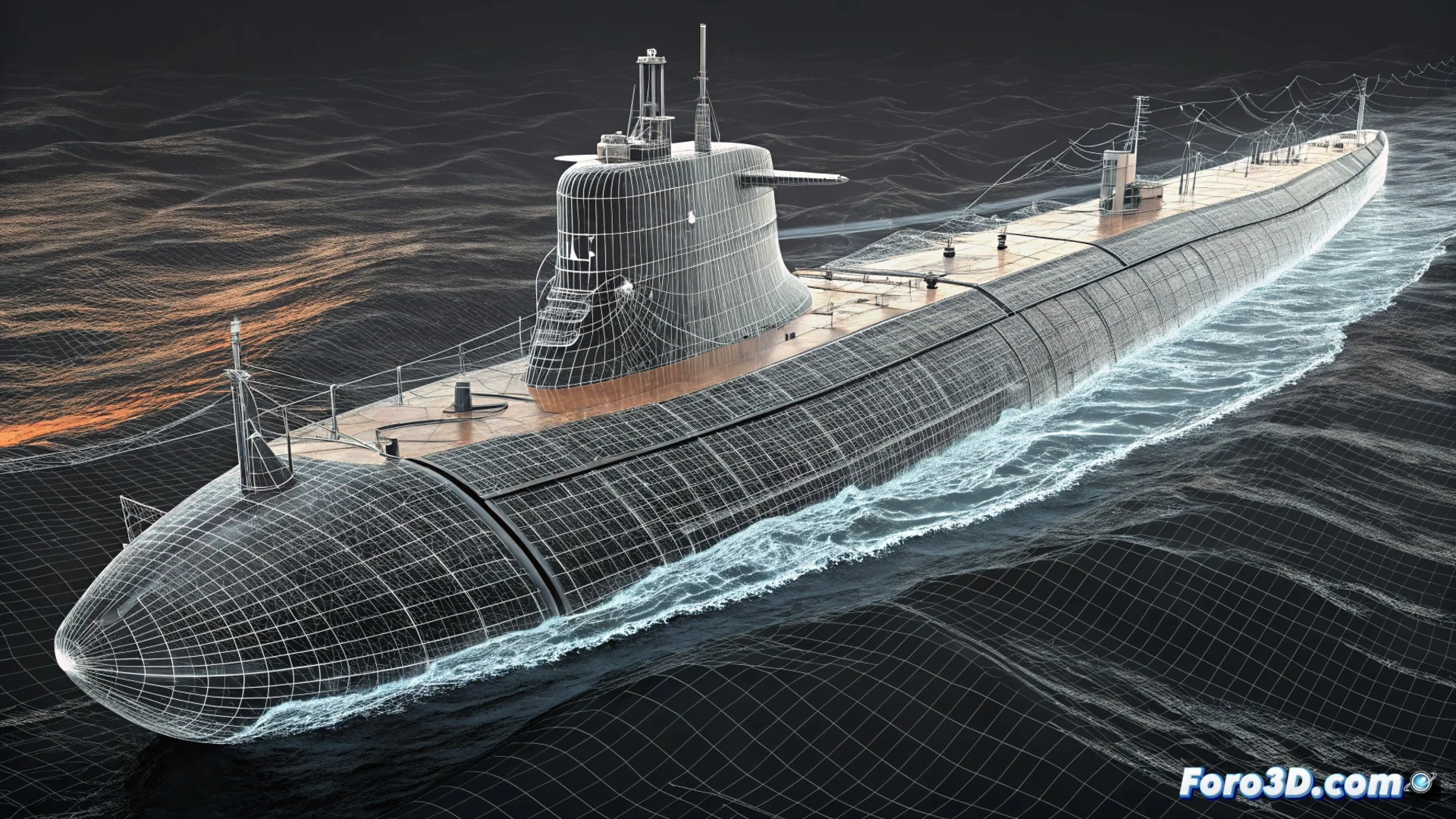
The Type 212A Submarine: Stealth and Autonomy Underwater
Developed jointly by Germany and Italy, the Type 212A attack submarine represents a technological leap in submarine operations. Its main feature is an air-independent propulsion (AIP) system, which allows it to navigate submerged without needing to surface to recharge batteries for weeks. This modern design integrates a smooth hull and an innovative X-shaped rudder for highly agile maneuvering. 🚤
Design Prioritizing Acoustic Discretion
The submarine's dimensions, 56 meters in length, 7 in beam, and 6 in draft, are optimized to reduce its acoustic signature. A single-piece hull, without protruding external elements, minimizes hydrodynamic resistance and noise. The X-shaped rudder provides precise control at low speeds and during operations near the seabed. Additionally, the hull is coated with an anechoic material that actively absorbs enemy sonar waves, making it a very difficult target to detect.
Key Design Features:- AIP Propulsion: Remains submerged for extended periods without using the snorkel.
- Advanced Hydrodynamics: Smooth outer fairing and sail with optimized profile.
- Special Coating: Material that absorbs sonar waves to evade detection.
The combination of AIP propulsion and a stealthy design redefines the capabilities of conventional submarines.
Offensive and Defensive Capabilities
To fulfill its missions, the Type 212A is equipped with versatile armament. It has six 533 mm torpedo tubes from which it can deploy state-of-the-art heavy torpedoes against surface ships and other submarines. Additionally, it can employ the IDAS missile system, designed to defend against aerial threats such as helicopters or to attack coastal land targets.
Main Armament Components:- Torpedo Tubes: Six 533 mm tubes for primary armament.
- Modern Torpedoes: Heavy ammunition to neutralize naval targets.
- IDAS Missiles: Missile system for air defense and coastal attack.
Life Onboard and Operability
Despite