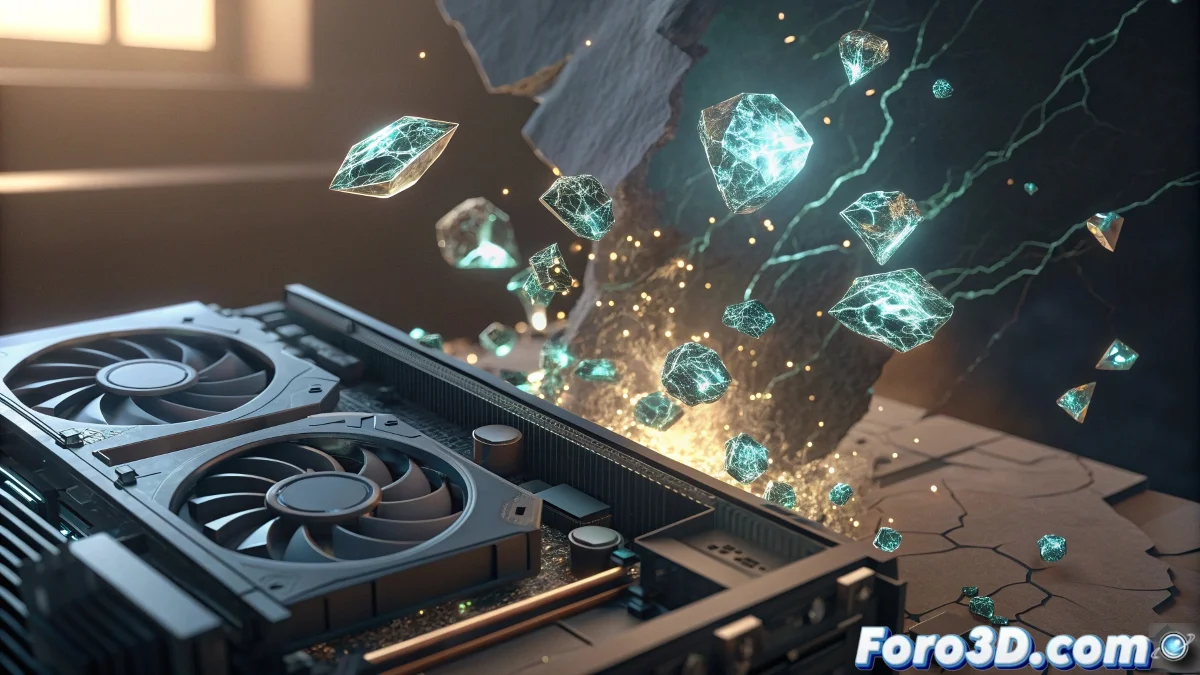
When Geopolitics Meets Your Graphics Card
The growing global trade tension over rare earths—17 chemical elements essential for modern technology—is generating shockwaves that directly reach our studios and workstations. These materials, with names that seem taken from a science fiction novel like neodymium, dysprosium, europium, and terbium, are critical components in virtually every piece of hardware we use for 3D creation and audiovisual production. The concentration of production in few countries, particularly China, creates a strategic vulnerability for our entire industry.
What makes this situation particularly concerning is that there are no viable short-term substitutes for most rare earth applications in electronics. While we can switch software or optimize code, the laws of physics and chemistry do not negotiate. A sustained supply disruption could dramatically slow hardware innovation and create artificial shortages in components that are already complex to manufacture.
Your RTX 4090 contains more international diplomacy than you imagine
Rare Earths in Critical Workstation Components
High-end workstations for 3D and VFX are particularly dependent on rare earths in multiple components. HDD hard drives use neodymium in high-power magnets for read/write actuators—without them, the storage density we need for 8K projects would be impossible. SSD drives, although without moving parts, require europium and terbium in semiconductor manufacturing processes.
Graphics cards—the heart of any render setup—depend on various elements in their magnets, fans, and electronic components. Cooling fans use neodymium magnets for their efficiency, while transformers and inductors in the power supply require specific alloys including dysprosium to maintain stability under prolonged intensive loads.
- Neodymium in hard drive and fan magnets
- Europium and terbium in semiconductor manufacturing
- Dysprosium in power components and transformers
- Lanthanum in camera lenses and specialized optics
Direct Impact on Prices and Availability
The pressure on prices is already being felt in specific components. Export restrictions and production quotas are creating bottlenecks in the supply chain that translate into 15-30% price increases in some professional GPU lines like NVIDIA RTX A-series and AMD Radeon Pro. Delivery times are extending from weeks to months for custom workstation configurations.
Most concerning is the impact on the next generation of hardware. Manufacturers like NVIDIA, AMD, and Intel are aggressively reviewing their product roadmaps, considering delaying launches or releasing "lite" versions with fewer performance improvements to keep prices accessible. The development of technologies like GDDR7 and new compute architectures could slow down if material costs skyrocket significantly.
In the global economy, a decree in Beijing can add $500 to the price of your next GPU in Madrid
- 15-30% increases in professional GPUs
- Extension of delivery times for workstations
- Review of roadmaps for next generations
- Possible delays in new technologies
Effects on the 3D and Audiovisual Industry
For VFX, animation, and archviz studios, the impact manifests in higher operating costs and more conservative planning. The ability to scale render farms on demand is compromised when new hardware costs significantly more or is simply unavailable. Equipment upgrade budgets must increase to maintain the same compute capacity, or alternatively, extend the lifespan of existing hardware with consequent impacts on energy efficiency and productivity.
Freelancers and small studios face the sharpest challenge, as they lack the negotiating power of big players and have less capacity to absorb cost increases. This could accelerate migration to cloud solutions, though that path comes with its own dependencies and recurring costs.
Impact on 3D Software and Development
Curiously, 3D software could be indirectly affected positively in the short term. Developers of engines like Unreal Engine, Unity, and Blender could intensify efforts in performance optimization and computational efficiency to maximize available hardware. We are already seeing features like DLSS in rendering and better support for older hardware that extend the lifespan of existing GPUs.
However, the development of new features requiring specific hardware—like advanced real-time ray tracing or more complex physics simulations—could slow down if the target hardware base does not evolve as expected. The software industry critically depends on hardware continuing to improve to enable new creative capabilities.
- Greater focus on optimization in software
- Extension of support for older hardware
- Possible slowdown of features requiring new hardware
- Intensification of cloud development as an alternative
Mitigation Strategies for Studios and Professionals
Smart players in our industry are implementing multiple strategies to navigate this uncertainty. Supplier diversification is no longer just about price—it's about ensuring continuous availability. Many studios are establishing direct relationships with manufacturers instead of relying exclusively on distributors, ensuring priority access to critical components.
Investment in preventive maintenance and warranty extensions is becoming more common to protect existing equipment. Simultaneously, there is a renewed interest in modularity and upgradability—systems that allow replacing specific components instead of entire workstations. Cloud rendering is gaining followers not only for flexibility, but as protection against hardware price volatility.
In times of geopolitical uncertainty, the best workstation is the one you already have running
The Long-Term Outlook and Emerging Alternatives
The future is not entirely bleak. Several promising developments could mitigate rare earth dependency in the medium term. Research into high-efficiency ferrite magnets could reduce the need for neodymium in some applications. Advances in rare-earth-free semiconductor manufacturing are showing progress, though they will likely take years to reach mass production.
The re-evaluation of closed mines and new extraction projects outside China is gaining momentum, with significant investments in North America, Australia, and Europe. Although the process of opening new mines is slow and environmentally complex, economic pressure is accelerating permits and financing.
Conclusion: Adaptation as Imperative
The rare earths trade war crudely reminds us that our creative industry depends on fragile and complex global supply chains. While governments and corporations negotiate, 3D and audiovisual professionals must adopt more flexible and resilient mindsets.
Efficiency, proactive maintenance, and technological diversification are no longer optional practices—they are professional survival strategies. The next time you render a complex scene, remember that behind every pixel there is not only your artistic talent, but also a global network of resources, diplomacy, and logistics that makes digital magic possible.
It seems that in the 3D world, the next big optimization might not be in our code, but in our supply chain ⚙️