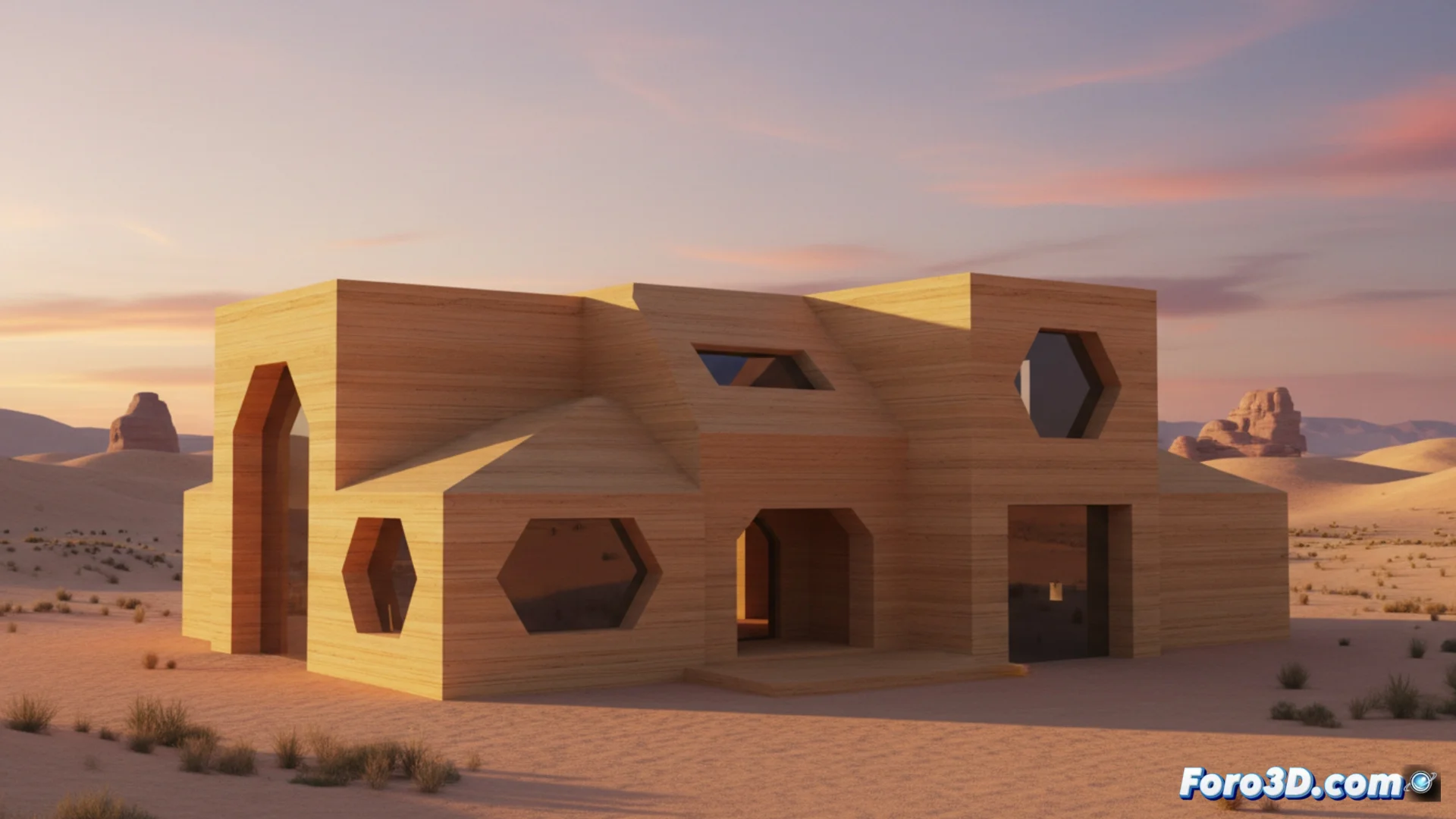
The Tùr House project explores building homes with 3D printed sand
Barry Wark Studio presents a speculative architectural investigation called Tùr House. This conceptual work analyzes the possibility of manufacturing a residential home using 3D printed sand modules. The central idea consists of assembling these three-dimensional blocks to form a complete structure, although the precise method to produce them is not yet clearly defined. 🏗️
A modular system to transform living spaces
The proposal is based on a modular concept where each 3D printed sand block acts as an independent building piece. This approach allows residents to easily modify their home if their needs change. The system aims to be adaptable and reusable, which would enable dismantling the building, altering its internal layout, or replacing components using local resources. By using sand, a material abundant in many regions, the process seeks to be more sustainable and economically accessible.
Key advantages of the modular design:- Spatial flexibility: Modules can be added, removed, or rearranged if the family grows or requires a different use of the space.
- Waste reduction: The structure is not permanent; it can be dismantled and relocated, minimizing waste associated with conventional construction.
- Sustainability: Using local sand as the main raw material aims to reduce the environmental footprint of the building process.
This speculative project initiates a dialogue on how 3D printing technology and local materials can transform the way we build.
An investigation imagining the future of construction
Barry Wark Studio emphasizes that Tùr House is a speculative investigation. This implies that it explores a future idea without confirming its technical or economic viability in the short term. The main objective is to promote a conversation on how to innovate in the construction sector, challenging the current model that often generates a lot of waste and is inflexible. Although it is a conceptual project without a physical prototype built, it serves to visualize solutions that could make housing more versatile and environmentally friendly.
Characteristics of the speculative investigation:- Futuristic focus: Studies long-term possibilities without guaranteeing immediate application.
- Debate promotion: Seeks to inspire discussions on new construction methods and materials.
- Conceptual visibility: Prioritizes presenting an innovative vision on sustainability and adaptability in architecture.
Challenges and realistic perspectives
Of course, the biggest practical challenge remains how to ensure the durability and stability of a sand-based structure, guaranteeing it withstands weather conditions. This is a detail that the speculative investigation is likely still analyzing. The Tùr House project offers an innovative and provocative vision for future construction, highlighting the potential of 3D printing and the circular economy, although its concrete realization is not yet confirmed. 🏠