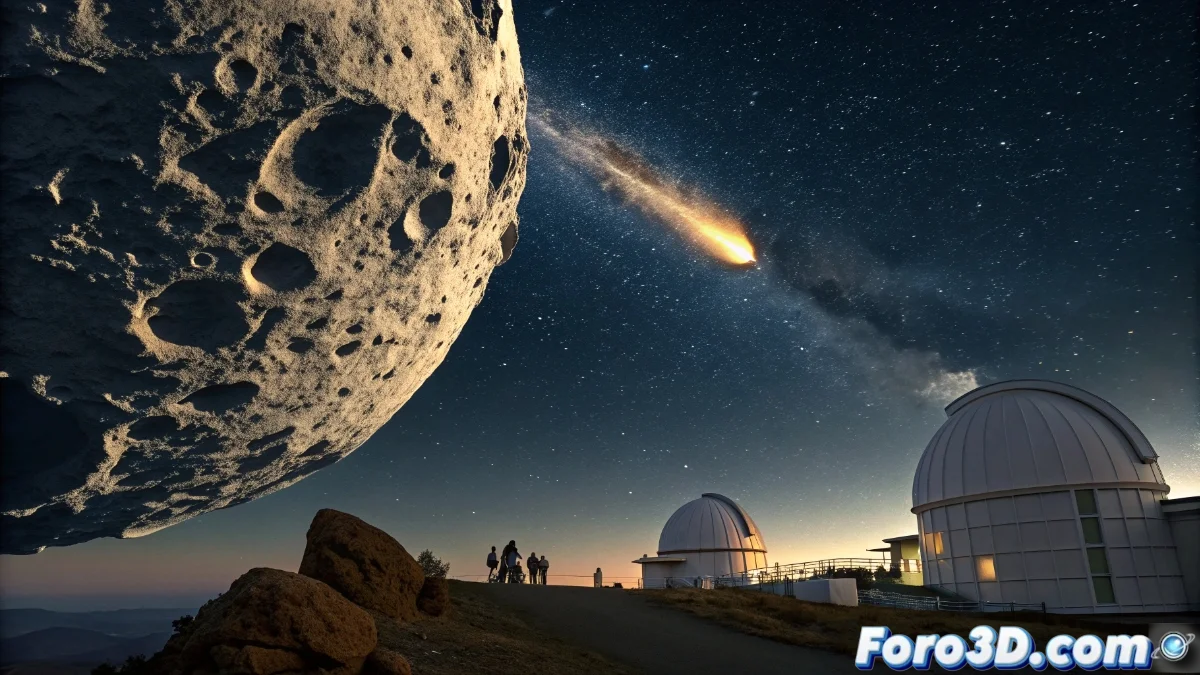
The Torino Scale and Planetary Defense by Richard Binzel
When celestial objects approach our planet, astronomers use the Torino scale as a fundamental tool to quantify and communicate the risk of collision. This classification system, developed by scientist Richard Binzel, integrates in an accessible way both the statistical probability of impact and the potential kinetic energy that the asteroid would carry, establishing categories from zero risk to certain collisions with catastrophic consequences 🌍.
Scientific Trajectory in Planetary Protection
Richard Binzel has dedicated five decades to researching asteroids and comets, specializing in planetary defense strategies. In an interview with New Scientist, the expert recounts how his work has transitioned from basic astronomical observation to actively participating in space missions aimed at altering trajectories or fragmenting dangerous objects. His legacy goes beyond the creation of the Torino scale, including the promotion of global monitoring systems that catalog and track thousands of celestial bodies annually, optimizing our preparation against imminent threats 🚀.
Key Contributions of Binzel:- Development of the Torino scale for comprehensive risk assessment
- Implementation of international tracking and cataloging programs
- Collaboration on space missions for asteroid deflection
"Sometimes it seems like the universe throws stones at us to see if we're paying attention, and thank goodness we have people like Binzel looking at the sky with a scoring system instead of just crossing our fingers"
Technology and Evaluation of Cosmic Threats
Precision in risk assessment has improved exponentially thanks to innovations in high-resolution telescopes and advanced computational models. Binzel emphasizes that, while most asteroids pose minimal danger, the Torino scale allows resources to be focused on those with significant destructive potential. Multilateral cooperations have strengthened planetary defense mechanisms, synchronizing data from space agencies and observatories to respond swiftly to verified alerts ⚡.
Implemented Technological Advances:- Next-generation telescopes for early detection
- Predictive computational simulations of trajectories
- Real-time data exchange platforms
Future Perspectives in Planetary Defense
The continuous evolution of monitoring systems and interception missions shapes a hopeful landscape for planetary security. The integration of artificial intelligence in data analysis and the development of innovative deflection techniques represent the next challenges in this field. The pioneering work of researchers like Binzel lays the foundation for humanity to face cosmic eventualities with scientific preparation, transforming uncertainty into actionable protocols 🌠.