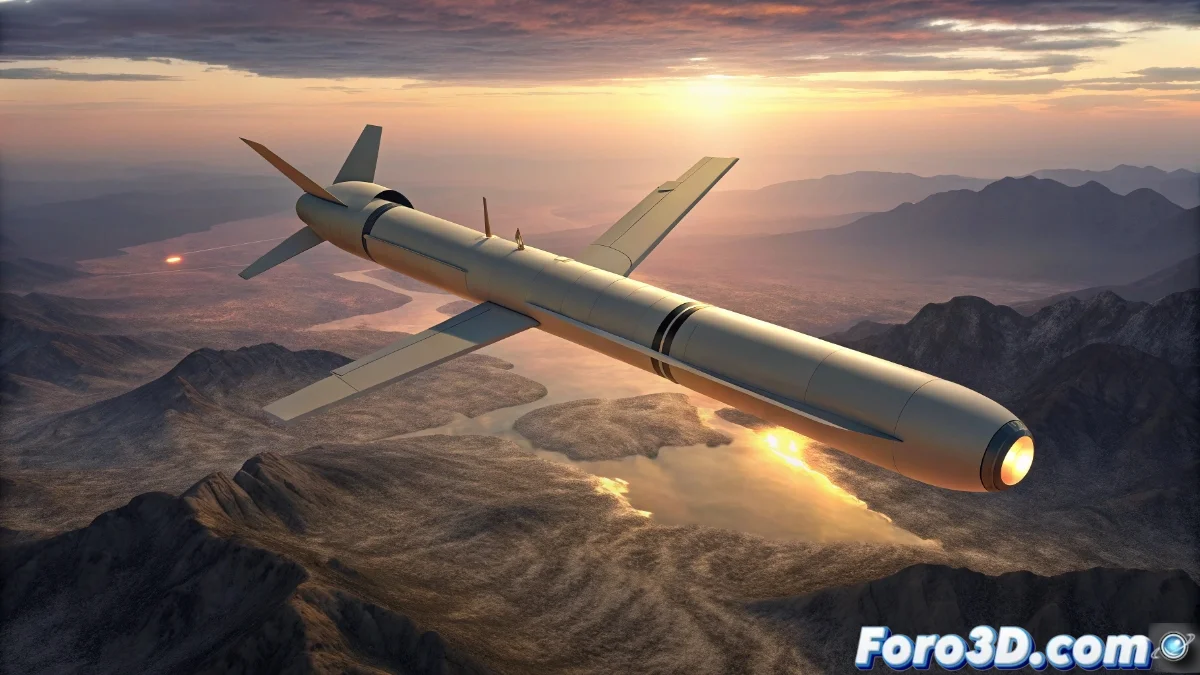
The Tomahawk Missile: Complete Guide to 3D Modeling
The Tomahawk represents one of the most versatile weapon systems currently in operation, specifically designed for precision strikes against land targets from naval platforms. Its ability to be launched from both submarines and surface ships makes it a fundamental element in modern military operations 🚀.
Fundamental Technical Characteristics
This subsonic cruise missile features variable dimensions depending on the specific configuration, with lengths between 6.2 and 6.6 meters and a constant diameter of 0.52 meters. The takeoff weight fluctuates between 1.3 and 1.5 tons, primarily influenced by the booster propellant and the type of warhead selected. Its operational range spans from 900 to 1,350 nautical miles, although the most advanced versions like the Block IV/B significantly exceed 1,000 kilometers with classified capabilities.
Flight Specifications and Payload:- Subsonic cruise speed between Mach 0.7 and 0.8
- Conventional unitary warhead or submunition configuration
- Ability to reorient in mid-flight toward alternative targets
The precision of the Tomahawk lies in its sophisticated integration of navigation systems, allowing impacts with minimal margin of error even at extreme distances.
Navigation and Guidance Systems
The effectiveness of the Tomahawk is based on a complex guidance system that combines multiple complementary technologies. The inertial navigation (INS) provides the base, while GPS continuously corrects the trajectory. The TERCOM and DSMAC systems enable terrain recognition and final adjustments to reach the target with extraordinary precision, even in adverse conditions or against moving targets 🎯.
Guidance System Components:- Inertial measurement unit for autonomous navigation
- GPS receiver for real-time position corrections
- Terrain correlation radar (TERCOM) for altimetric adjustments
- Digital scene matching area correlator (DSMAC) for visual recognition
Essential Considerations for 3D Modeling
When creating three-dimensional representations of the Tomahawk, it is crucial to faithfully capture its characteristic morphology. The main cylindrical body must include the foldable wings and stabilizers in post-launch deployment configuration. Details of the engine intake grids for the turbofan engine and coupling mechanisms for vertical launch systems (VLS) or submarine tubes require special attention to achieve visual authenticity. Differences between variants significantly affect dimensions and overall profile, particularly regarding the launch booster and warhead configuration 💻.
Critical Elements for Realism in 3D:- Exact geometry of the cylindrical fuselage with smooth transitions
- Wing and stabilizer deployment mechanisms
- Surface details such as access panels and sensors
- Visual differentiation between main variants
Applications and Final Reflections
Precise 3D models of the Tomahawk find application in flight simulations, audiovisual productions, and specialized technical studies. This weapon system's ability to deliver payloads at continental distances with metric precision represents a technological milestone, although its destructive power reminds us of the importance of using these representations with ethical responsibility for educational or training purposes. The combination of exact technical data with artistic skills allows virtually recreating this formidable instrument of modern defense 🎨.