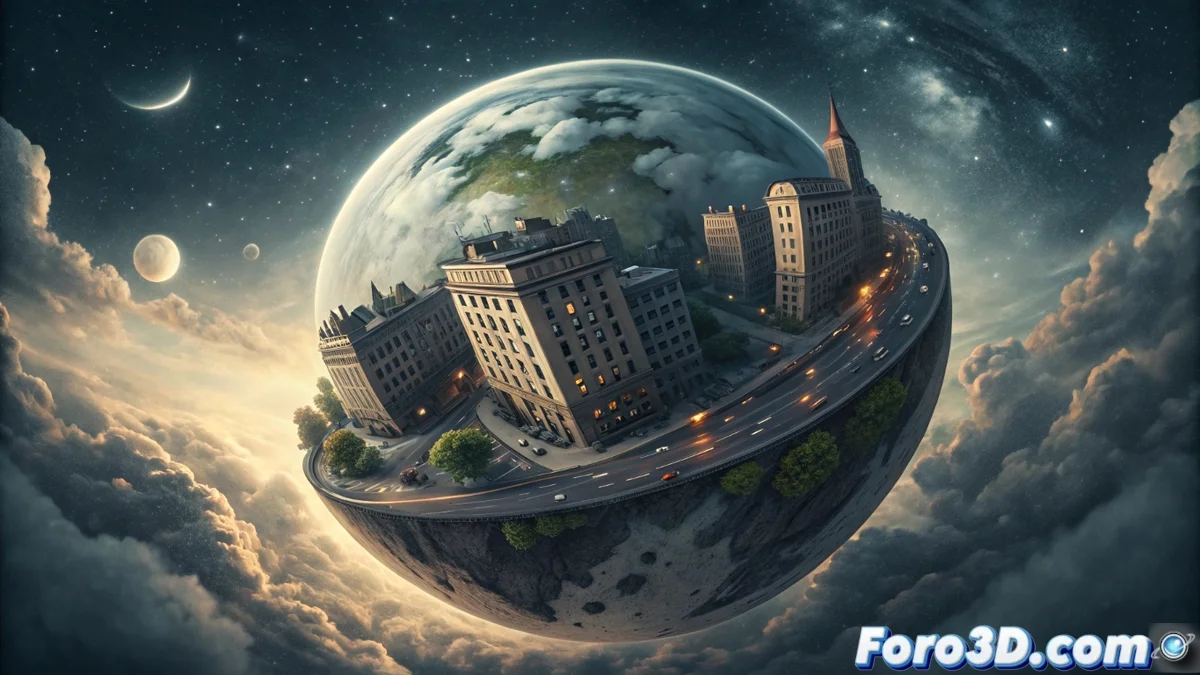
The Tiny Planet Effect in Digital Photography
Technically known as stereographic projection, the tiny planet effect is a fascinating visual manipulation that folds a complete panoramic scene onto itself. The final result is a compact and dreamlike sphere, where the horizon becomes the boundary of a small world to explore. 🪐
Practical Guide to Creating Your Planet
The process begins with the essential capture: a 360-degree panoramic photograph. Once obtained, the next step is editing. You can use professional applications like Adobe Photoshop or take advantage of free online editors, such as the one in Google Photos. The key lies in applying distortion filters, specifically those that allow spherization or extreme curvature of the image.
Fundamental Steps to Follow:- Panoramic Capture: Use your camera or smartphone's panoramic mode, rotating around yourself to cover the entire surroundings without cuts.
- Import and Prepare: Upload the image to your editing software. Ensure that the left and right edges visually match for a perfect closure.
- Apply the Transformation: Search for and apply the polar or spherical coordinates filter. This is the heart of the effect, which will join the ends of your photo into a circle.
The magic of tiny planet lies in transforming the ordinary into an extraordinary miniature, a universe contained in a single frame.
Creative Advantages and Applications
Beyond its playful appearance, this technique is a powerful compositional tool. It allows revealing details and symmetries that go unnoticed in the linear panoramic view, such as patterns in a cloudy sky or the repetitive geometry of an architectural facade. It is ideal for creating impactful visual content on social platforms, standing out from the constant flow of conventional images.
Key Benefits for Photographers:- New Perspective: Offers a completely novel view of familiar scenes, blending reality and fantasy.
- Highlighting Details: Focuses attention on central textures and structures, giving them spherical prominence.
- Accessible Experiment: Both amateurs and professionals can experiment with surprising results without expensive equipment.
Considerations and Common Challenges
Although the process is simple in theory, practice can yield unexpected results. A common mistake is getting a "twisted planet" or one with a visible seam, which more closely resembles a homemade unidentified flying object. This is usually due to an incomplete initial panorama or imperfect alignment during editing. Patience and several adjustment attempts are the best allies for mastering this creative distortion technique and achieving that perfect and captivating little world. 🌍