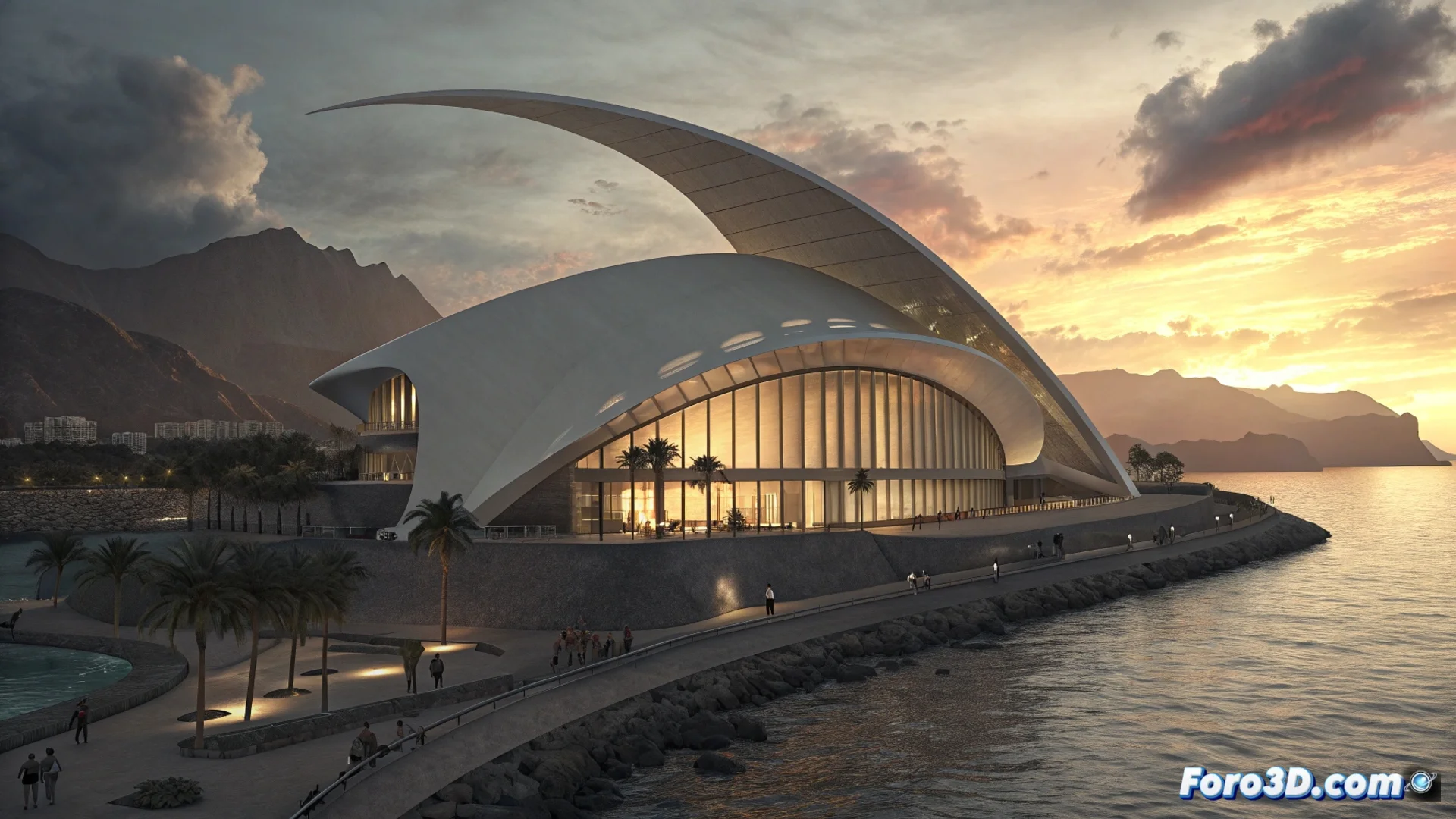
The Tenerife Auditorium: an iconic design that was never completed
The Adán Martín Tenerife Auditorium dominates the Santa Cruz skyline with its unmistakable silhouette. Its curved roof, which many interpret as a wave or a wing, is the visual identity of the city. However, few know that the building standing today is only a fraction of the architectural vision that Santiago Calatrava conceived and which won an award in 1991. 🏗️
The original project: symmetry and balance
Calatrava's initial idea featured a perfectly symmetrical composition. The famous roof we know today would have been paired with an identical second structure. This twin visor was not designed to move, but to act as a visual and formal counterweight, harmoniously closing the architectural gesture. The concept sought a balance that transcended mere functionality.
Key elements of the award-winning design:- Two large identical structural wings in shape and size.
- A closed and balanced composition, where each part complemented the other.
- A fixed visor that completed the iconic image, beyond its practical use.
The auditorium built between 1997 and 2003 represents only part of the architect's original idea.
The built reality: budget vs. vision
During the process to execute the work, economic limitations forced a rethinking of the project. The final decision was to completely eliminate the second symmetrical wing. This radically transformed the structural and formal proposal, resulting in the asymmetrical profile that defines the city today. Although the auditorium's interior functions optimally, with its two main halls and excellent acoustics, from a pure design perspective, the building remains incomplete.
Consequences of modifying the design:- The visual balance and original compositional intent were lost.
- The building went from being a closed form to an open and asymmetrical gesture.
- A contrast was created between its functional success and its structural incompleteness compared to the plans.
A symbol with one wing less
This story explains why, despite having become the undisputed symbol of Tenerife, there is always a lingering feeling that the auditorium is missing something. Some suggest that when strong wind blows from the sea, the structure seems to try to deploy that companion wing that was never built. Thus, the Tenerife Auditorium remains a powerful reminder of how practical constraints can shape, and even truncate, an artist's integral vision. 🌀