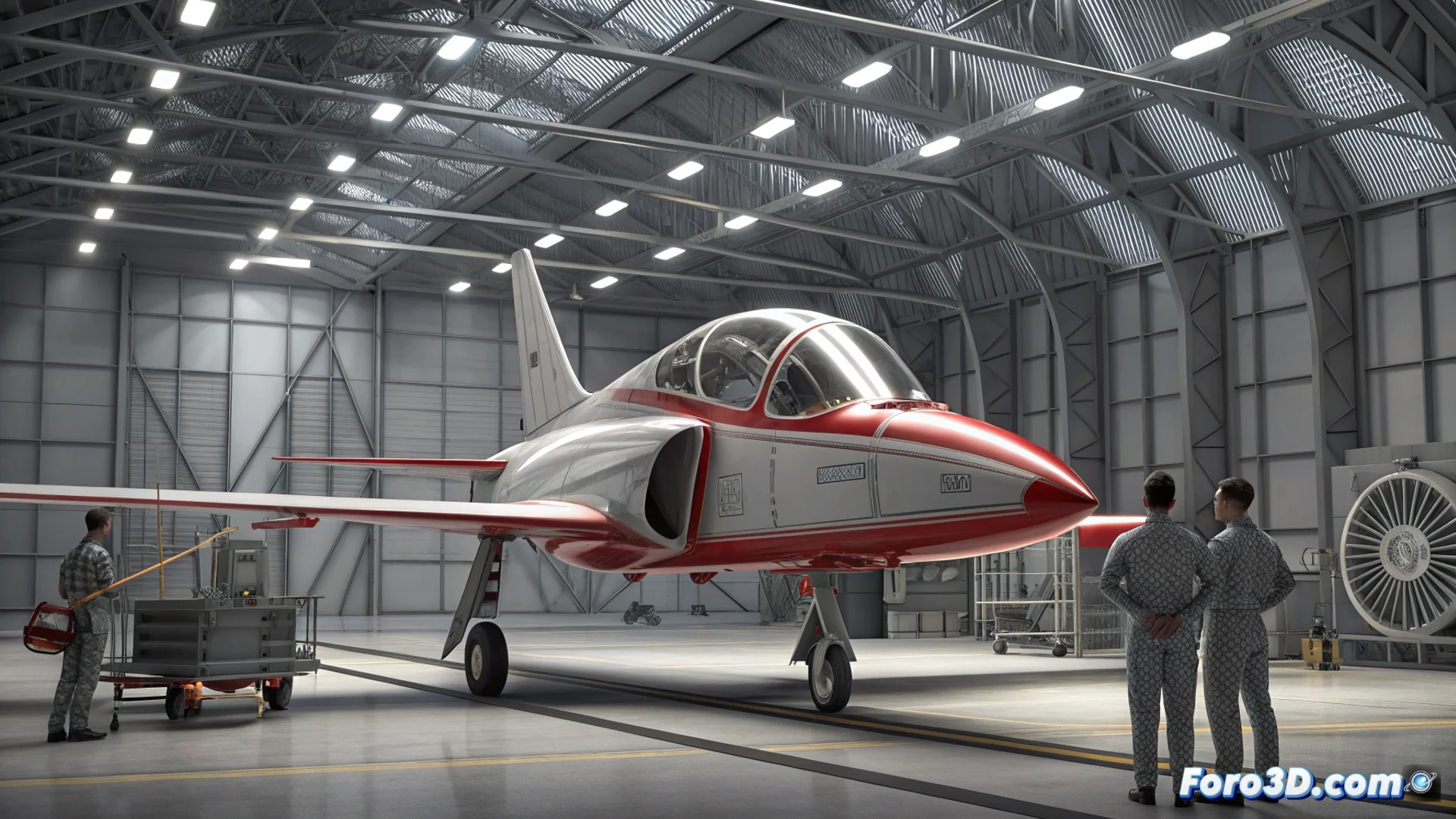
The T-7A Red Hawk Accelerates Its Development with Additive Manufacturing
Additive manufacturing is changing how modern military aircraft are built. A flagship case is the T-7A Red Hawk, an advanced training aircraft designed by Boeing and Saab for the U.S. Air Force. This project demonstrates the power of fully integrating digital design and physical production. ✈️
A Fully Digital Approach from the Start
The engineering team created and tested the aircraft in a unified simulation environment before manufacturing any physical components. This method allows producing over 90% of the parts for assembling the aircraft and the assembly tools with 3D printers. The result is an 80% reduction in the time needed to develop the aircraft, compared to conventional processes.
Key advantages of the digital process:- Integrate design and production into a single continuous workflow.
- Test and validate components in high-performance virtual simulations.
- Avoid building metal molds and fixtures, which are costly and slow to manufacture.
Additive manufacturing streamlines the design and testing cycle, significantly shortening delivery timelines.
Technical Benefits of Manufacturing Tools with 3D Printing
Using 3D printing for tooling provides concrete technical advantages. Complex internal geometries can be manufactured that would be nearly impossible to machine with subtractive techniques. The composites used have the necessary strength to withstand the rigorous aircraft assembly process.
Impact on production:- Create intricate shapes that optimize tool functionality.
- Reduce the number of individual parts needed for each assembly.
- Simplify supply chains by relying less on external suppliers for specialized components.
Conclusion: A New Paradigm in the Industry
The T-7A Red Hawk project sets an important precedent for the aerospace industry. It demonstrates that it is possible to deliver an advanced training aircraft in record time without compromising quality standards. The future of aircraft manufacturing may depend less on traditional nuts and bolts, and more on optimizing the digital data flow and the precision of 3D printers. 🚀