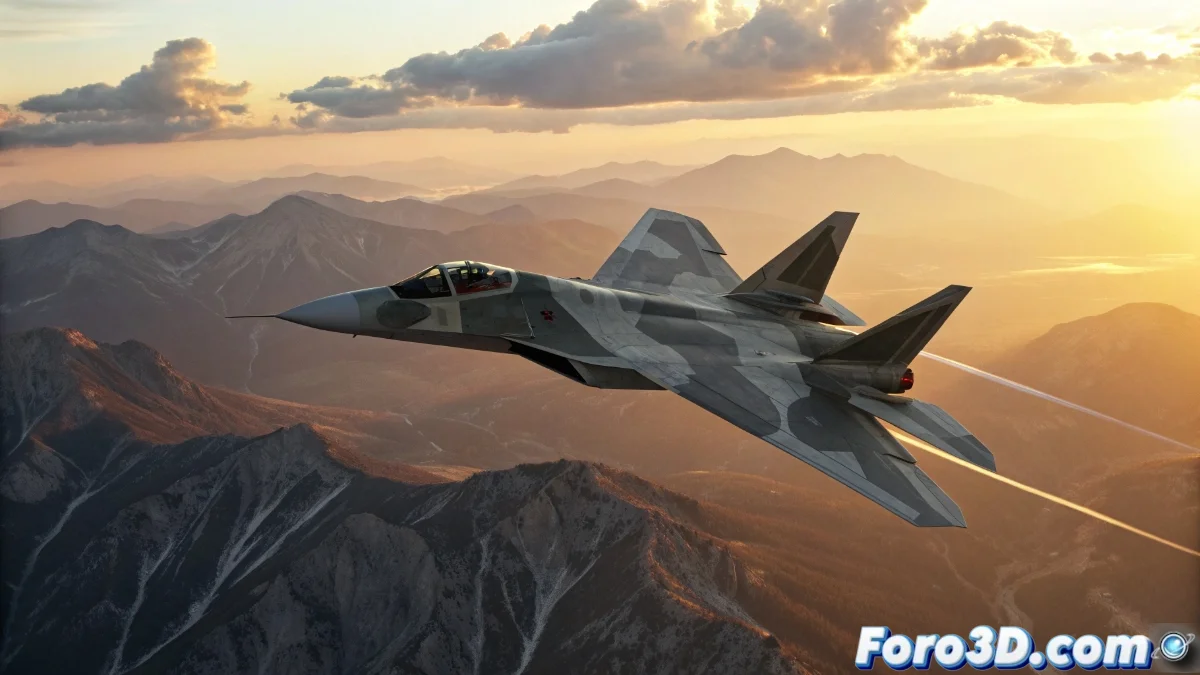
The Sukhoi Su-57 Felon: Technical Analysis and 3D Modeling Guide
The Sukhoi Su-57 Felon represents the spearhead of Russian military aviation, embodying the fifth generation of stealth-capable fighters that compete with the best Western developments. Its dimensions of 19.8 meters in length, 13.95 meters in wingspan, and 4.74 meters in height have been meticulously optimized to achieve an exceptional aerodynamic profile in air superiority missions. ✈️
Technical Features and Advanced Design
The Su-57's design incorporates leading edge root extensions (LERX) that significantly enhance maneuverability during high angle-of-attack maneuvers. Its twin-engine configuration with three-dimensional thrust vectoring provides unprecedented agility in close-quarters combat, while the internal weapons bays preserve its stealth characteristics by keeping missiles hidden during cruise flight. 🛡️
Key Design Elements:- Wings with LERX for high maneuverability in close combat
- Separate engines with 3D thrust vectoring nozzles
- Internal bays that maintain the stealth profile during flight
The integration of stealth technologies with thrust vectoring capabilities makes the Su-57 an exceptionally versatile combat platform
Weapons Systems and Combat Capabilities
The Felon's arsenal includes a 30 mm GSh-30-1 automatic cannon for close-range engagements, complemented by a wide range of advanced air-to-air missiles. Among these stand out the medium-range R-77M missiles and the short-range R-74M2 missiles, which can be deployed from the internal bays to maintain stealth during missions. These systems are integrated with sensors and avionics that enable multiple target tracking, ensuring precise attack capabilities in both BVR (beyond visual range) environments and dogfights. 🎯
Weapons System Components:- GSh-30-1 cannon for close combat
- R-77M missiles for medium range
- R-74M2 missiles for short-range engagements
Critical Aspects for Accurate 3D Modeling
To create an authentic 3D model of the Su-57, it is essential to capture the geometry of its composite surfaces, specifically designed to reduce radar reflectivity. The wing edges and curved air intakes require special attention to detail to faithfully replicate their stealth design. The weapons bays must be modeled with realistic opening mechanisms, and the engine arrangement with 3D thrust vectoring nozzles needs texturing that simulates high-temperature resistant materials. Including elements like the LERX and the elongated fuselage will help convey its aggressive and functional profile. 🎨
Final Considerations for 3D Artists
Despite its advanced technology, the Su-57 still relies on the pilot's skill to avoid bird strikes, a reminder that even the most sophisticated thrust vectoring has practical limitations. For 3D modelers, capturing this duality between cutting-edge technology and human factors is essential to create authentic representations that communicate both the technical capabilities and the operational realities of this formidable fifth-generation fighter. 💻