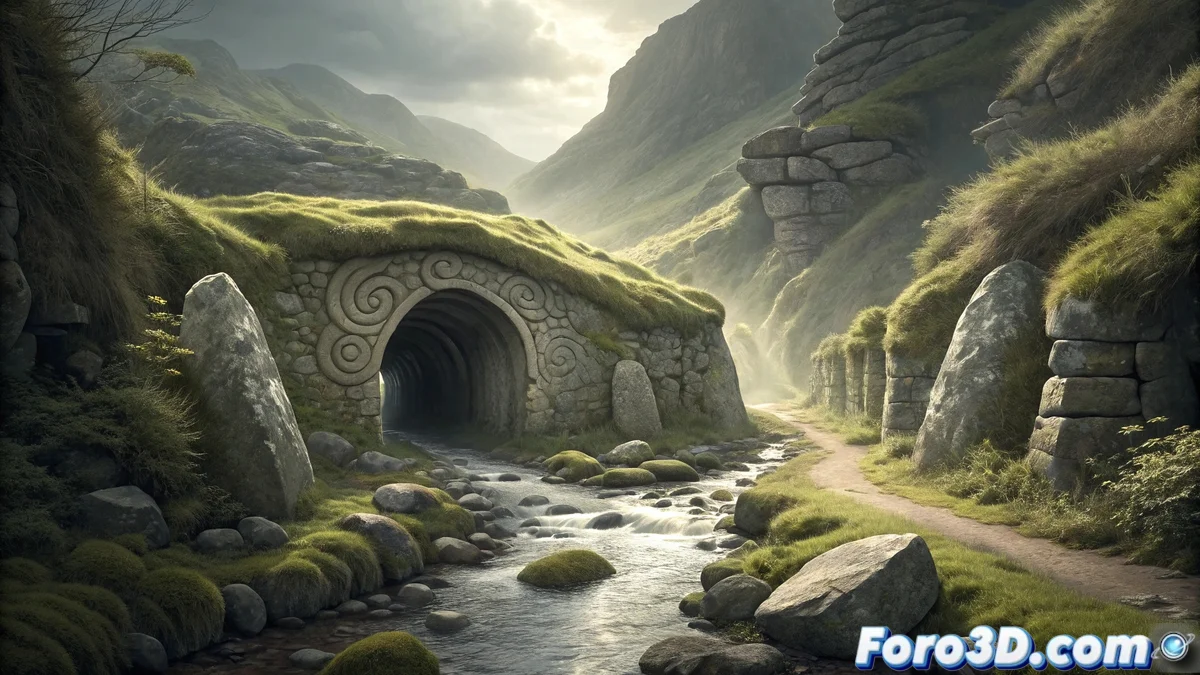
The Growing Stone Tunnel: Scottish Mystery and Blender Recreation
In the Scottish Highlands hides a fascinating structure that defies the laws of physics: a stone tunnel that, according to local records, has been slowly expanding since the 18th century. Originally built as a passage for a stream under a hill, this traditional masonry work has become a geological enigma that has captured the imagination of generations. 🏴
Historical Origins and Development of the Mystery
The initial construction dates back to the 18th century, when the region's inhabitants adapted a natural drainage system using local stone and traditional Scottish techniques. The tunnel featured a completely ordinary design until, during the 19th century, inexplicable reports began to emerge about its anomalous behavior. Farmers and surveyors documented measurements showing constant increases in the length of the underground passage, giving rise to the legend that endures to this day.
Key Characteristics of the Phenomenon:- Documented expansion of approximately 30 centimeters between 1890 and 1910 according to community records
- Minimal but constant increases in each annual measurement taken
- Local theories about the stone developing a "hunger for space" and autonomous growth capacity
"The stones of these lands have memory and will of their own - this tunnel is living proof that what we call inanimate can have more life than we think" - Highland Elder
Cultural Significance and Folkloric Legacy
The legend has deeply integrated into Scotland's collective imagination, representing the mysterious connection between rural communities and their natural environment. The fear that the tunnel may eventually extend to engulf the nearest village reflects deep cultural anxieties about humanity's relationship with natural forces it cannot control.
Cultural Manifestations of the Myth:- Numerous oral stories passed down through generations
- Poems and songs exploring the theme of living and relentless nature
- Strengthening of regional identity as a territory where the ordinary and the supernatural coexist
Project Preparation in Blender
To recreate this phenomenon in a 3D environment, we begin by setting up Blender with metric units and realistic scale to maintain dimensional coherence. Filmic color mode provides the necessary dynamic range to capture the characteristic misty atmosphere of the Highlands. The initial setup includes removing default elements and setting Cycles as the render engine for maximum realism in materials and lighting. 🎨
Modeling the Structure and Terrain
The modeling process begins with a subdivided plane that uses the Displace modifier with Perlin noise texture to generate the natural hill. The stream's path is defined by a Bezier curve, over which we extrude an irregular stone profile. The Solidify modifier adds realistic thickness to the walls, while sculpt mode with brushes like Clay Strips and Crease adds organic textures that suggest the gradual growth described in the legend.
Advanced Modeling Techniques:- Controlled variations in tunnel diameter to simulate progressive expansion
- Manual sculpting to create textures suggesting "living" growing stone
- Geometry optimization to maintain performance during the creative process
Lighting and Materials System
The lighting recreates the cloudy Scottish weather using Sky Texture with high turbidity and low intensity. Strategically placed point lights at the tunnel ends create the characteristic mysterious depth effect of the place. Stone shaders use Principled BSDF with noise texture and musgrave texture connected to roughness and normal for visually convincing eroded and wet surfaces.
Realistic Material Development:- Mixing multiple grayish colors using Mix Shader nodes
- Vertex painting to add moss in low-light exposure areas
- Subsurface scattering shaders to simulate moisture and vegetation
Special Effects and Rendering Process
Light volumetrics with Principled Volume create a subtle mist that emphasizes the tunnel's supernatural nature. The growth animation is achieved through frame drivers that modify noise parameters in the stone materials. The render setup includes AOV passes like mist, normal, and position for advanced post-processing in the Compositing node editor, where we apply color grading with cool tones and contrast adjustments to enhance the mysterious atmosphere. ✨
Conclusion and Final Reflections
This project demonstrates how local legends can become inspiration for sophisticated digital creations. The growing Scottish tunnel represents not only a historical enigma, but also an opportunity to explore advanced 3D visualization techniques. As oral tradition aptly notes, sometimes stones show more growth ambition than many half-abandoned Blender projects - a perfect metaphor for creative persistence in the digital design world. 🌄