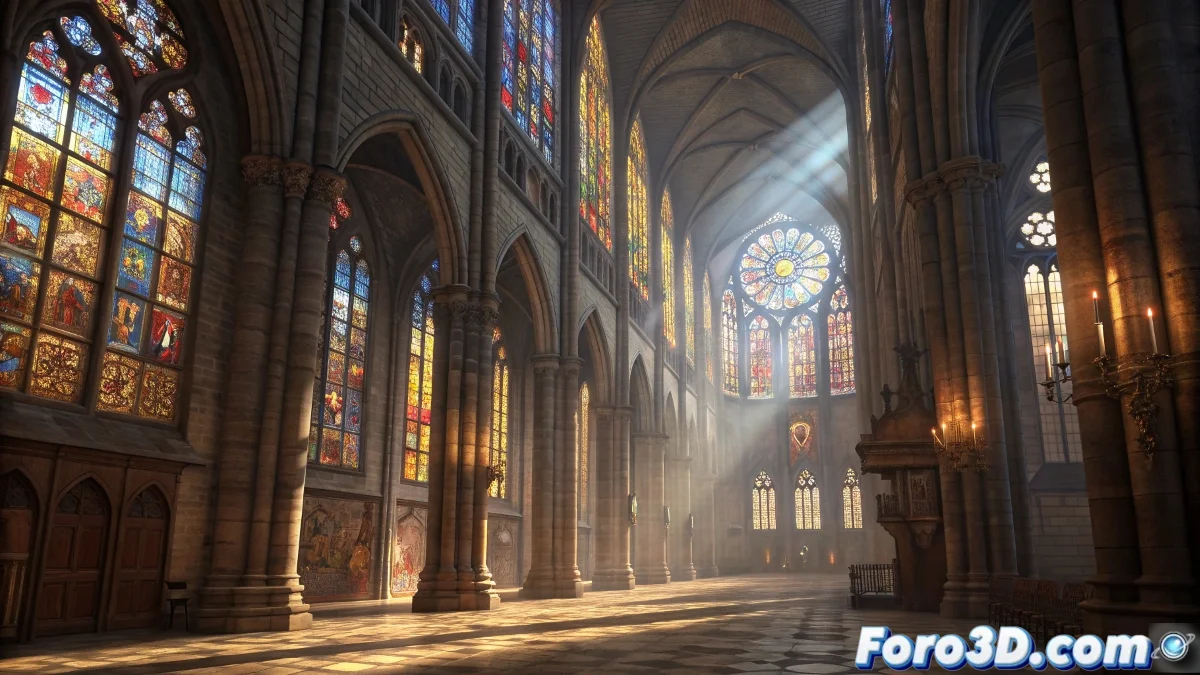
When Light Becomes a Prayer of Colors
The Cathedral of León, known as the Pulchra Leonina, houses one of the most dazzling treasures of world Gothic: more than 1,800 square meters of stained glass windows that transform natural light into a unique spiritual and artistic experience. 🎨 This ensemble, created between the 13th and 14th centuries, not only decorated the sacred space but also functioned as a Bible of the poor, narrating sacred stories through a visual language that everyone could understand, regardless of their literacy. For 3D artists, recreating these stained glass windows in Blender represents the ultimate challenge of capturing not only shapes and colors, but an entire philosophy of light and color that has inspired generations.
The Technique That Defied Gravity and Time
The Leonese stained glass windows are a masterclass in medieval engineering applied to art. Each panel, composed of thousands of pieces of colored glass joined by lead profiles, is a perfect balance between apparent fragility and proven resistance over centuries. 🔨 What is extraordinary is how medieval artisans understood the properties of light and color decades before optics became a formal science. Cobalt blue for divinity, intense red for passion, hopeful green, and celestial gold were not casual aesthetic choices, but a codified chromatic language that every medieval believer understood instinctively.
Most Emblematic Stained Glass Windows of the Ensemble:- Virgen del Camino with blue and red tones and Marian scenes
- Last Judgment: dramatic composition on the western facade
- Apostles and Prophets: gallery of figures with identifying attributes
- Noble Donors: integration of heraldry into sacred narrative
Blender Recreation to Capture the Luminous Magic
Recreating these stained glass windows in Blender goes beyond precise modeling; it's about capturing the very essence of how light interacts with colored glass to create a complete sensory experience. ?The key is understanding that each stained glass window is not a static object, but an optical instrument that transforms white light into chromatic narrative. Blender materials must simulate not only the transparency of the glass, but also its density, imperfections, and that almost liquid quality that light has when passing through centuries-old crystals.
Practical Guide from Basic Plane to Gothic Stained Glass
The process in Blender begins with the methodical decomposition of each stained glass window into its basic components: glass pieces and lead profiles. The modeling must reflect the organic irregularity of medieval handwork, where no piece is perfectly geometric. 🏰 Material application requires special attention to transmission and refraction properties, recreating how light not only passes through the glass, but is modified in its journey. Lighting is the element that finally brings the entire ensemble to life, transforming static 3D models into dynamic luminous experiences.
Essential Workflow in Blender:- Modeling of glass pieces with organic subdivisions
- Creation of lead profiles with precise geometry
- Development of glass materials with advanced PBR properties
- Setup of dynamic lighting and volumetric effects
Materials and Nodes for the Science Behind the Beauty
The materials in this recreation do much more than define colors; they must capture the very physics of light interacting with translucent matter. The use of Principled BSDF with full transmission is just the starting point. 🔍 Roughness adjustments simulate the surface wear of centuries-old glass, while subsurface scattering recreates how light scatters within the glass thickness. Color nodes must reflect not only the base tones, but also the variations and imperfections that give historical authenticity to the recreation.
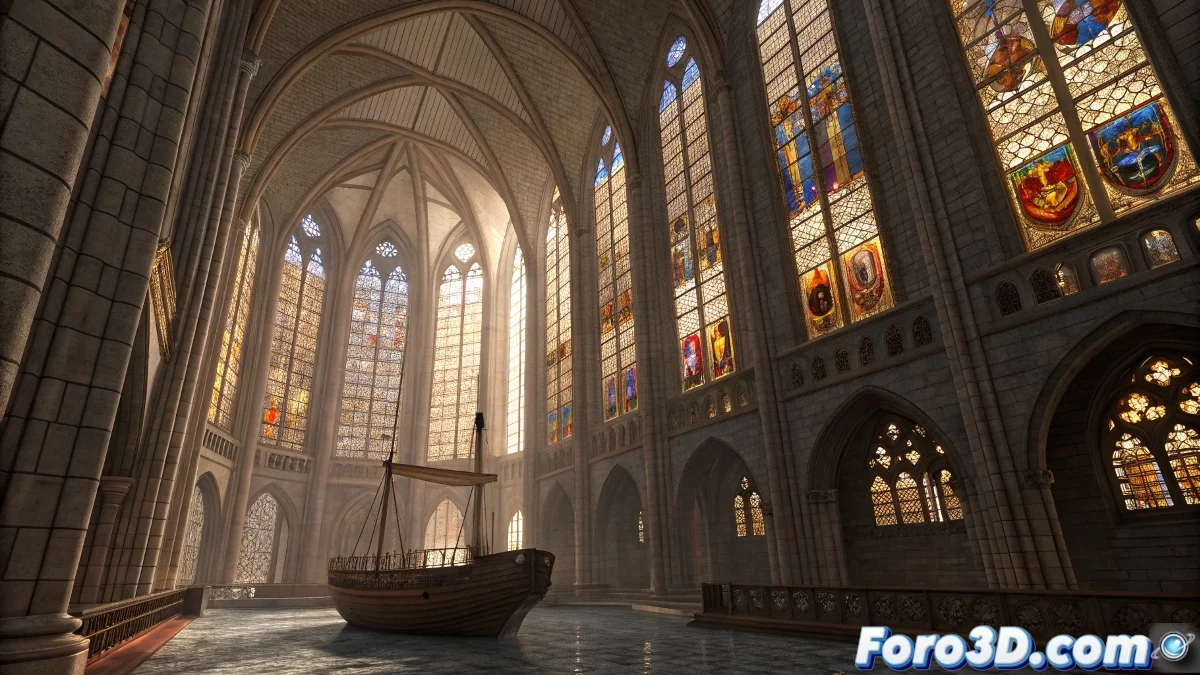
Lighting: When the Sun Becomes a Brush
The true magic of the Leonese stained glass windows occurs when natural light passes through them, and recreating this phenomenon in Blender is the heart of the project. The sun setup with variable trajectory allows simulating how the stained glass windows completely transform the interior space throughout the day. 💡 Volumetric effects add that tangible quality to the air that so characterizes sacred spaces, where beams of colored light seem to have physical substance. The projection of color patterns on floors and walls completes the illusion, demonstrating that stained glass windows are not passive objects, but active generators of atmosphere.
Advanced Techniques for Historical Realism:- HDRI setup for precise ambient lighting
- Texture nodes to simulate antique glass with bubbles and inclusions
- Particle systems for atmospheric dust in light beams
- Solar trajectory animation to show temporal changes
The Chromatic Cycle Recreating Time in 3D
One of the most fascinating features of the Leonese stained glass windows is their ability to create a color cycle that varies with the seasons and times of day. In Blender, this can be recreated through animations that show how the same stained glass windows project completely different colors and patterns at midsummer noon than at winter sunset. 🌅 This temporal dimension adds depth to the recreation, reminding us that Gothic art was not static, but deeply connected to the natural rhythms of the cosmos that mediated between the human and the divine.
Render and Post-Production in the Culmination of the Luminous Journey
The Cycles render phase must carefully preserve all the subtle interactions between light, color, and matter that make these stained glass windows unique. Sample management for complex transparencies, caustic handling, and preservation of the full dynamic range are crucial. 🎭 Post-processing can add those final adjustments that make the difference: selective enhancement of specific colors, careful contrast management, or even slight chromatic aberrations that suggest the organic quality of light filtered through antique glass.
Gothic stained glass windows do not merely let light pass through; they educate it, color it, and transform it into visible theology
Conclusion: Preserving Legacies in Pixels
The recreation of the stained glass windows of León Cathedral in Blender demonstrates how 3D technology can serve not only to create new art, but to preserve and understand ancient art in previously impossible ways. 🔮 This guide not only teaches modeling and rendering techniques, but invites deeper reflection on how medieval art understood and manipulated light as a metaphor for the divine. After all, in an era of screens and artificial light, we may need to remember that there was a time when natural light was the most prized artistic medium, and some artists knew how to master it with a skill that still leaves us breathless today. 😉