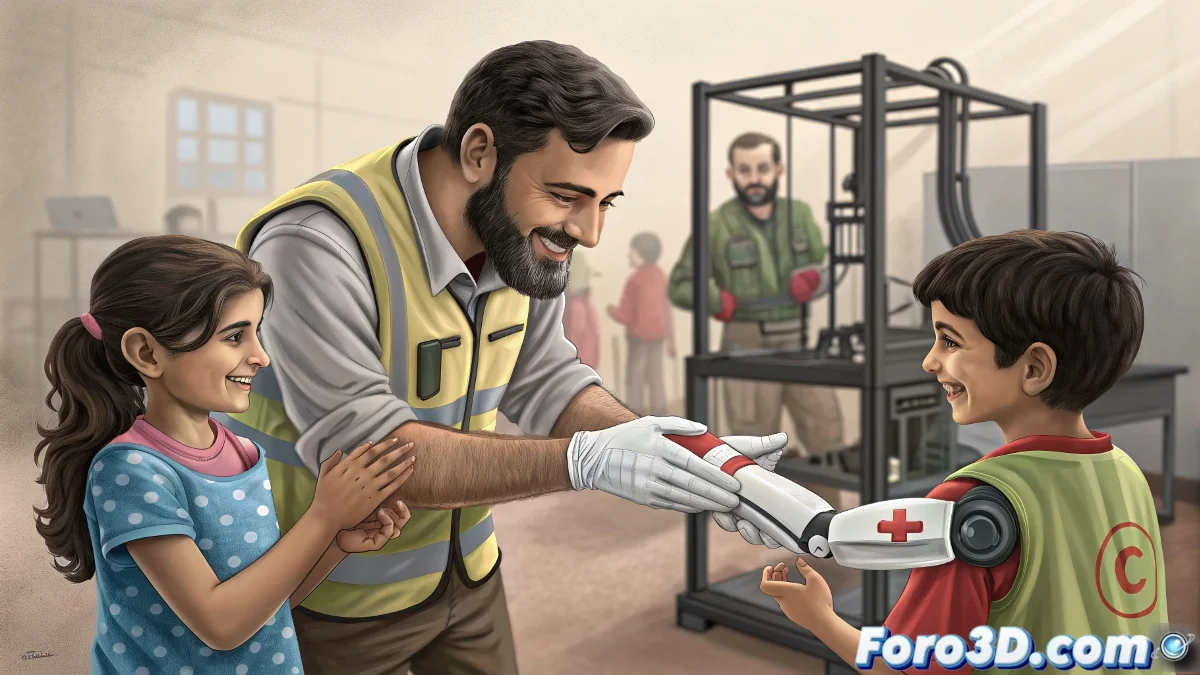
When 3D Printing Becomes a Solidarity Embrace for the Most Vulnerable
In the midst of one of the world's most complex humanitarian contexts, Spanish technology is building bridges of hope. The NGO Ayúdame3D, led by Guillermo Gauna-Vivas, has successfully delivered the first 3D-printed prostheses to amputee children in Gaza, demonstrating that digital manufacturing can transcend laboratories and workshops to become a tool for direct social transformation. Each prosthesis represents not only a functional device, but an international message of solidarity that challenges geopolitical barriers.
Ayúdame3D's work exemplifies how technical simplicity can generate the greatest humanitarian impact. Using basic 3D printers and conventional filament, the organization creates customized devices that restore autonomy to minors who have lost limbs in the conflict. What would be a makerspace project in privileged environments becomes a vital resource in Gaza that changes personal trajectories. Technology becomes humanized when it serves those who need it most. 🤝
In Gaza, a 3D-printed prosthesis is not just a medical device, it is a bridge to stolen childhood
The Logistics of Hope in Complex Environments
The delivery of these prostheses represents a logistical and diplomatic triumph as much as a technological one. Operating in Gaza involves overcoming monumental obstacles.
- Design adaptation for local conditions with limited resources and frequent power outages
- Training of local personnel in the use and maintenance of prostheses and printing equipment
- Coordination with humanitarian actors to ensure project continuity beyond one-time deliveries
- Exhaustive customization considering the specific needs of each child and their family environment
The choice of 3D printing is not casual: it allows creating custom prostheses at minimal costs, repairing them easily, and adapting them to the children's growth, something crucial in contexts where access to specialized medical care is limited.
The Impact Beyond the Physical
For these children, the prostheses represent the recovery of their autonomy and self-esteem. The benefits transcend the functional.
- Reintegration into school activities and games with peers
- Recovery of independence in basic daily tasks
- Reduction of social stigma associated with disability in traditional cultures
- Improvement in mental health by regaining control over their own body
Ayúdame3D's work demonstrates that appropriate technology—simple, accessible, and replicable—can have profound impacts where high-tech solutions would be unsustainable.
The Spanish Model Inspiring the World
This initiative positions Spain as a reference in the humanitarian application of 3D printing. Ayúdame3D's model is replicable and scalable.
While large corporations invest millions in next-generation bionic prostheses, this Spanish NGO demonstrates that low-cost solutions can change lives immediately. Its approach prioritizes access over technical perfection, immediacy over prolonged development, and local adaptation over global standardization. In a world of growing technological inequality, this model offers an alternative path. ❤️
And if a simple 3D printer can bring back a smile to a child in Gaza, perhaps the true technological advancement lies not in materials but in the will to use them for the common good... though Guillermo and his team probably prefer to keep printing solutions rather than speeches 😉
You can learn more about the topic: here