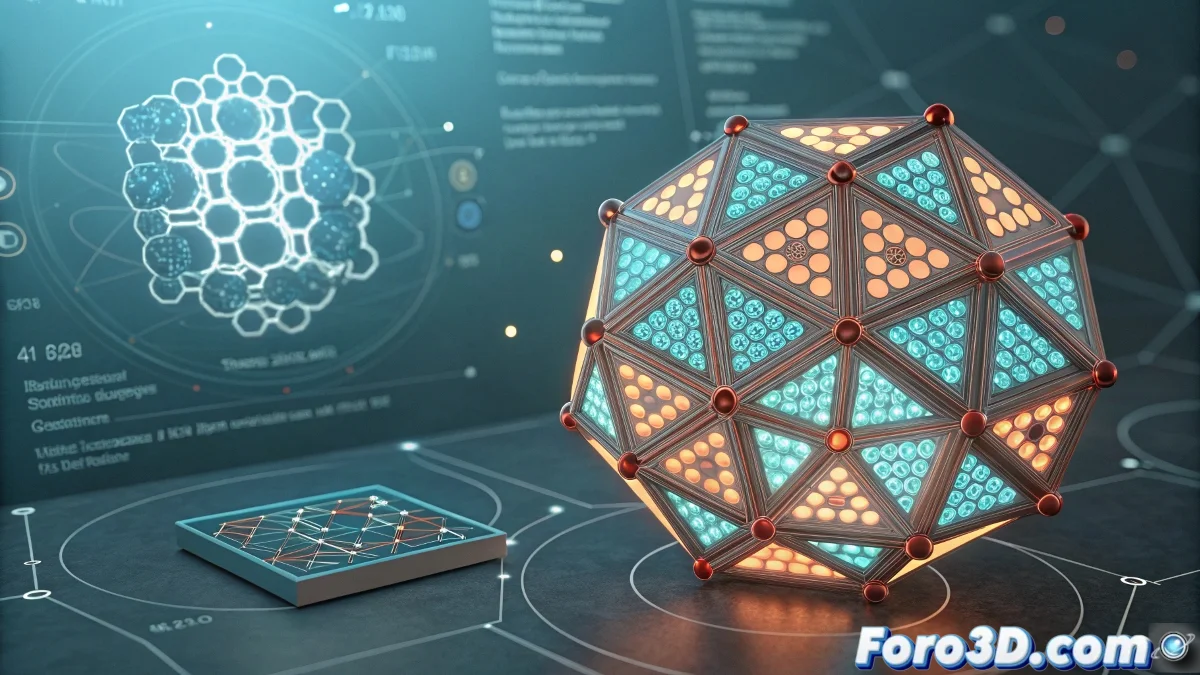
When Nature Breaks Its Own Design Rules
Quasicrystals have been the ugly duckling of materials physics for decades: they are not ordered crystals, nor amorphous glasses. 🌌 A new study has just revealed their surprising secret: these atomic structures with forbidden symmetries are actually more stable than we imagined. For 3D artists, this confirms that the most fascinating patterns are often the ones that break the rules.
Mathematics That Challenge the Grid
What makes quasicrystals unique:
- Order without repetition: Like a 3D Penrose tiling
- Impossible symmetries: Pentagonal and dodecahedral patterns
- Energetic efficiency: Stability where we previously saw only chaos
Inspiration for 3D Artists and VFX
In the 3D world, quasicrystals are pure gold:
- Procedural textures: Complex patterns that don't repeat
- Advanced shaders: Simulations of exotic materials
- Generative architecture: Designs that challenge classical symmetry
"Quasicrystals are proof that the universe has a random mode... but with style"
A Lesson for Designers
This discovery teaches us that:
- Perfection doesn't always mean repetition
- The "rules" of design are sometimes meant to be broken
- What seems chaotic can have hidden order
For 3D artists, quasicrystals are like that art teacher who told you "forget the rules and create": now we know that the universe follows that advice too.