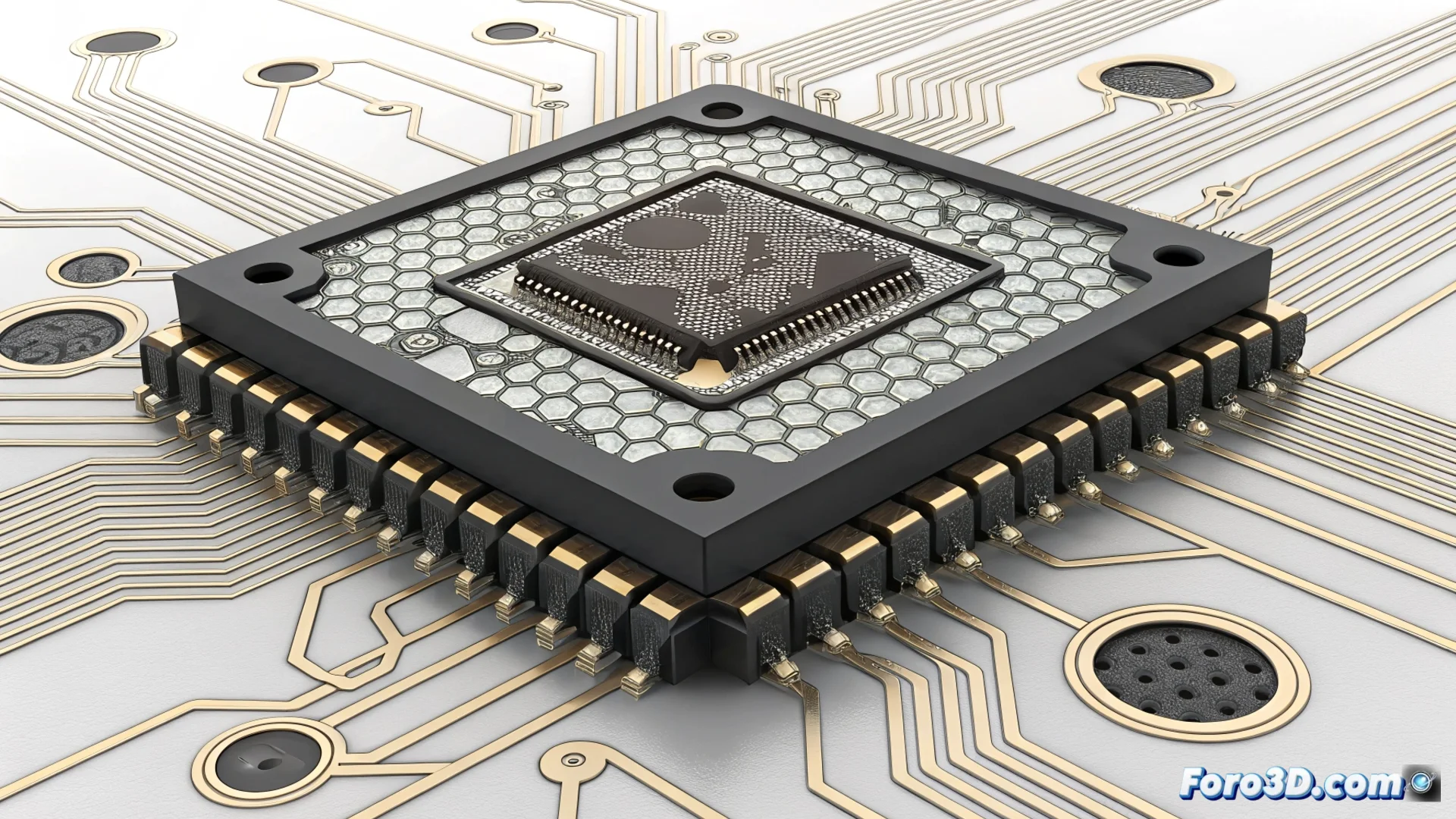
The Silicon Interposer, the Base that Connects Chiplets
At the heart of the most advanced processors is a passive but crucial component: the silicon interposer. This substrate does not process data, but functions as a complex electrical highway at a microscopic scale to join several chiplets within the same package. Its role is fundamental for creating powerful and efficient systems. 🧩
What is it and how does this key piece work?
Imagine a motherboard, but reduced to tiny dimensions and integrated directly into the processor package. That's an interposer. It is a silicon base on which different functional blocks are mounted, such as CPU cores, specialized accelerators, and stacks of HBM memory (High Bandwidth Memory). Its main task is to route the immense amount of electrical signals between these modules with maximum speed and minimum delay. This enables integrating components manufactured with different node technologies into a single system.
Main features of the interposer:- Passive function: It does not perform calculations, only interconnects.
- Microscopic scale: It houses thousands of connection paths in a minimal space.
- Technological integrator: It allows combining chiplets from 5nm, 7nm, and other nodes in a single package.
Without the interposer, modern chiplets would be like a metropolis of skyscrapers connected only by dirt roads; the bottleneck would nullify any advantage.
TSVs: the paths that make the magic possible
The technology that enables this dense interconnection is TSVs (Through-Silicon Vias). These are vertical conductors that completely pierce the silicon substrate of the interposer, creating direct electrical paths. These micro-vias offer extremely low latency and very high bandwidth to communicate the top part (where the chiplets are) with the bottom (which connects to the motherboard). Thousands of TSVs are organized in a dense matrix, forming the main interconnection network.
Key advantages of using TSVs:- Direct vertical connection: Eliminates the need for long and winding routes.
- High bandwidth: Essential for supplying data to processing cores and HBM memory.
- Low latency: Signals travel minimal distances, reducing wait times.
Essential enabler of chiplet-based architecture
The interposer with TSVs is the pillar that supports chiplet-based architecture. This approach allows dividing a large and complex processor design into several smaller and easier-to-produce chips. Then, the interposer unites them in a package that behaves as a single unit. This methodology not only improves performance during manufacturing, by having higher yields on small wafers, but also provides flexibility to mix and match silicon blocks designed with different technologies, thus optimizing cost and performance independently for each module. 🚀