When the Floor Hides Paths to the Divine
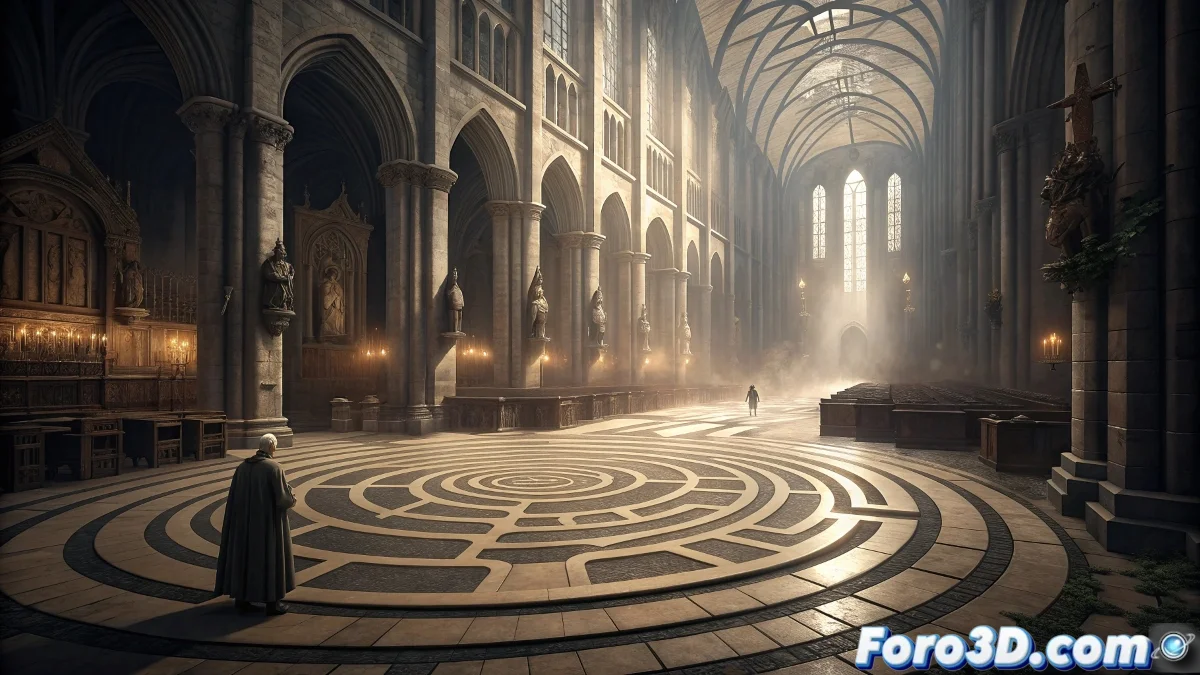
Beneath the majestic vaults of the choir of León Cathedral hides one of the best-kept secrets of Spanish Gothic: a labyrinth engraved in stone that has challenged the understanding of visitors and historians for centuries. This intricate design, modest in size, encloses a symbolic depth that transcends its physical appearance. 🌀 Representing the tortuous path of the soul toward salvation, each bend and turn seems to whisper lessons about earthly life and its trials. For 3D artists, this labyrinth offers the perfect challenge: capturing not just a form, but an entire medieval philosophy through digital modeling in Blender.
The Symbolism That Turns Stone into Prayer
Labyrinths in Gothic cathedrals were not mere architectural ornaments; they constituted active meditation tools for the clergy. The canons would traverse these patterns mentally or physically during their moments of contemplation, using each turn as a metaphor for the decisions and challenges of human existence. 📜 The León labyrinth, in particular, stands out for its strategic location under the choir, as if it wanted to remind the singers that even in the highest praise there is a personal path to tread. Its specific design follows patterns documented in medieval manuscripts, connecting it to a spiritual tradition that extended throughout Christian Europe.
Symbolic Elements of the Labyrinth:- Single path representing the uniqueness of the spiritual journey
- Twists and turns symbolizing trials and temptations
- Invisible center representing union with the divine
- Absence of bifurcations signifying no shortcuts to salvation
Recreation in Blender: From Pixel to Philosophical Stone
Recreating this labyrinth in Blender requires an approach that honors both its historical precision and its spiritual weight. The key is to treat each line not as simple geometry, but as a stroke loaded with meaning. ?Textures must convey the weight of centuries, showing the wear from countless respectful gazes and perhaps some furtive steps. Lighting must create that atmosphere of recollection that turns architectural space into a transcendent experience. Every technical decision must serve the higher purpose of communicating why this simple stone engraving has fascinated generations.
Practical Guide: From Empty Plane to Spiritual Path
The process begins with the import of precise historical references, where the accuracy of the pattern is crucial to maintaining symbolic authenticity. Modeling the labyrinth requires meticulous attention to proportions and spatial relationships, as each element contributes to the overall meaning. 🏰 The extrusion of the paths must reflect the real depth of the original engraving, creating that play of light and shadows so characteristic of stone worked by medieval artisans. The surrounding architectural environment establishes the necessary context to understand the real scale and location of the labyrinth within the cathedral complex.
Essential Workflow in Blender:- Import and setup of precise historical references
- Modeling of the labyrinth pattern with controlled extrusions
- Development of aged stone materials with PBR textures
- Setup of atmospheric and volumetric lighting
Texturing: Making the Passage of Time Visible
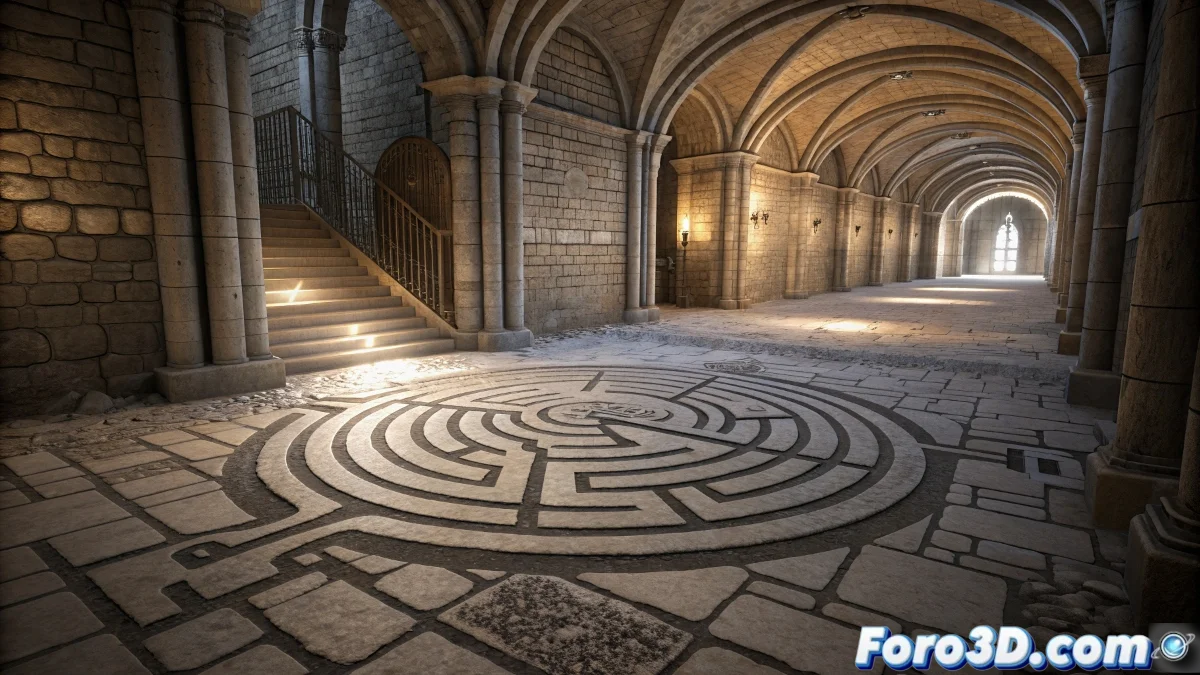
Textures in this recreation do much more than define materials; they tell the visual story of centuries of existence. Color variations suggest differential wear in different areas, perhaps indicating mentally more traveled paths. 🔍 Micro-cracks and erosions speak of thermal and structural changes, while more polished areas might suggest occasional though respectful contact. The use of displacement and normal maps allows achieving that subtle relief that transforms a flat surface into a three-dimensional historical document, where every imperfection adds authenticity rather than detracting from it.
Lighting and Atmosphere: The Magic of the Digital Cathedral
Lighting is the element that truly brings the labyrinth's symbolism to life. Side lights simulating illumination filtered through stained glass create elongated shadows that seem to guide the visual journey. 💡 Volumetric effects add that tangible quality to the air breathed in ancient sacred spaces, where centuries-old dust seems to float as a silent witness. The contrast between illuminated and shaded areas can represent that duality between the divine and the human, the known and the mysterious, which so characterizes the labyrinthine experience.
Advanced Techniques for Historical Authenticity:- Use of HDRI for credible ambient lighting
- Setup of materials with variable roughness
- Particle systems for atmospheric dust
- Depth of field to direct attention in animations
Animation: Traversing the Path Without Stepping on It
The camera animation in this recreation must emulate the meditative experience of the labyrinthine journey. Slow and fluid movements that follow the labyrinth pattern create that sensation of visual pilgrimage that medieval canons experienced mentally. 🎥 Changes in perspective, from aerial views revealing the full pattern to ground-level shots immersing in the experience, allow appreciating the labyrinth in all its dimensional complexity. The rhythm must be paused, reflective, inviting contemplation rather than mere observation.
Some paths are meant to be traversed with the eyes of the spirit more than with the feet of the body
Render and Post-Production: The Final Touch of the Eternal
The render phase must carefully preserve all the subtle lighting and material effects that bring the labyrinth to life. Cycles, with its ability to handle subtle reflections and complex shadows, is ideal for capturing the stony essence of the original. 🎨 Post-processing can add those final adjustments that make the difference: a subtle vignette directing the gaze toward the symbolic center, contrast adjustments accentuating the depth of the engravings, or even slight chromatic aberration effects suggesting the passage of light through centuries-old stained glass.
Conclusion: When Technology Meets Transcendence
The recreation of the León Cathedral labyrinth in Blender demonstrates how digital tools can serve to preserve and understand our deepest cultural heritage. This guide not only teaches architectural modeling techniques but invites reflection on how sacred spaces communicate meanings that transcend their practical function. 🔮 After all, what better way to honor a medieval symbol than using contemporary technology to reveal its secrets to new generations. And who knows, perhaps after digitally recreating this stone path, we will understand why some truths prefer to hide in patterns rather than reveal themselves in words. 😉