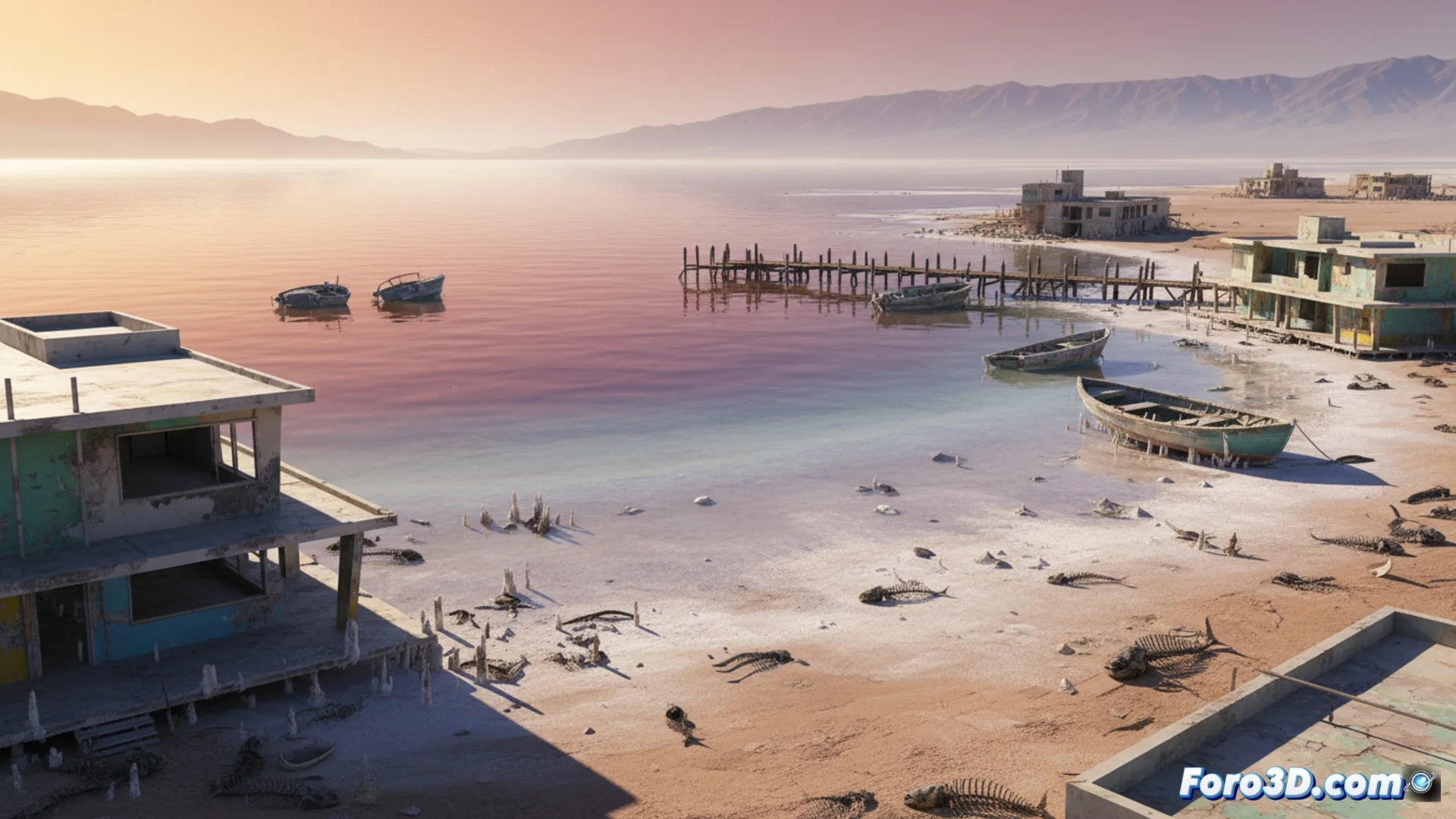
The Salton Sea: from accident to modern ruin
An irrigation canal failure in 1905 diverted the Colorado River's flow into a desert depression, accidentally forming this massive saline lake. Decades later, the place was promoted as California's Riviera, attracting visitors and developments. 🌊
The tourist mirage fades
The initial success soon showed its limits. Lacking a natural outlet, the water can only evaporate, causing salts and agricultural chemicals to accumulate. Its salinity came to exceed that of the ocean. Mass fish die-off events became common, generating bad odors and a visibly degraded environment that drove people away.
Consequences of the decline:- The extreme concentration of minerals and contaminants made the water hostile.
- Episodes of aquatic wildlife mortality scared away tourism.
- Environmental deterioration accelerated the abandonment of vacation complexes and homes.
Perhaps California's largest real estate project is the one that water built and salt demolished.
A landscape of contrasts and scars
Today, the coast is dotted with ghost structures: empty hotels, uninhabited houses, and piers disintegrating under the sun. The lake endures as a radically transformed ecosystem, serving as a vital refuge for migrating birds, but also as tangible proof of how human intervention can create and then ruin an entire environment. 🏚️
Present realities:- Residual communities deal with the challenges of an unstable and changing body of water.
- The site functions as a crucial habitat, though deeply altered, for wildlife.
- It stands as an involuntary monument to failed planning and lasting environmental impact.
Legacy between salt and oblivion
The story of the Salton Sea encapsulates a cycle of accidental creation, ephemeral boom, and ecological collapse. More than a simple lake, it is a physical archive of human ambitions and their unforeseen consequences, where nature reclaimed its space in a way no one anticipated. Its future remains an enigma, marked by salt and the memory of what could have been. 🤔