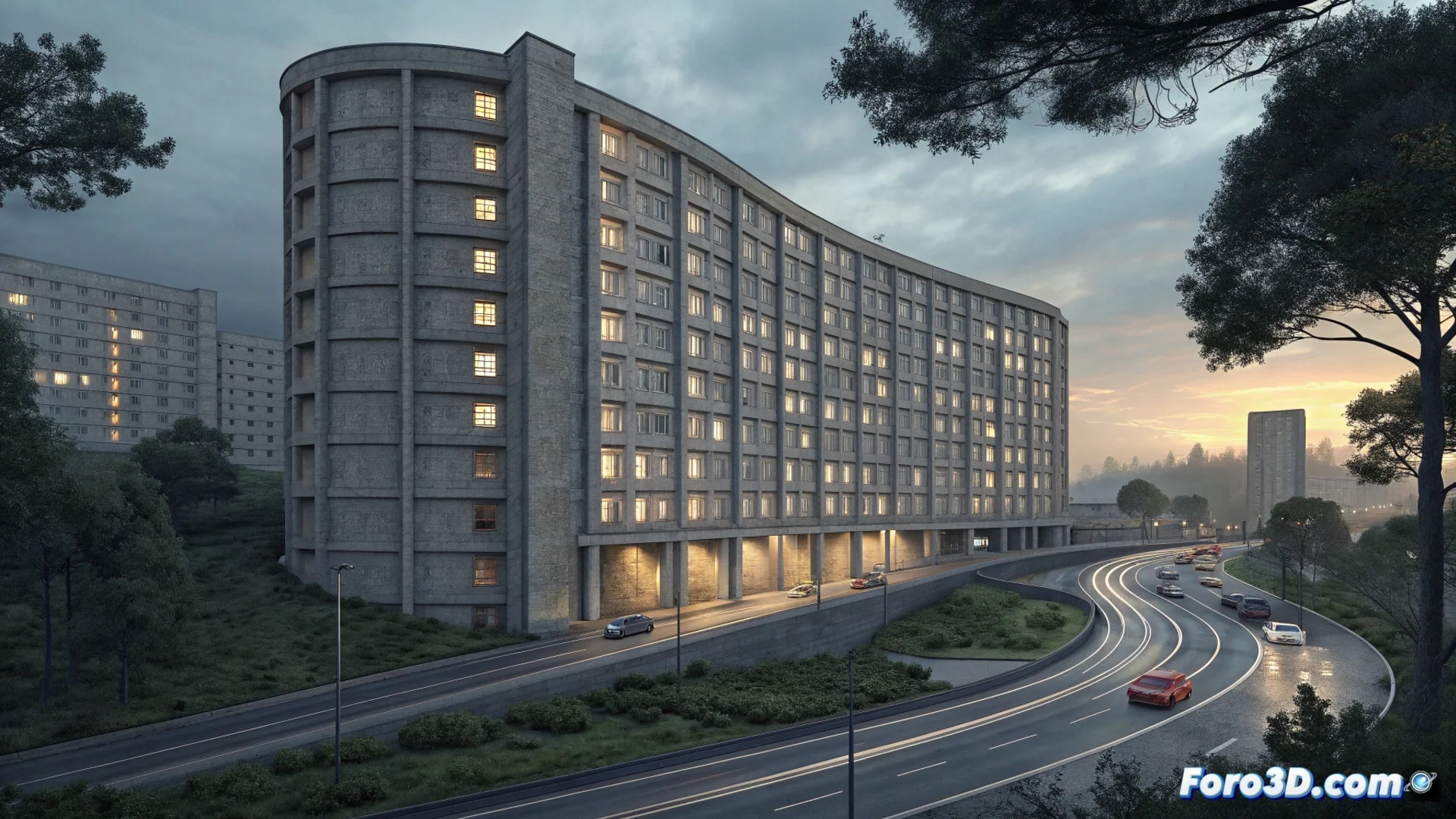
El Ruedo of the M-30: the social utopia that architecture could not build
In the Madrid landscape, next to the M-30 highway, stands El Ruedo, a concrete structure designed by Francisco Javier Sáenz de Oiza in the 1980s. Its objective went beyond housing people; it sought to create a living barrier against noise and, at the same time, a self-sufficient micromundo for its residents. Its curved and closed shape, evoking a bullring, encloses an ambition that reality could not match 🏗️.
A visionary design with dual function
Oiza did not just project a social housing block. He conceived an integral complex that would function as an acoustic shield for the neighborhood and, within its perimeter, house everything necessary for living. The original plan included shops, social facilities, interior gardens, and extensive common areas. The idea was to foster a cohesive community, protected from external problems and bustle, where residents could meet their basic needs without leaving the enclosure.
Key elements of the original project:- Structural acoustic barrier: The building's own mass and curved shape were designed to absorb and deflect noise from the M-30.
- Programmed self-sufficiency: Including services, shops, and green areas within the complex to avoid residents depending on the outside.
- Generous community spaces: Patios and extensive common areas intended to be the heart of the site's social life.
The greatest acoustic isolation achieved by El Ruedo may not be against highway noise, but against the bustle of community life that never reached its patios.
The gap between the plan and the built reality
The construction of El Ruedo encountered budgetary restrictions and changes in public management. This meant that many of the essential components of its social soul never materialized. The building fulfilled its physical function as a noise screen and delivered housing, but the social project was cut short. The shops, facilities, and large green areas remained on paper or were executed very limitedly.
Factors that limited the original vision:- Insufficient economic resources: Budget cuts prevented the development of the planned commercial and service areas.
- Changes in administration: Variations in public management during construction altered the initial priorities and focus.
- Focus on the structural: Completing the building's shell was prioritized over implementing the internal community programs.
The legacy of an incomplete icon
Today, El Ruedo persists as a architectural icon of great visual power. Its imposing silhouette continues to define the area, but its interior lacks the community life that its architecture promised. It symbolizes an incomplete urban utopia, where the form survived the dreamed social function. Its history teaches how a bold design can be left halfway when not backed by the resources and political will necessary to execute all its aspects. It is a tangible reminder of the limits between theorizing and building 🏛️.