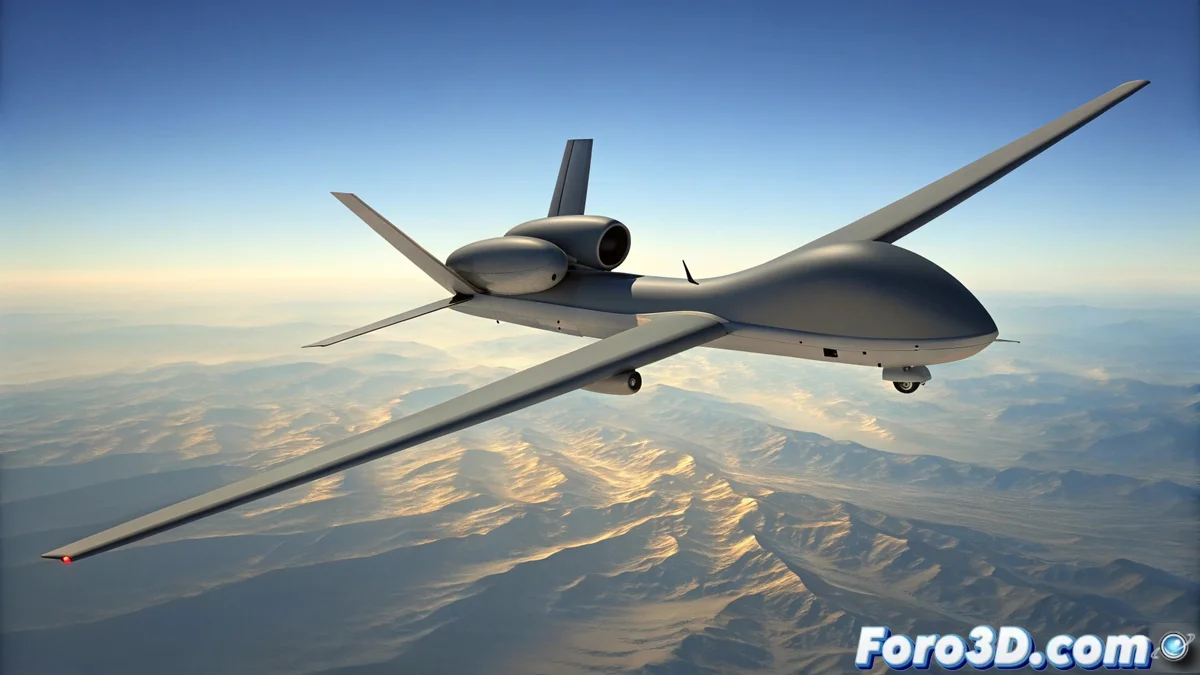
The RQ-4 Global Hawk: Surveillance from the Heights
In the realm of aerial surveillance, the RQ-4 Global Hawk stands out as a key asset for the United States Air Force. This unmanned aerial system is designed to operate continuously at extreme altitudes, serving as persistent eyes over vast regions without requiring a pilot to assume risks. 🛩️
A Design Built for Endurance
The Global Hawk's architecture focuses on achieving maximum efficiency. Its notably long wings with a thin profile resemble those of a glider and are essential for flying stably above 18,000 meters. The fuselage incorporates a front bulb that protects critical communication systems, while a jet engine is located in the upper rear. The combination of a V-tail and a bulky gondola under the belly defines its unique silhouette.
Key features of its structure:- High aspect ratio wings: Optimized to reduce drag and enable very long-duration flights.
- Integrated ventral gondola: Houses the main suite of sensors for data collection.
- Aerodynamic fuselage: Designed to maintain performance in the thin atmospheres of high altitude.
From the ground, its presence is only revealed as a white and silent dot high above, a constant reminder of modern surveillance.
The Mission: See and Understand
The essential function of this drone is to provide intelligence, surveillance, and reconnaissance. Without carrying armament, all its capacity is dedicated to observation. The ventral gondola integrates a powerful combination of sensory systems, including a synthetic aperture radar and electro-optical and infrared sensors. This technology allows it to capture detailed images and track moving targets 24 hours a day, overcoming obstacles like cloud cover, and transmit the information to command centers almost instantly.
Capabilities of its sensory systems:- All-weather vision: The radar penetrates clouds and darkness to obtain images.
- Motion detection: Infrared sensors can track the heat from vehicles or people.
- Real-time transmission: Data flows via satellite for analysts to process without delay.
The Pillar of Information Gathering
The value of the Global Hawk lies in its ability to extend missions for more than thirty hours, covering vast areas from a privileged vantage point. It represents a fundamental pillar in the information gathering strategy, where persistence and range are prioritized over speed or noisy stealth. Its operation demonstrates how technology enables surveillance without exposing human lives, maintaining constant situational awareness from the heights.