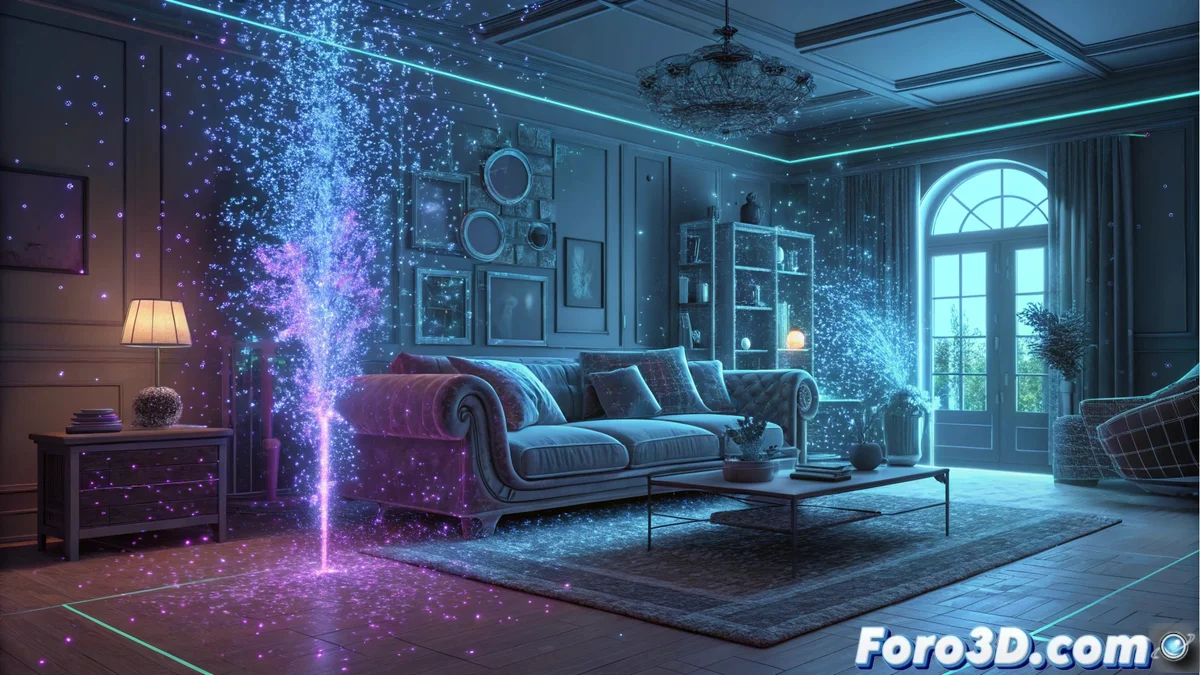
The Gaussian Splatting Revolution in 3D Capture and Its Impact on Virtual Reality
Three-dimensional capture technology is experiencing a true worldwide revolution with innovative methods like Gaussian splatting, which enables the generation of volumetric representations of extraordinary quality in real time. This methodological approach is quickly gaining followers due to its ability to reconstruct three-dimensional spaces with an unprecedented level of detail, opening new opportunities for augmented and virtual reality applications where absolute precision and total immersion are fundamental 🚀.
Technical Foundations of the Gaussian Approach
Gaussian splatting operates by representing 3D scenes through millions of tiny Gaussian elements that are projected and intelligently combined to form complete volumetric models. Unlike conventional polygonal mesh techniques, this method captures visual appearance and lighting properties in a more organic and natural way, allowing reconstructions that preserve textures, lighting, and geometric details with exceptional fidelity. The computational efficiency of the process makes it particularly suitable for real-time applications, where processing speed is crucial for smooth and responsive interactive experiences.
Key Advantages of Gaussian Splatting:- Representation using millions of Gaussian elements that capture microscopic details
- Natural preservation of textures, lighting, and geometric properties
- Efficient processing that enables real-time applications with high visual quality
The ability to digitally recreate any location with an astonishing level of detail represents a monumental advance, although we still face the humorous challenge of our pets appearing as pixelated ghosts in the middle of the reconstructions.
Transformation in AR/VR Development
The implementation of Gaussian splatting is radically revolutionizing how environments are scanned and reconstructed for augmented and virtual reality, facilitating the creation of digital spaces that integrate seamlessly with the tangible physical world. Developers and digital artists can now generate high-quality 3D assets from simple captures, drastically reducing the time and resources needed to produce convincing immersive content. This technology not only substantially improves the visual quality of AR/VR experiences but also unlocks new applications in education, entertainment, and professional simulation where extreme realism becomes an indispensable requirement.
Transformative Applications:- Creation of digital spaces that naturally blend with real physical environments
- Generation of high-quality 3D assets from simplified basic captures
- Significant reduction in time and resources for immersive content production
Future and Practical Considerations
Gaussian splatting marks a before and after in three-dimensional capture, offering capabilities that until recently seemed like science fiction. However, like any emerging technology, it presents interesting challenges, such as the appearance of unwanted elements during scanning 🐱. The continuous evolution of these methods promises to take virtual and augmented reality to levels of realism that will fundamentally transform how we interact with digital environments, creating truly immersive experiences that blur the boundaries between the physical and the virtual.