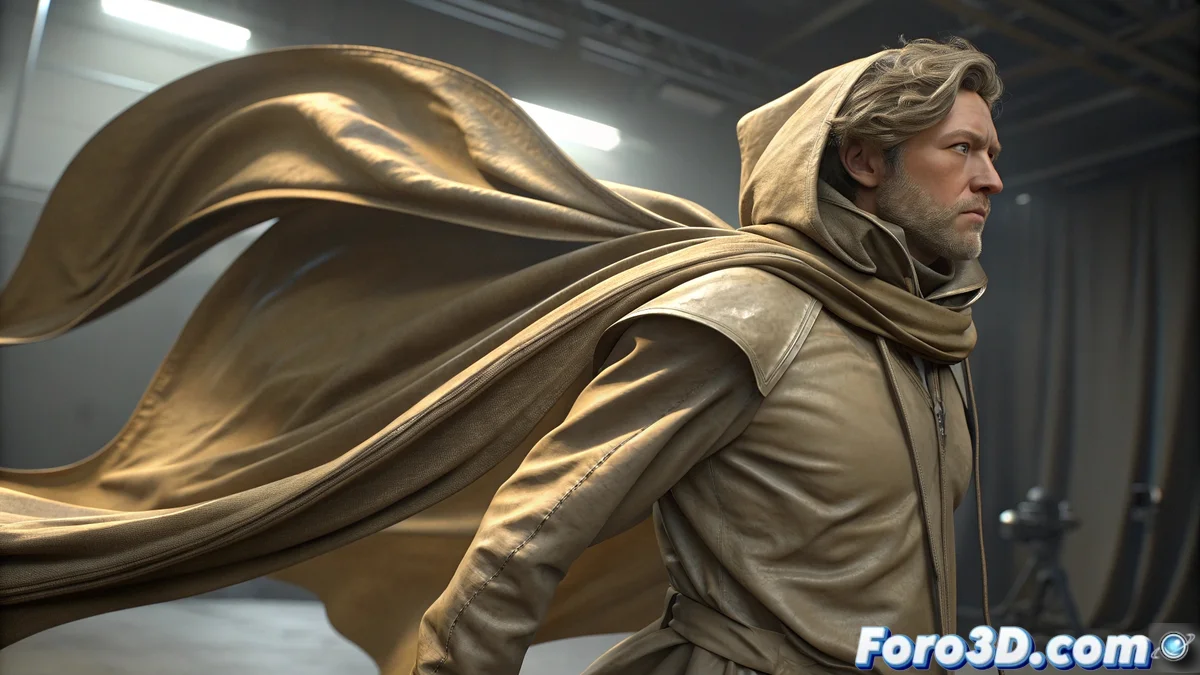
Blender's Cloth Simulation Revolution: Unprecedented Realism and Stability
The latest version of Blender has radically transformed its cloth simulation system, introducing a completely overhauled engine that provides much more natural and fluid interactions with other physical elements and animated sequences. This technical evolution allows digital artists to design clothing that behaves organically with character movements and virtual environmental influences, resolving most of the irregularities that characterized previous software iterations. 🎭
Completely Rebuilt Textile Physics Engine
The heart of these revolutionary improvements lies in the cloth simulation core, which now processes collisions and deformations with unprecedented precision. Virtual garments interact coherently with skeletal meshes and particle systems, maintaining their shape and volume even during sudden or rapid movements. Adjustments to fundamental parameters such as stiffness, friction, and damping generate highly predictable results, significantly minimizing the need for manual corrections during post-production phases.
Main advantages of the new system:- Precise handling of collisions between multiple layers of cloth and complex geometries
- Automatic preservation of volume and physical characteristics during fast animations
- Consistent response to external forces such as wind, gravity, and force fields
The optimized stability ensures that complex simulations run without interruptions, greatly facilitating the creative workflow
Perfect Synchronization with Production Pipelines
Cloth simulation integrates harmoniously with character animations and the Eevee and Cycles rendering engines. Artists can visualize in real-time how clothing responds while developing their projects, dramatically accelerating creative iteration cycles. This deep integration allows virtual fabrics to react consistently to various environmental forces across all production stages, from the initial layout to the final high-quality render.
Improved integration features:- Real-time preview of clothing effects during the creative process
- Full compatibility with particle systems and soft body dynamics
- Unified response to physical forces throughout the entire production pipeline
From Unpredictable Chaos to Total Artistic Control
It is now possible to create characters whose layers of clothing do not turn into vibrating gelatinous masses at the first movement, although some nostalgic users might miss those unpredictable moments that turned a simple walk into psychedelic experiences of rebellious fabric. This evolution represents a quantum leap in artistic control and predictability, setting new standards for textile simulation in open-source 3D software. 🚀