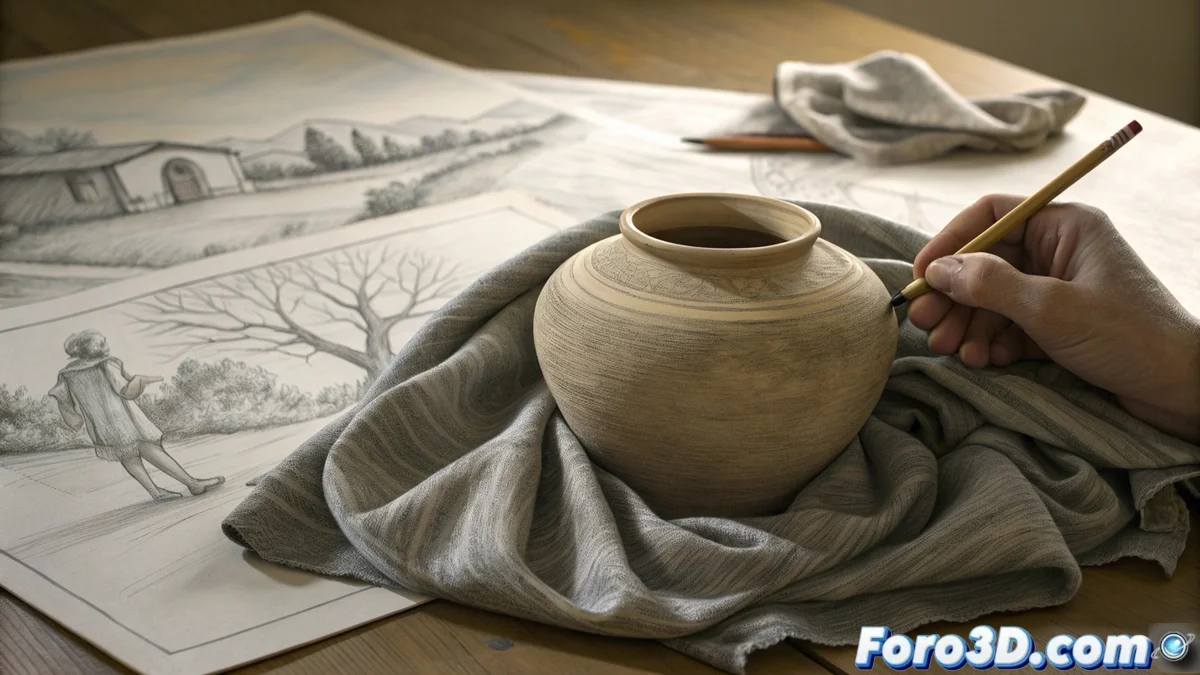
The Reverse Visual Anchor Technique to Reorganize How to Draw
In the world of illustration and drawing, traditional methods usually prioritize the focal point. This technique proposes the opposite path: starting with what seems insignificant. By inverting the pre-established visual hierarchy, habits are challenged and a door is opened to richer and less predictable compositions. 🎨
Challenging Conventional Visual Priority
Instead of sketching the main face or key element first, the artist must identify and detail the component considered most mundane. This could be a shadow, a background object, or an architectural detail. By dedicating time and precision to this reverse anchor, the mind is forced to find value where it previously saw none. This process trains to see texture, shape, and interaction with negative space in a new way.
The step-by-step process:- Select the anchor: Deliberately choose the element perceived as least interesting within the planned scene.
- Detail meticulously: Treat this element with the same technical importance and attention as a traditional focal point.
- Build around it: Develop the rest of the composition by organically integrating the parts around this already defined core.
"It's not about eliminating the focus, but weaving a web where everything contributes." – Reflection on the technique.
Developing Observation and Cohesion Skills
Implementing this method regularly not only improves how to organize elements on a plane, but also sharply enhances the ability to observe. To detail something considered secondary, its structure and role in the whole must first be understood. The resulting composition tends to show a more subtle harmony, where the gaze explores without being immediately captured by a single point, generating a more prolonged and satisfying visual experience.
Key benefits of practicing this technique:- Improves visual integration: All components support each other, creating a network of relationships instead of a pyramidal structure.
- Fosters deep observation: Forces the study and understanding of the anatomy and function of every part of the drawing.
- Generates unique graphic narratives: Prioritizing a stone over a face can tell a different story and spark conversations about artistic decisions.
Integrating the Focus into a Cohesive Whole
The ultimate goal is not to banish focal points, but to integrate them in such a way that the composition functions as a unit. This approach builds a graphic narrative where every mark on the paper has a purpose. By learning to imbue any area with interest, the artist gains total control over balance and visual flow, producing works that invite exploration time and again. ✏️