The Qubit: The Quantum Unit That Challenges the Limits of Computing
At the heart of the quantum revolution lies a fascinating entity: the qubit or quantum bit. While traditional computing is based on bits that are clearly 0 or 1, the qubit introduces a new paradigm of information. Its ability to exist in a coherent superposition of both states simultaneously, and to entangle with other qubits, is what opens the door to previously unimaginable processing capabilities. This is not a simple evolution; it is a fundamental change in how we conceive of computation and problem-solving. 🚀
The Dual Nature of the Qubit: Beyond 0 and 1
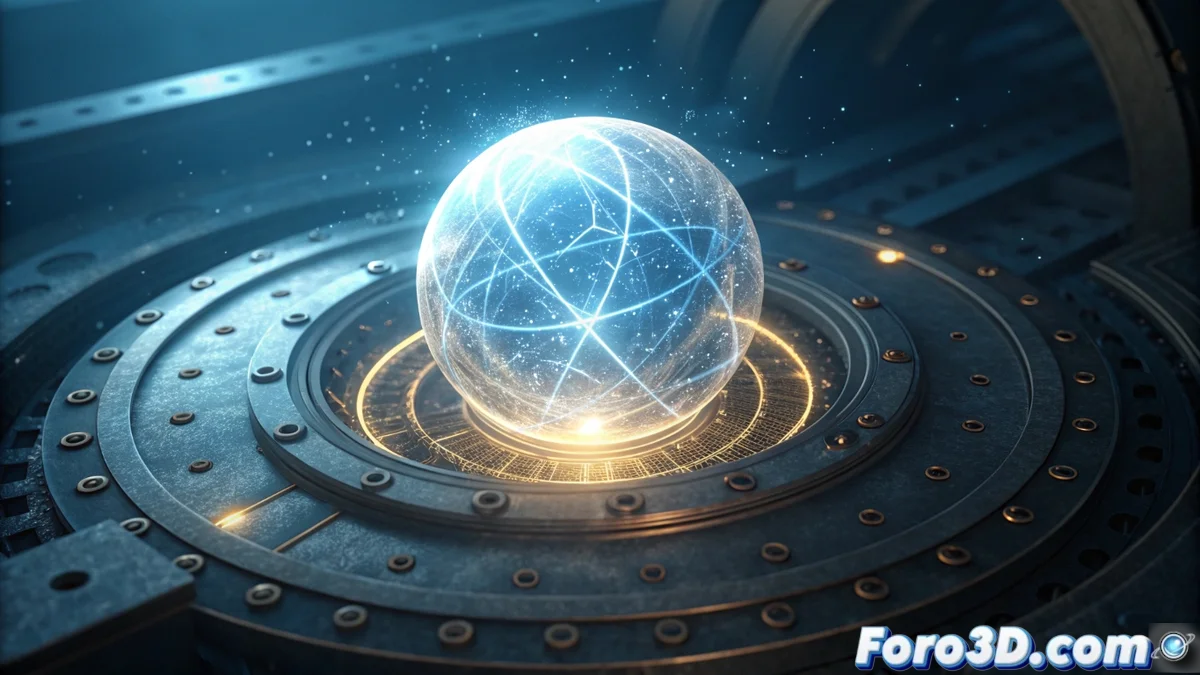
The magic of the qubit lies in its probabilistic and wave-like nature. A classical bit is like a switch: on (1) or off (0). A qubit, however, is like a sphere (the Bloch sphere), where every point on its surface represents a possible quantum state. Only when measured does the qubit "collapse" to a defined state, 0 or 1. This superposition allows a system of n qubits to represent an astronomical number of combinations at once, offering an intrinsic quantum parallelism. Combined with entanglement, where the state of one qubit instantaneously depends on another regardless of distance, it creates the substrate for algorithms that exponentially surpass classical ones in specific tasks.
Main technologies to materialize a qubit:- Superconducting circuits: Used by leaders like IBM and Google, they are small loops of superconducting material cooled to cryogenic temperatures. Their advantage is the relative ease of fabrication using microelectronics techniques. ❄️
- Ion traps: Trap individual atoms (ions) in vacuum using electromagnetic fields. The ion's energy levels act as the qubit. They are known for their high fidelity and long coherence times.
- Silicon quantum dots: Tiny nanoscopic "boxes" that confine electrons on a silicon chip. This approach seeks to leverage the massive infrastructure of the semiconductor industry to scale. 💻
The great challenge is not just creating qubits, but maintaining their fragile quantum state isolated from the noise of the outside world, a phenomenon known as decoherence.
The Present and Future: Promised Power and Real Obstacles
It is crucial to understand that quantum supremacy is not universal. A quantum computer will not render your 3D scene faster or improve your web browsing experience. Its power unfolds in very specific domains where massive exploration of possibilities is key. Currently, we live in the NISQ era (Noisy Intermediate-Scale Quantum), with processors of tens to hundreds of "noisy" qubits prone to errors.
Areas of transformative impact:- Cryptography and security: Algorithms like Shor's could break current encryption systems, driving the development of post-quantum cryptography.
- Materials and drug discovery: Accurately simulating the behavior of complex molecules to design new drugs or superconducting materials. 🧪
- Optimization and logistics: Solving routing problems, resource allocation, or financial portfolio management with classically unattainable efficiency.
- Quantum Machine Learning: Enhancing artificial intelligence algorithms for pattern recognition in large volumes of data.
Conclusion: A Revolution in Progress
The path to a universal and fault-tolerant quantum computer is fraught with engineering challenges, with quantum error correction being the holy grail. For now, it is unlikely that you will have a "quantum GPU" in your PC. The most immediate access will be through quantum cloud, where companies and researchers will run specialized algorithms on remote hardware. Meanwhile, our classical CPUs and GPUs will remain the undisputed queens for the vast majority of graphics computing, simulation, and design tasks. The qubit does not come to replace the bit, but to complement it, opening new horizons for science and technology. 🌌