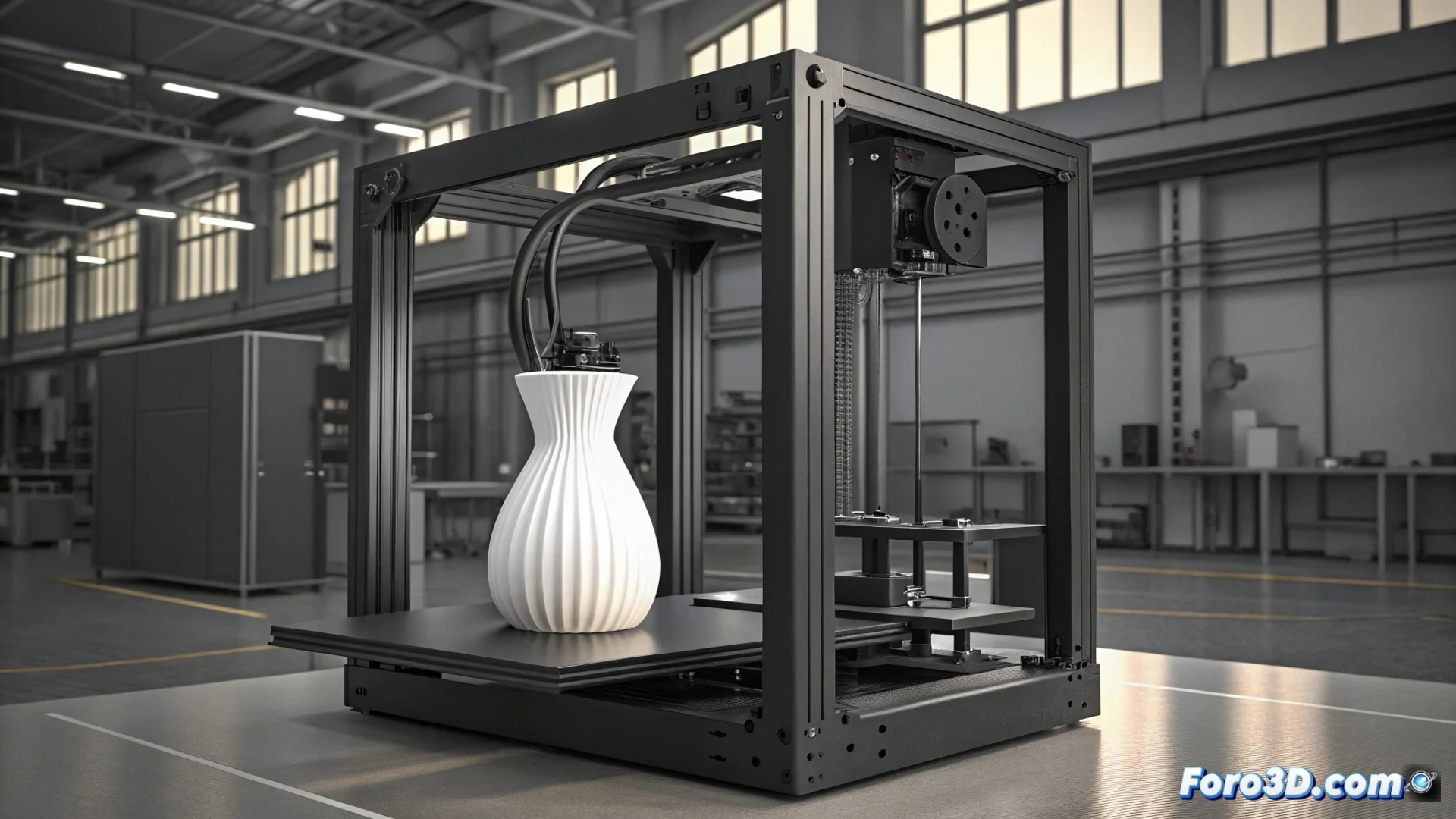
The Prusa MK4 Reveals Fine Vertical Artifacts on Smooth Surfaces
The Prusa MK4 3D printer has such a high level of detail that it can make imperfections perceptible that other machines mask. These artifacts, known as VFA, appear as extremely thin vertical lines on flat areas of models. Their origin is not a serious failure, but a physical phenomenon inherent to the printing mechanics. 🧐
The Origin Lies in the System's Micro-Vibrations
The stepper motor does not rotate with perfectly smooth motion. Small irregularities in its advance, combined with the natural resonance of the printer's chassis, generate a repetitive vibration pattern. This pattern couples with the head's displacement on the Y axis and the vertical movement of the hot bed on the Z axis. When extruding plastic over a smooth wall, these rhythmic oscillations minimally alter the material flow, leaving a barely visible mark that light reveals.
Factors Influencing VFA Visibility:- The printing speed for layers and external contours.
- The rigidity and assembly of the machine's structure.
- The type of filament used, with bright colors accentuating them the most.
For the user seeking aesthetic perfection, these artifacts become a constant challenge, where polishing the piece sometimes means testing one's own perseverance.
Strategies to Reduce Visual Impact
Although it is complex to eliminate the root cause, it is possible to minimize how these artifacts are perceived in the final result. The approach must be comprehensive, acting on several printing parameters and machine maintenance.
Practical Actions to Implement:- Adjust the speed of the external walls. Testing different values helps find a point where resonance is lower.
- Install the latest version of the firmware, as updates usually optimize how movements are controlled.
- Verify that all belts are properly tensioned and that the bearings slide without any play.
- Opt for matte finish filaments or those with texture, which diffuse reflections and camouflage the lines better than smooth and shiny plastics.
A Trade-off Between Precision and Finish
The presence of VFA in the Prusa MK4 is, in a way, a consequence of its high mechanical fidelity. It does not affect the strength or utility of the parts, but it poses an aesthetic limit for projects that require impeccable surfaces. Understanding that it is a systemic phenomenon and not an isolated defect allows addressing the problem with practical solutions, accepting that in 3D printing, sometimes the pursuit of perfect detail reveals new nuances to manage. ⚙️