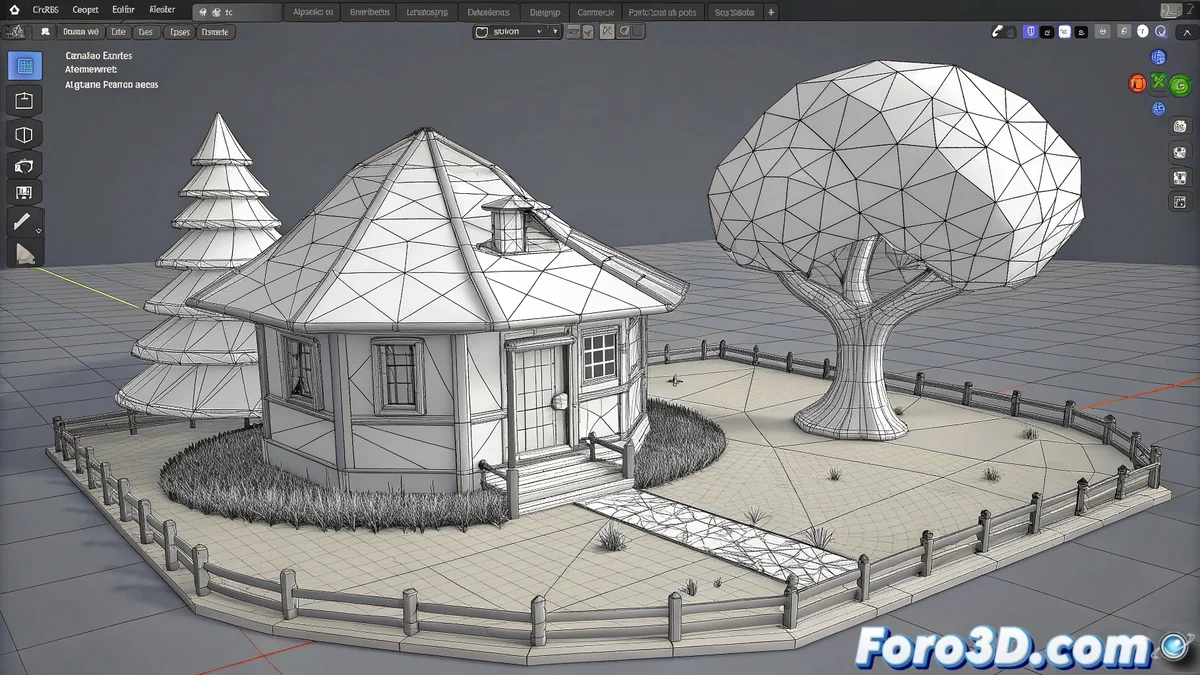
The Art of Saying a Lot with Very Little
In the world of real-time 3D graphics, less is more. Low poly modeling is not about making poor models, but about creating intelligent and optimized geometry that fulfills its function with maximum efficiency. 🎮 This discipline is fundamental for video games, virtual reality, and mobile applications, where every triangle counts and performance is crucial. A good low poly artist is not the one who adds more details, but the one who knows which ones to eliminate without the model losing its essence.
Starting with the Basics: Shape Blocking
Every optimized model begins with simple shape blocking. Using primitives like cubes, spheres, and cylinders, the proportion and general volume of the object are defined. 🧱 This is the moment to think about the silhouette, as it will be what the player identifies at first glance. Complex details are left for later; the priority is to establish a solid and recognizable base with the fewest polygons possible.
The silhouette is the soul of a low poly model; if it is clear, the model will work.
Key Techniques for Optimization
Once the base shape is defined, refinement comes. Topology is fundamental; the use of quads should be prioritized, but triangles are acceptable in flat areas or areas with little deformation to reduce the count. ✂️ The true modern magic comes with the use of Normal Maps. These maps allow "tricking" the graphics engine, projecting the details of a high poly model onto the optimized mesh. This way, rich visual detail is achieved without the computational cost.
- Efficient UV Mapping: Unwrap the UVs to make the most of every pixel of the texture.
- Avoid unnecessary vertices: Clean the mesh of edges and vertices that do not contribute to the shape.
- Strategic details: Add polygons only where the silhouette requires it.
The Low Poly Artist's Mindset
Success in this field requires a change of mindset. Instead of sculpting every detail, the artist must think like an engineer, seeking the maximum visual impact with the minimum resource expenditure. 💡 This implies making constant decisions: Is that extra edge necessary? Does this vertex contribute to the silhouette? The answer is usually "no". Elegance lies in effective simplicity.
A well-executed low poly model is like a good short joke: it manages to convey the complete idea with economy of means, leaving a powerful and lasting impression. 😄 Without detours or superfluous elements.