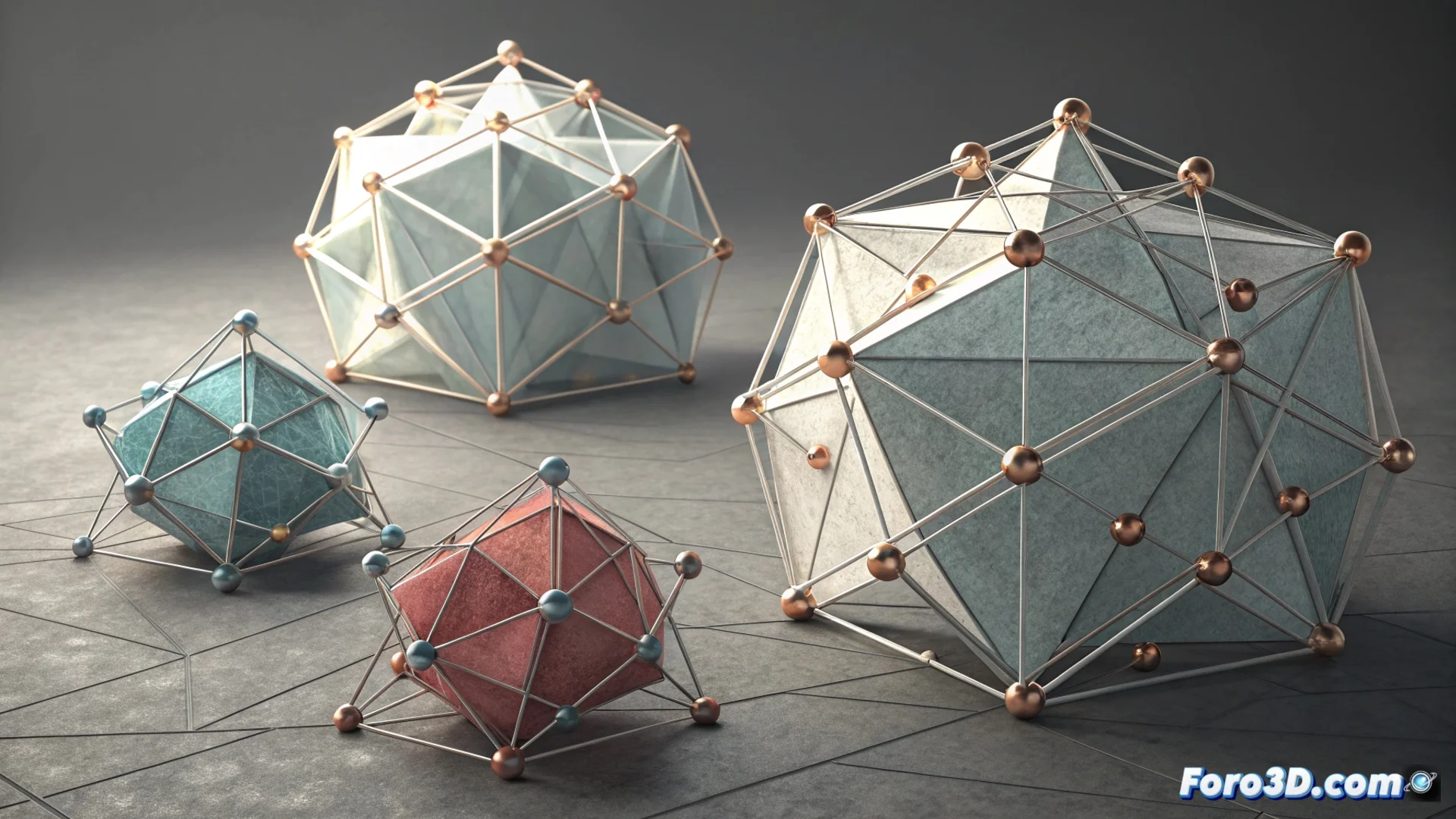
The Principle of Proximity in Visual Design
Gestalt theory offers us fundamental laws about how we perceive. Among them, the principle of proximity states that visual elements that are close to each other are interpreted by our brain as a group or a unit. This concept is an essential tool for organizing information intuitively in any visual project. 🧠
How Does Grouping by Closeness Work?
By placing related objects very close together, you create content blocks that the mind processes more easily. This allows structuring a scene, design, or interface without relying on lines, boxes, or other explicit separators. Proximity naturally directs the viewer's attention and defines relationships between different components of an image.
Practical Applications for Structuring:- In user interfaces: Group buttons for the same action and separate unrelated controls to improve usability.
- In artistic composition and 3D rendering: Position objects from the same set close together so they are perceived as a coherent entity.
- In graphic design: Reduce visual noise and communicate the information hierarchy clearly and efficiently.
Proximity is a basic tool for creating order and legibility, allowing the content to communicate by itself.
The Automatic Power of Physical Closeness
The effect of this principle is immediate and powerful. Even when elements have different shapes, colors, or sizes, physical closeness can dominate and forge a perceptual grouping. This is useful for directing the gaze toward a focal point or suggesting a narrative within the image.
Keys to the Effect in Design and Art:- In 3D modeling and scene design, organizing assets by proximity helps tell a coherent visual story.
- It works because our brain constantly seeks patterns and simplifies what it sees to understand it quickly.
- It prevents ambiguity: separated elements will not be perceived as related unless a specific expressive effect is sought.
Integrate the Principle into Your Workflow
To apply this principle, evaluate the distance between the elements of your composition. Group what belongs to the same concept and separate what is different. Don't let the viewer guess the relationships; use them to guide their visual experience effectively. In essence, mastering proximity allows you to compose with greater clarity and purpose in any visual medium. 🎯