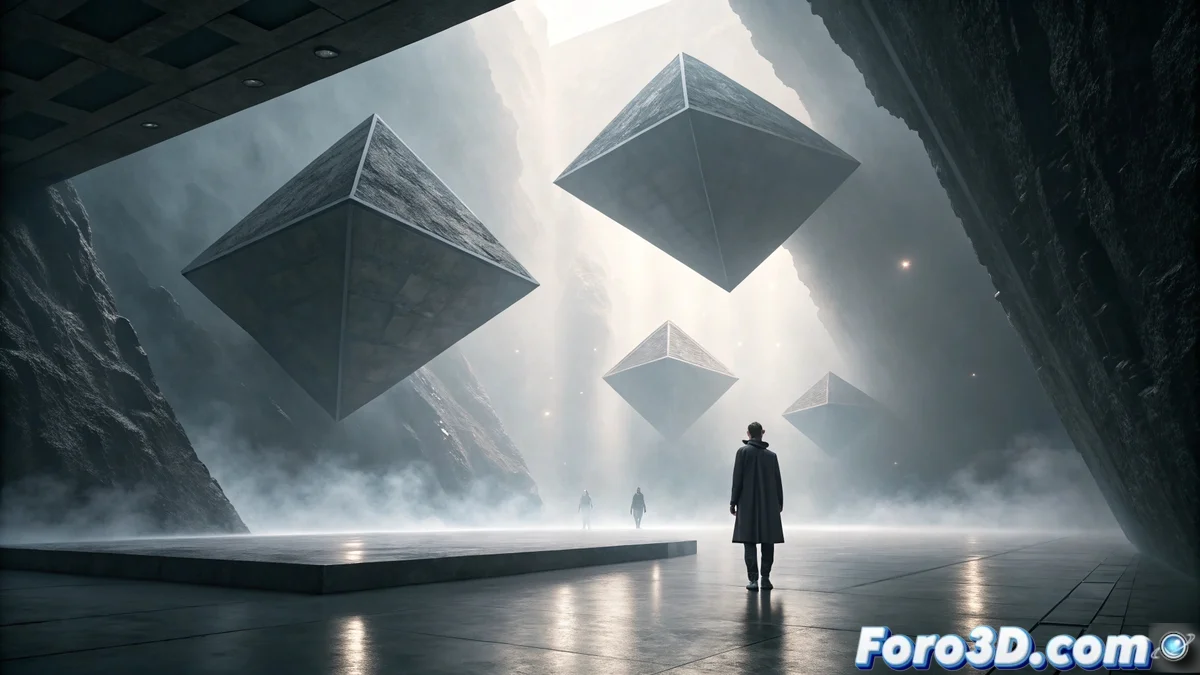
The Power of Negative Space in 3D Modeling
In the universe of three-dimensional modeling, negative space emerges as a silent protagonist that completely transforms the perception of a scene. These strategically designed voids are not mere absences, but active elements that constantly dialogue with the modeled forms, creating a visual choreography where the unsaid carries as much weight as the explicitly represented 🎭.
The Void as Visual Architecture
Negative spaces function as invisible structures that fundamentally organize the 3D composition. When an artist consciously dedicates attention to modeling the voids between objects, they are building breathing pauses that allow the scene to maintain its visual balance. These areas without active geometry establish eye navigation paths that lead the viewer through carefully planned paths, defining compositional rhythms and enhancing the presence of the main volumes.
Essential functions of negative space:- Hierarchical organizer that establishes which elements deserve priority attention
- Gaze director that guides the visual exploration of the scene
- Emotional regulator that modulates sensations of claustrophobia or freedom
"The true art in 3D is not only in what we model, but in the courage to know what to leave unmodeled. The voids speak with the eloquence of silence amid visual noise."
The Invisible Narrative
In three-dimensional storytelling, negative space becomes a narrative resource of extraordinary power. Strategically placed voids can evoke abstract concepts like loneliness, anticipation, or infinite potential, adding layers of meaning that exponentially enrich the viewer's experience. An empty hallway in a horror environment generates more unease than one cluttered with elements, while a clean horizon in an epic composition amplifies the sense of vastness and possibilities.
Narrative applications of the void:- Suspense and mystery through spaces that suggest more than they show
- Scale and proportion that contextualizes the magnitude of the modeled elements
- Dramatic tension created by the contrast between presence and absence
The Art of Subtraction
Paradoxically, the most experienced 3D modelers understand that removing can be more creative than adding. In many projects, more time is spent removing superfluous polygons than incorporating new elements, seeking that point of balance where the void communicates more eloquently than the filled space. This approach often generates questions from clients who do not understand why there are apparently "unused" areas in the final render, ignoring that these spaces are as intentional and significant as any detailed model ✨.