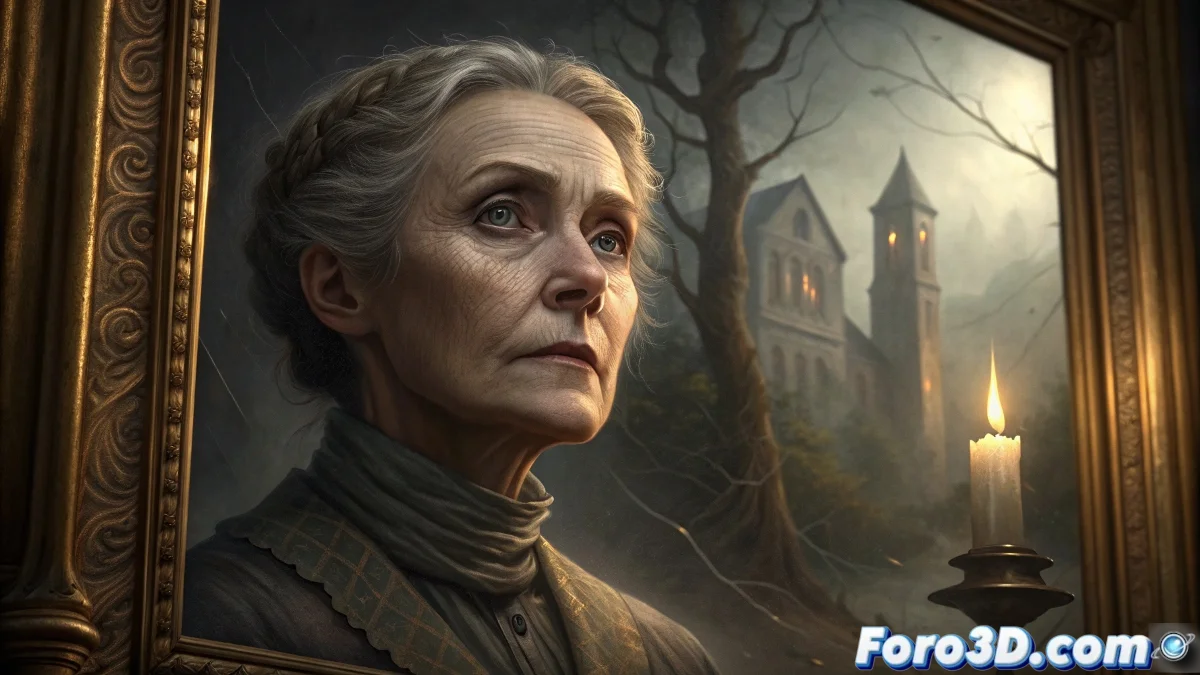
The Portrait That Ages: Gothic Myth and Digital Recreation in Meshroom
The fascinating legend of the portrait that ages emerges from the depths of nineteenth-century Gothic tradition, where ancestral mansions guarded family secrets within their centuries-old walls. This supernatural narrative revolves around a peculiar canvas that defies temporal laws, showing the progressive deterioration of a female figure over the years. Unlike conventional portraits, this work manifests subtle but undeniable transformations that suggest a paranormal connection with the fate of the mansion's owners 👻.
Historical Evolution and Cultural Variants
Over time, the original myth was enriched with various regional interpretations that added layers of symbolic complexity. Some versions narrate how the portrayed woman made a dark pact to preserve her youth at the expense of future generations, while others suggest the presence of a spirit trapped in the canvas, doomed to exchange its aging with successive inhabitants. The narrative reached its peak popularity during the Victorian literature era and later transitioned to classic horror cinema, where the concept of the cursed portrait adapted to various cultural contexts 🎭.
Main variants of the legend:- Supernatural pact to preserve youth through generational sacrifices
- Spirit trapped in the canvas that transfers its aging to the owners
- Cinematic adaptations that reinterpret the myth in contemporary contexts
The portrait that ages symbolizes the transfer of physical decay and family secrets that resurface through generations.
Cultural Legacy and Symbolic Meaning
This legend has endured as a cultural archetype that explores universal themes such as the fear of aging, human vanity, and the consequences of pacts with supernatural entities. The transformable portrait serves as a powerful visual metaphor for family secrets that inevitably resurface, while its influence transcends folklore to inspire literary works, cinematic productions, and artistic explorations that examine the relationship between art, identity, and mortality 🎨.
Project Preparation in Meshroom
To digitally recreate the portrait that ages in Meshroom, it is essential to organize two separate photography sessions of the same female model with different apparent ages. It is recommended to capture between 80-120 high-resolution photographs for each age variant, ensuring 60-80% overlap between images. Both sets should be imported into Meshroom using the default node structure, keeping the image groups organized in separate folders labeled as young and aged to optimize the subsequent workflow 📸.
Essential initial setup:- Two photography sessions with differentiated age variants
- 80-120 high-resolution photographs per set
- 60-80% overlap between images for accurate reconstruction
- Organization in separate folders to facilitate processing
Modeling Process and 3D Structure
Run the standard photogrammetry pipeline on both image sets, starting with StructureFromMotion to generate cameras and continuing with PrepareDenseScene and DepthMap to create detailed point clouds. Use the Texturing node with UV mapping configuration to generate high-quality textures of both face versions. Export the resulting meshes in OBJ or FBX formats, ensuring both versions share the same topology and scale to allow a smooth transition between temporal states 🖥️.
Lighting and Materials for Gothic Atmosphere
Set up the lighting to simulate the old mansion atmosphere, using soft directional lights with a warm color temperature between 2500-3000K. Apply materials with subsurface scattering properties to simulate realistic human skin and adjust specular reflectivity parameters to recreate the appearance of traditional oil painting. For the progressive aging effect, use normal and displacement maps that show wrinkles, facial volume loss, and changes in skin pigmentation, recreating the temporal deterioration of the legendary portrait 💡.
Key material elements:- Subsurface scattering for human skin realism
- Adjusted specular reflectivity for pictorial appearance
- Normal and displacement maps for wrinkles and facial changes
- Warm color temperature (2500-3000K) for gothic atmosphere
Special Effects and Final Rendering
Create a temporal transition between the two portrait versions using morphing techniques or texture blending controlled by a time parameter. Add selective fading effects in specific face areas to simulate the characteristic progressive deterioration of the legend. For the frame and canvas, incorporate craquelure and dust accumulation textures using roughness and ambient occlusion maps. Set up the final render with multiple sampling and subtle depth of field to emulate the pictorial quality of a traditional portrait, demonstrating that even in the digital age, some portraits remain more expressive than we would like, especially when they start complaining about their digital wrinkles 🎭.