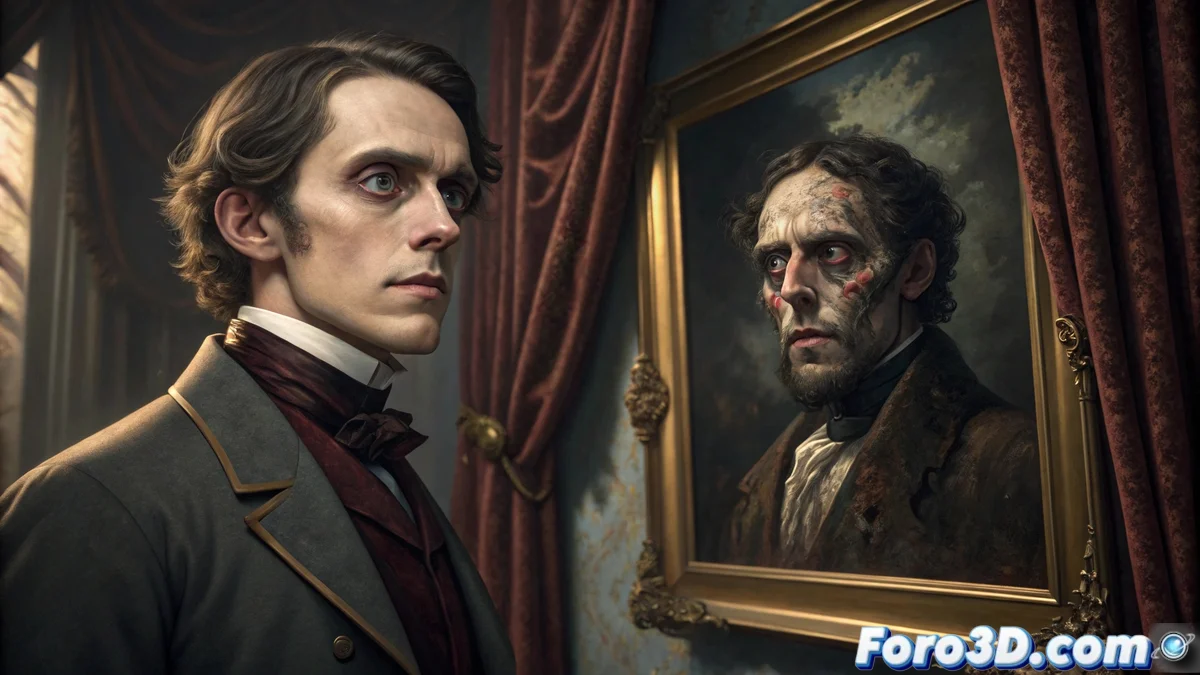
The Picture of Dorian Gray: Duality between Beauty and Corruption
In the fascinating narrative of Oscar Wilde, we encounter Dorian Gray, a young man of extraordinary beauty who makes a disturbing wish: to maintain his youth eternally while his portrait absorbs the passage of time and moral degradation. This supernatural premise triggers a psychological journey where the painting becomes the mirror of the soul corrupted by the protagonist, allowing him to enjoy a hedonistic existence without externally showing the traces of his actions. 🎭
The Visual Metaphor of Human Duality
While Dorian preserves his youthful and immaculate appearance, the painting undergoes a grotesque transformation that reflects every immorality and sin committed. This fundamental duality establishes a dramatic contrast between external aesthetic perfection and internal spiritual corruption, challenging conventional values about beauty and ethics. Wilde uses this powerful metaphor to criticize the social hypocrisy that prioritizes appearances over moral authenticity.
Key Elements of Duality:- Visual contrast between the protagonist's eternal beauty and the progressive deformation of the portrait
- Criticism of Victorian society and its superficial values regarding aesthetics
- Reflection on how vanity can destroy the fundamental human essence
The true curse was not aging, but having to live with one's most authentic version
Psychological Consequences and Moral Burden
Although Dorian initially experiences an apparent freedom by avoiding the physical consequences of his actions, he gradually develops a devastating psychological burden that consumes him internally. The portrait transforms into a constant reminder of his own ethical degradation, symbolizing that no action goes without consequence, even when these are not externally visible. The work delves into how the evasion of moral responsibility inevitably leads to existential isolation and profound despair.
Manifestations of the Consequences:- Progressive paranoia and social isolation of the protagonist
- The painting as a visualized conscience of immoral acts
- Irony of possessing everything materially desirable but losing inner peace
Final Reflection on the Human Condition
In a tragic ironic twist, Dorian achieves the longed-for dream of eternal youth that many desire, but ends up a prisoner of a nightmare where his own artistic reflection reminds him of everything he has sacrificed as a human being. The work confronts us with the essential question: is it worth preserving external beauty at the cost of moral integrity? Wilde shows us that the true curse does not lie in natural aging, but in the inability to reconcile with one's inner truth. 💀