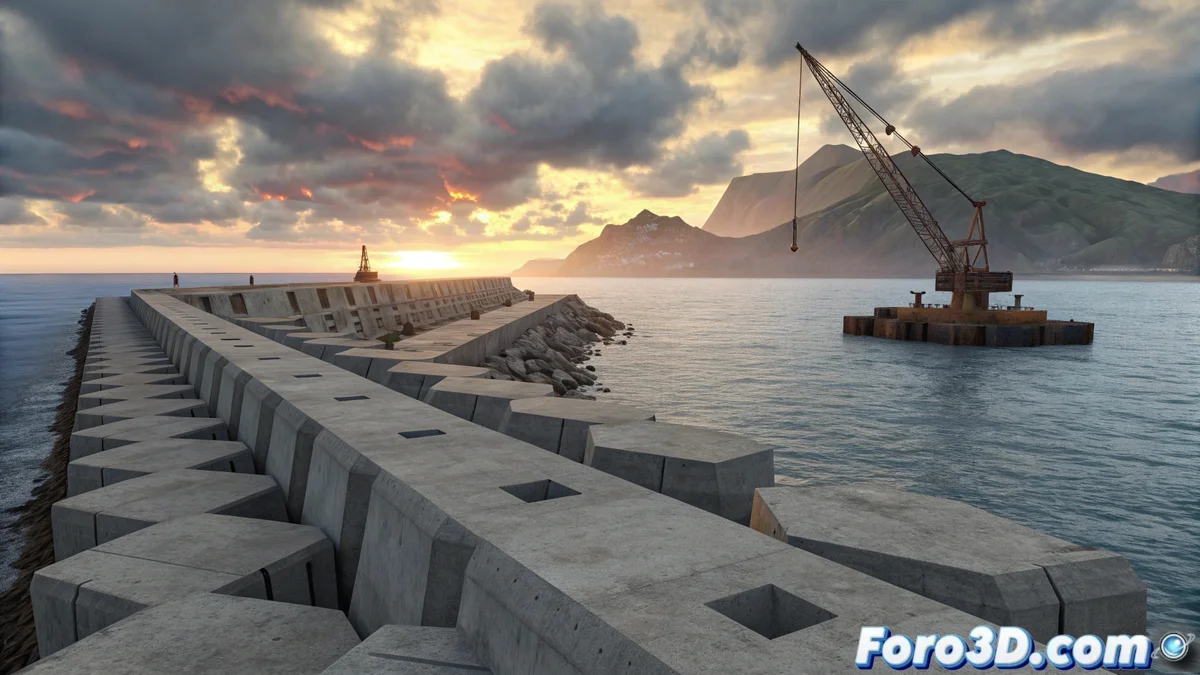
The Port of Granadilla: A Pharaonic Work Frozen in Time
On the southeast coast of Tenerife stands one of the most controversial infrastructures in the Canary Islands. The Port of Granadilla, with its massive concrete breakwaters, dominates the coastline like a sleeping giant. Conceived to relieve maritime traffic from Santa Cruz and act as a logistics hub, its construction seems to have stopped forever, leaving a half-finished industrial scene. 🏗️
A Concrete Colossus Facing the Atlantic
The multi-ton blocks forming the shelter breakwaters extend into the sea to protect an artificial platform of enormous dimensions. However, activity is almost nil. The pace of work is so slow that it turns the place into a modern ruin, where silence is only broken by the sea. This enclave, far from bustling with port activity, remains in a state of perpetual construction that defies the initial plans.
Key factors in the paralysis:- Critical ecological impact: Construction of the south breakwater damaged a sebadal, an underwater meadow vital to the local marine ecosystem.
- Ongoing legal controversy: Judicial appeals filed by environmental groups have forced the work to stop and resume multiple times.
- Questioned environmental compensations: Measures to repair the damage to the sebadal are considered insufficient by scientists and activists.
"The only ones using the port are the fishermen and urban explorers." This phrase from the locals sums up the irony of a multi-billion infrastructure.
The Debate on Its Real Utility
While the infrastructure waits, uncertainty grows about its economic and strategic viability. Critics of the project argue that the capacity of existing ports could be optimized, avoiding the enormous cost of finishing and maintaining this mega-project. The consortium in charge insists it is essential for the island's development, but the lack of a clear completion date fuels doubts.
Points of conflict regarding its future:- Dubious strategic need: There is debate on whether the archipelago really requires a port facility of such magnitude.
- High maintenance costs: Maintaining the unfinished infrastructure represents an ongoing expense for public coffers.
- Uncertain return on investment: The general perception points to poor planning and unclear economic benefits.
An Involuntary Monument to Bureaucracy
The Port of Granadilla has become more than an engineering project. It is a tangible symbol of the collision between development and conservation, and of how bureaucracy and litigation can freeze time. In this context, "in the long term" takes on an ironic meaning, equivalent to a practical "never." Its silhouette over the Atlantic remains as a reminder of the complex challenges involved in large-scale construction in the 21st century. ⏳