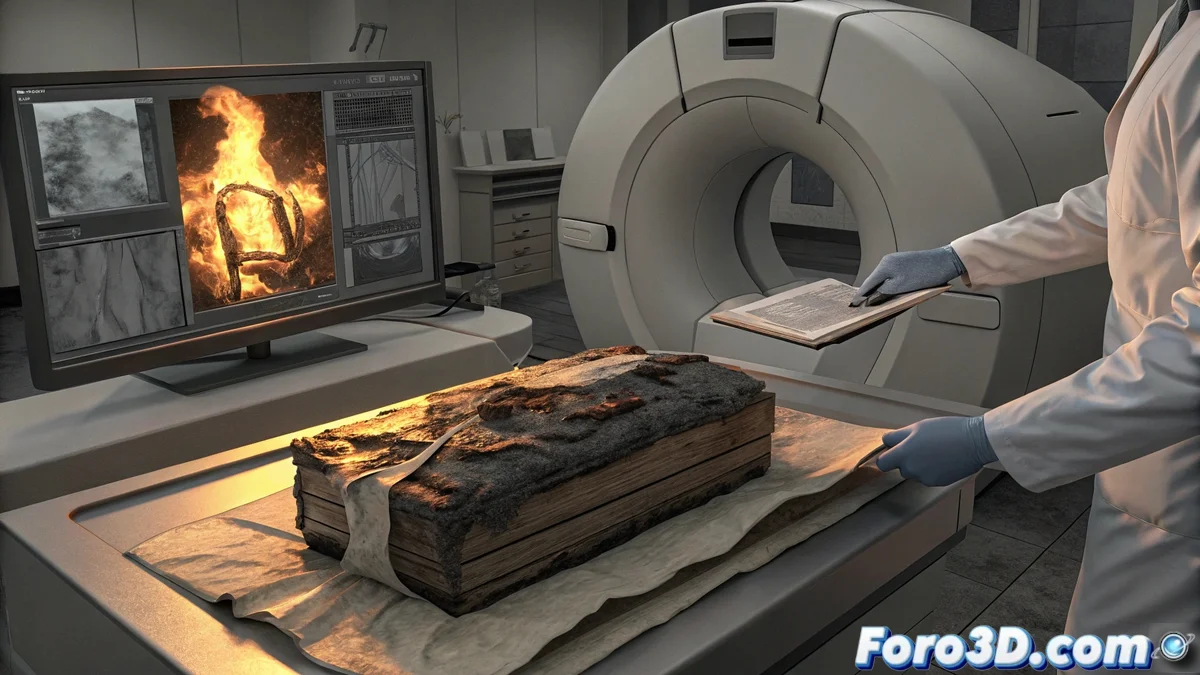
Police Reconstruct Burned Documents Using Computed Tomography
When a fire carbonizes documents, the physical evidence becomes extremely fragile. Handling those blocks of burned paper would destroy them. To avoid this, forensic investigators turn to adapted medical technology: the computed tomography (CT) scanner. This equipment, often an industrial model from Nikon, captures a complete three-dimensional digital volume of the object without physical contact, preserving its original state intact. 🔍
From Carbonized Block to Virtual 3D Model
The tomograph acts as the investigators' eyes, allowing them to see inside the compact block. It generates thousands of X-ray images that, when combined, form a precise digital representation. This 3D volume contains all the information from the pages stacked and curled by the fire, but to read it, one more step is needed.
The digital capture process:- The object is placed on the CT scanner platform, which surrounds it completely.
- The equipment takes multiple X-ray projections from different angles.
- A computer reconstructs the data to create a detailed volumetric model.
The key lies in a specialized algorithm that can virtually unroll the stacked and carbonized pages.
Specialized Software to Reveal Hidden Text
With the 3D volume captured, the work continues in the digital realm. Advanced analysis programs like Volume Graphics VGSTUDIO MAX are used. This software not only visualizes the data but also executes complex algorithms. The main function is to digitally unroll the sheets, calculating their curvature and flattening them to separate the text from each individual page.
Phases of digital processing:- Apply the "virtual unrolling" algorithm to separate overlapping pages.
- Flatten each sheet digitally, correcting deformations caused by heat.
- Isolate the data from each page into an independent 2D image.
Enhancing Contrast and Recovering Legibility
After virtual unrolling, the images often show very low contrast; the ink and carbonized paper have similar density. To solve this, forensic image processing techniques are applied. Gray levels are adjusted, contrast masks are used, and algorithms that enhance writing strokes are employed. The goal is to maximize the difference between the background and the text, transforming ambiguous stains into readable words. The final result is flat and clear reproductions of each page, which experts can analyze without risking the original physical evidence. Thus, a diary that seemed lost forever can tell its story again. The next time you think about burning a secret document, remember that forensic technology might still be able to read it. 📄➡️💻