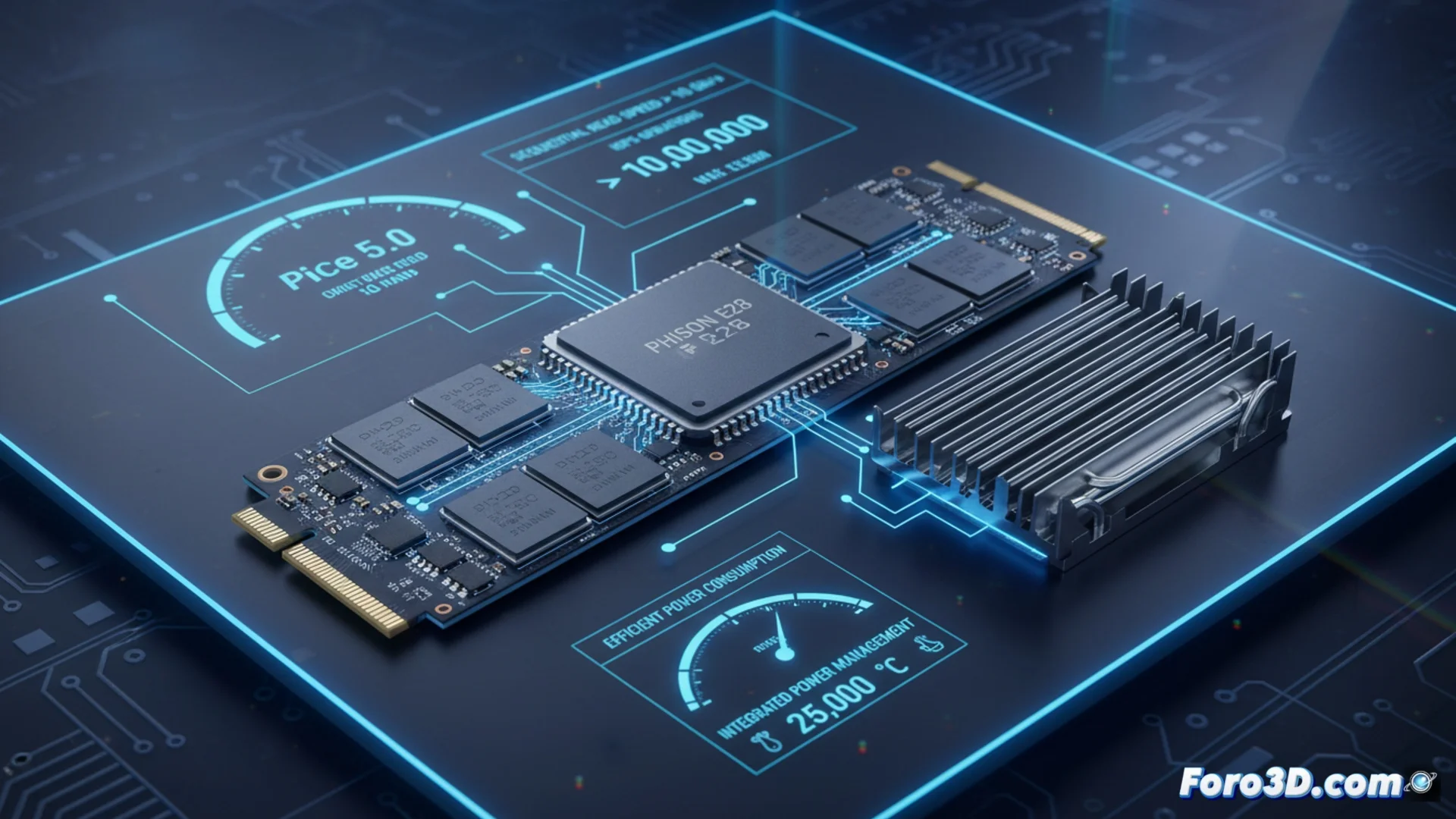
The Phison E28 Controller Sets the Pace for PCIe 5.0 SSDs
The new Phison E28 chip redefines what can be expected from a solid-state drive with PCIe 5.0 interface. Its commercial debut in the Corsair MP700 Pro XT showcases a generational leap in speed and efficiency, establishing a new benchmark for high-performance storage. 🚀
A Quantum Leap in Speed and Efficiency
This controller enables drives to reach previously unthinkable figures. The MP700 Pro XT achieves sequential data reading at nearly 15 GB/s and executes more than three million input/output operations per second. Most notably, it achieves this power with an energy consumption that does not exceed 7 watts, a key factor for building powerful systems that are also efficient.
Key Performance Features:- Sequential read speeds approaching 15 gigabytes per second.
- Capacity to exceed 3 million IOPS (input/output operations per second).
- Contained power consumption, always below 7 watts.
The Phison E28 is not just about raw speed; its design prioritizes intelligently managing the PCIe 5.0 x4 bandwidth to reduce latency to a minimum.
Architecture Designed for Parallelism
The strength of the E28 lies in its internal architecture, optimized to fully exploit the fifth-generation PCIe bus. It processes data streams in parallel, which drastically reduces wait times when executing commands. This translates to sustained performance even under heavy workloads, such as transferring huge files or loading complex software environments. Its integrated thermal management system prevents heat from forcing premature performance limitations.
How Corsair Implements the Technology:- Integrates NAND flash memory of TLC type along with a DRAM buffer to cache data agilely.
- Includes a specific heatsink to dissipate the heat generated by the chip during operation.
- Uses the standard M.2 2280 form factor, compatible with motherboards that support PCIe 5.0.
Considerations for the Current User
Although the Phison E28 and drives like the MP700 Pro XT promise to revolutionize storage, their adoption has a clear requirement: you need a motherboard with PCIe 5.0 support. For users with previous hardware, the investment may not yet be justified, as the performance is so high that the next bottleneck will be deciding how to make use of all that power before the rest of the system evolves. 💡