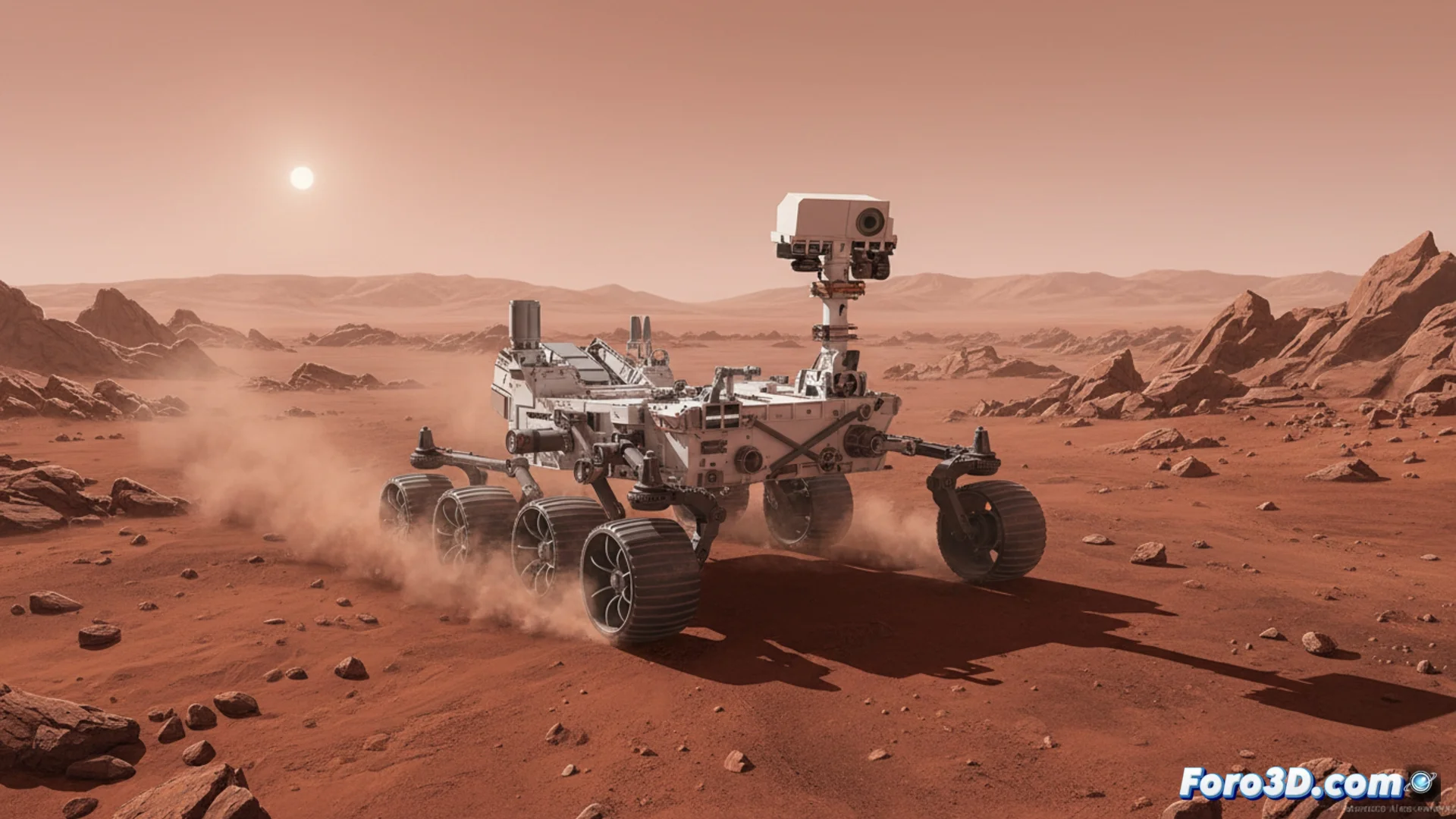
The Perseverance Rover Navigates Mars with an AI Autopilot
NASA's vehicle no longer needs a person to choose each step it takes on the red planet. In early December 2025, Perseverance completed a nearly 500-meter traverse within Jezero Crater, guided by an artificial intelligence system that decides its path. This advancement proves that other worlds can be explored independently, transforming the approach to future space expeditions. 🚀
An Artificial Brain to Guide the Rover
The autopilot integrated into the rover examines the information captured by its cameras and sensors. It analyzes the environment instantly, detecting obstacles such as large rocks, steep slopes, and areas that might interest scientists. With this data, it plots the safest and most direct route. This capability allows Perseverance to move more quickly and cover a wider terrain each sol (Martian day). Controllers on Earth monitor the activity, but the AI executes navigation decisions in real time.
Key Advantages of Autonomous Navigation:- Allows moving with greater agility and covering more distance per day.
- Identifies and avoids terrain hazards in real time.
- Optimizes the route to predefined scientific targets.
Achieving independent robot exploration is crucial for missions to distant worlds, where radio signals take minutes or hours to arrive.
The Future of Robotic Space Exploration
This milestone marks a turning point. To reach distant planets and moons, where communication with Earth suffers significant delays, it is vital for robots to be able to act on their own. The technology validated with Perseverance can be used in future rovers, landers, and even aerial vehicles for other worlds. By being able to decide for itself, the rover accelerates how it collects samples and studies hard-to-reach areas, multiplying the scientific value of each mission. 🔴
Future Applications of This Technology:- Adaptation for landing modules on moons of giant planets.
- Use in drones or aircraft that explore from the air.
- Maximizing data return in environments with limited communication.
A New Paradigm in Martian Operations
NASA has been investigating the Jezero region for years to decipher the geological history of Mars. With this system, Perseverance not only fulfills its task but does so with unprecedented efficiency. It seems that, finally, the rover can report a truly productive day without any operator managing each of its movements from millions of kilometers away. Autonomous exploration is now a reality.