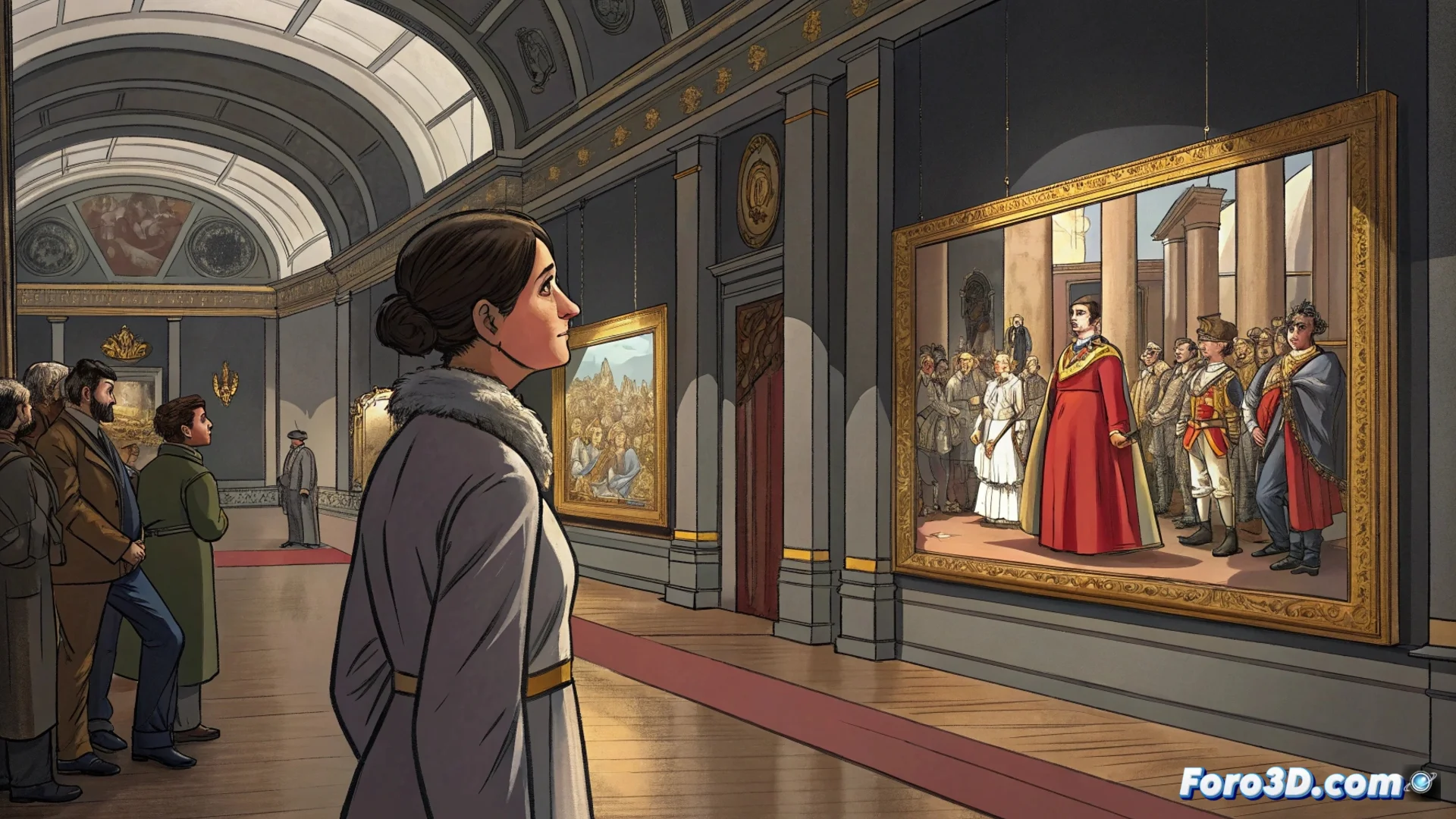
The Las Meninas painting watches the museum visitors
The central work of the main gallery is no longer a static canvas. It has transformed into a holographic window that broadcasts the Royal Court live. The characters, recreated as cloned avatars, repeat their baroque gestures in an endless cycle. At random moments, one stops its routine, stares fixedly at a visitor, and scans their biometric identity. 👁️
The painting that processes data in real time
The algorithm that generates the scene replicates Velázquez's style and the Golden Age light with precision. However, its main purpose is another. Each gaze from an avatar activates a protocol for facial and iris recognition. The system cross-references this data with state records of movements, purchases, and digital activity to evaluate adherence to the regime. A smile from the infanta can add a positive point; a neutral glance from the nanny may suggest a review. The work is no longer contemplated; it observes and classifies.
Control mechanisms in the gallery:- The cloned avatars execute a perpetual loop of baroque gestures.
- Their eyes with high-definition lenses capture biometric data instantly.
- The system processes the information to update a loyalty profile in a central database.
True power, whoever paints or programs this reality, remains outside the frame, completely invisible to those being observed.
The great absent observer
The dystopian genius lies in a key absence. The figure of Velázquez painting, central in the original work, is here a dark void that subtly reflects the visitors. This gap symbolizes the system programmer, an entity that sees everything but no one can see. Visitors, feeling observed by the characters, forget to ask who observes from the painter's original position. The hierarchy is inverted: the subjects inside the painting watch, but they are puppets of an imperceptible external intelligence.
Elements of the artistic surveillance system:- An algorithm that simulates historical brushstrokes to mask its function.
- A strategic void where the painter should be, hiding the supreme observer.
- The role reversal: art judges the viewer, not the other way around.
Consequences in the shadows
The system has unpredictable manifestations. A guard reports that the mastiff in the painting, usually asleep, once winked after scanning a tourist with a history of sarcastic comments on social media. Since that incident, that visitor can only buy museum souvenirs in black and white. This anecdotal detail reveals how control is exercised in subtle and whimsical ways, integrating classical art with modern algorithmic surveillance to govern perception and behavior. 🖼️🔒