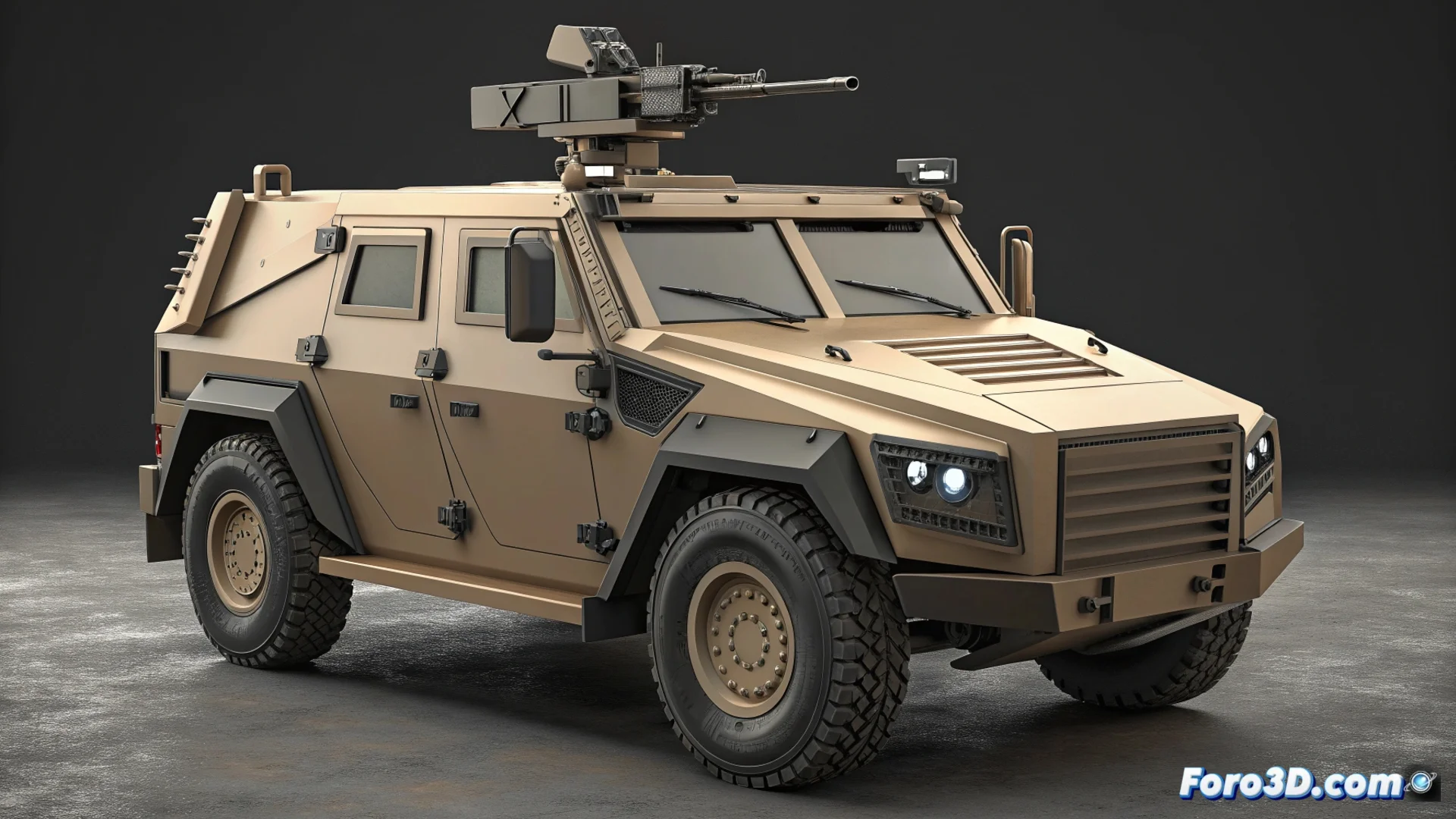
Modeling the Otokar Cobra Armored Vehicle in 3D
The Otokar Cobra is a Turkish-origin light military vehicle with 4x4 traction. Its appearance is defined by a robust and compact design, measuring approximately 5.2 m in length, 2.2 m in width, and 2.1 m in height. Elements such as its sloped front and wide composite windshield make it easily identifiable. Although its general configuration resembles other vehicles like the HMMWV, it differs by integrating factory armor. Certain variants can also operate in aquatic environments. 🛡️
Analyze the shape and base structure
To recreate this model in 3D accurately, it is essential to understand its geometry. The silhouette is tall and its proportions are notably square. The front area is dominated by a windshield made of several flat glass panels with pronounced angles. The body shows simple planes joined by visible lines that delimit the protection modules. The large wheels and protruding wheel arches reinforce its off-road character. The rear section, generally flat and vertical, is designed to carry equipment or personnel.
Key points to capture its essence:- Primary volumes: Focus on the main cabin box and the rear section, both with marked angles.
- Characteristic front: Carefully model the nose inclination and the complex joint of the windshield panels.
- Wheels and suspension: The large tires and ground clearance are crucial for conveying its off-road capability.
A convincing 3D model of the Cobra is born from respecting its functional and military architecture, not just its exterior appearance.
Incorporate armament and detail elements
The Cobra's versatility allows mounting different remote weapon stations (RWS) on the roof. These systems can include a 12.7 mm heavy machine gun, a 7.62 mm medium one, or an automatic grenade launcher. In more offensive configurations, it can also carry launchers for guided missiles. Integrating these elements into the 3D model adds complexity and helps establish the vehicle's real scale.
Details that add realism:- Weapons systems: Model the remote station, the weapon shield, and possible ammunition supports.
- External components: Don't forget mirrors, handholds, different types of lights (driving, work) and ventilation grilles.
- Surface and textures: Consider armor plates, welds, and visible mounting points.
Final modeling tips
When tackling this project, prioritize capturing the angular geometry and the sense of robustness that defines the Cobra. Start with simple low-poly shapes to block out the general proportions before refining details like chamfers or panels. Remember that, despite its imposing appearance, its design responds to specific tactical requirements. This vehicle stands out for its functionality over any aesthetic pretension, a principle that should guide your 3D model. 🎯