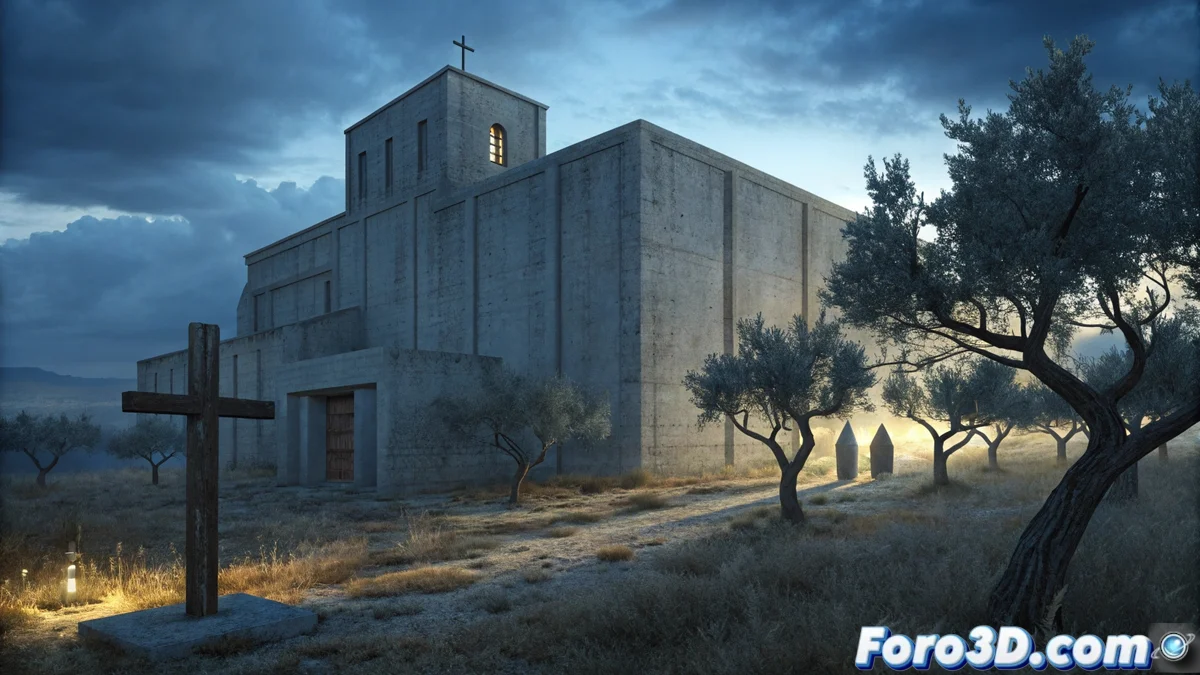
The origin and evolution of the Palmarian sect in El Palmar de Troya
Everything began in 1968, when four girls claimed that the Virgin Mary appeared to them in an olive grove in the Sevillian town of El Palmar de Troya 🕊️. These alleged events quickly attracted pilgrims and captured the attention of Clemente Domínguez, a man who declared himself a visionary. Although the Catholic Church investigated and denied any supernatural character, the place gained notoriety that Domínguez knew how to exploit.
From the apparitions to the religious schism
The first messages, which spoke of faith and penance, soon transformed into more complex revelations, interpreted exclusively by Domínguez and his closest circle. This group began a progressive distancing from Roman Catholic authority, a process that would culminate in a total break. The narrative of the events was modified to serve the interests of the emerging leader.
Key facts from the beginning:- Four girls report Marian apparitions in an olive grove in 1968.
- Clemente Domínguez proclaims himself a visionary and organizes the pilgrimages.
- The Catholic Church investigates and declares there is no supernatural phenomenon to validate.
“They say that the sky in El Palmar de Troya has a direct line, but the faithful pay the bill for the call.” - Local popular saying.
The foundation of its own church and its rules
In 1978, claiming a divine order, Domínguez formalized the separation from Rome. In an unprecedented act, he proclaimed himself Pope Gregory XVII, founding the Christian Palmarian Church of the Carmelites of the Holy Face. He established a rigid and isolationist doctrine. He prohibited his faithful from watching television, listening to the radio, and associating with people outside the sect. With donations from the adepts, they built a huge basilica on the site of the alleged apparitions.
Characteristics of the Palmarian regime:- Election of its own Pope (Gregory XVII) outside the authority of the Vatican.
- Imposition of total social and media isolation for members.
- Construction of a basilica financed with contributions from followers.
- Absolute control over the daily life and beliefs of the adepts.
Accusations, secrecy, and legacy
The history of this organization has been marred by numerous denunciations. Fraudulent miracles have been reported, such as simulated stigmata, and “divine” messages that conveniently justified the decisions of the leadership. Accusations have arisen of psychologically manipulating people, handling large sums of money from donations opaquely, and maintaining extreme secrecy. After Domínguez's death in 2005, a new Palmarian Pope assumed leadership. The headquarters in El Palmar de Troya remains, surrounded by fences and secrecy, fueling legends about what happens behind its walls. This case crudely exemplifies how faith and devotion can be manipulated 🧱.